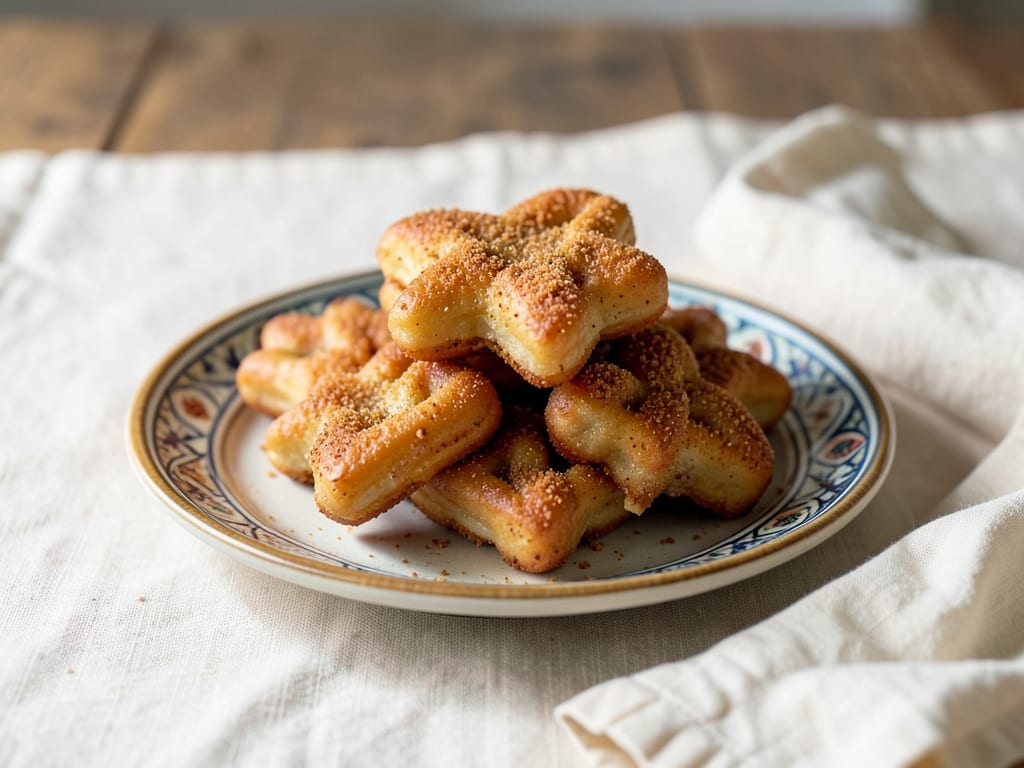
Churro Zalabia with Cardamom Sugar
A Middle Eastern–Mexican fusion dessert that marries the tender, yogurt-based fried pastry of zalabia with churro-style piping and star-shaped exterior. Crispy on the outside, impossibly light within, and dusted with fragrant cardamom and cinnamon sugar that blooms with warm spice as you bite through the crispy shell.
Steps
Before you start
- Read the entire recipe to understand the timeline
- Attach an instant-read thermometer to a heavy pot before you begin
- Set up a cooling station with paper towels near your frying pot
- Gather all equipment—churrera or pastry bag with star tip, spider strainer, scissors, and shallow coating dish—before heating oil
Mix dry ingredients
- In a medium bowl, whisk together the flour, baking powder, and salt until evenly combined with no lumps.
- Set aside.
+ Show details− Hide details
Ready when: Dry ingredients are uniform and lump-free
Combine wet ingredients
- In another medium bowl, whisk together the egg, yogurt, and vanilla extract until smooth and fully combined.
- Break down any yogurt lumps thoroughly—the mixture should be uniform and pourable.
+ Show details− Hide details
Ready when: Mixture is smooth and free of lumps
Make the batter
- Pour the wet ingredients into the bowl with the dry ingredients.
- Fold gently together until just combined—the batter should be thick and smooth, like cake batter, with no visible streaks of flour.
- Do not overmix, as this develops gluten and makes the fried zalabia tough and dense.
- Let the batter rest, uncovered, for 2–3 minutes to allow the flour to fully hydrate and the leavening to activate.
+ Show details− Hide details
Ready when: Batter is thick, smooth, and easily pourable through a piping bag
Tip: Gentle folding prevents overdevelopment of gluten. Overmixing creates dense, tough fried pieces instead of airy ones.
Heat the frying oilOven 350°F / 175°C
- Pour 2 quarts (2 liters) of vegetable oil into a 3–4 quart heavy-bottomed pot or deep skillet.
- Clip an instant-read thermometer to the side and heat over medium-high heat to exactly 350°F (175°C).
- This takes about 8–12 minutes depending on your stove.
- Do not leave the oil unattended—monitor the thermometer carefully.
+ Show details− Hide details
Ready when: Thermometer reads exactly 350°F (175°C)
Tip: Use an instant-read thermometer clipped to the pot—guessing by appearance is unreliable. Temperature control is critical to avoid greasy or burnt zalabia.
Mix cardamom sugar coating
- In a shallow dish (a small bowl or plate works well), combine the granulated sugar, ground cardamom, and ground cinnamon.
- Stir with a fork or small spoon to distribute the spices evenly throughout the sugar.
- Set aside near your frying station for easy access.
+ Show details− Hide details
Ready when: Sugar and spices are uniformly combined with no visible clumps
Test oil temperatureOven 350°F / 175°C
- When the thermometer reaches 350°F (175°C), pinch off a small walnut-sized piece of batter and carefully drop it into the oil.
- It should sizzle immediately upon contact and float to the surface within 10 seconds.
- If it sinks, the oil is too cool; if it browns too rapidly, the oil is too hot.
- Adjust heat as needed and wait another minute or two before proceeding.
+ Show details− Hide details
Ready when: Test piece sizzles immediately and floats to the surface within 10 seconds
Fill piping tool with batter
- If using a traditional churrera, load the barrel with batter according to the manufacturer's instructions.
- If using a pastry bag fitted with a ½-inch (1 cm) star piping tip, fill it about halfway with batter—do not overfill, as you need room to squeeze.
- Keep the tool within arm's reach of the pot of hot oil.
+ Show details− Hide details
Ready when: Piping tool is loaded and ready to use
Fry first batch of zalabia
- Hold the churrera or pastry bag 2–3 inches above the surface of the oil.
- Slowly squeeze to extrude a 4–5 inch log of batter directly into the hot oil, using your other hand to guide the stream.
- Use kitchen scissors to cut the batter cleanly at the tip to separate each piece.
- Pipe 4–6 pieces into the oil—do not crowd the pot, or the oil temperature will plummet and the zalabia will absorb oil instead of crisping.
- Fry for 1–2 minutes until the undersides turn deep golden brown.
- Using a fork or slotted spoon, carefully flip each piece.
- Fry another 1–2 minutes until the second sides are also deep golden.
- Remove immediately with a spider strainer and place on paper towels to drain.
+ Show details− Hide details
Ready when: Both sides are deep golden brown, crispy on the exterior, with no pale spots
Tip: Frying small batches keeps oil temperature stable. Crowding the pot drops the temperature, causing them to absorb oil and become greasy rather than crispy.
Fry remaining batchesOven 350°F / 175°C
- Return the piping tool to your side (if it has cooled, hold it briefly over the oil to warm).
- Allow the oil temperature to recover and stabilize for 30–45 seconds by watching the thermometer.
- Once it reads 350°F again, repeat the piping and frying process with the next batch of 4–6 pieces.
- Continue in batches until all the batter is used—you'll typically complete 3–4 more batches after the first.
- Remove each batch to paper towels as soon as they reach deep golden brown.
+ Show details− Hide details
Ready when: Each batch is deep golden brown on all sides with no pale spots
Tip: If the oil temperature drops below 340°F, raise the heat slightly or let it recover longer before the next batch. The thermometer is your guide—trust it more than appearance.
Coat with cardamom sugarOven 200°F / 95°C
- Working while the zalabia are still warm (but cool enough to handle without burning yourself), brush each piece lightly on all sides with melted butter using a pastry brush or the back of a spoon.
- Immediately transfer it to the shallow dish of cardamom sugar and toss or roll it until evenly coated on all sides.
- Arrange on a clean serving plate.
- Work quickly so the pieces remain warm—the butter and warmth help the sugar adhere.
- If some pieces cool before you finish coating, place them on a baking sheet and warm in a 200°F (95°C) oven for 2 minutes, then coat with sugar.
+ Show details− Hide details
Ready when: All zalabia are evenly coated with fragrant cardamom sugar on all sides
Tip: Melted butter acts as an adhesive for the sugar and adds richness. Work quickly while the zalabia are warm—the warmer they are, the better the sugar sticks.
Cool and serve
- Let the finished zalabia rest on the plate for 3–5 minutes before serving, allowing them to firm up slightly while still warm.
- This brief rest helps them achieve maximum crispness on the exterior while remaining tender inside.
- Serve immediately for the best texture and flavor.
- They can also be eaten at room temperature, though they are at their best warm, with the cardamom sugar still fragrant and the exterior still crispy.
+ Show details− Hide details
Ready when: Zalabia are cool enough to serve but still warm and crispy
Good to know
Tips
- Oil temperature is absolutely critical—350°F (175°C) is non-negotiable. Too hot and the outside burns before the inside cooks through; too cool and they absorb oil, becoming greasy and heavy. Use an instant-read thermometer and adjust heat as needed to maintain this exact temperature throughout frying.
- Do not skip the vanilla extract. It adds subtle depth and complexity, complementing the cardamom beautifully and preventing the spice from dominating. It rounds out and balances the entire flavor profile.
- For a more authentic zalabia appearance, pipe the batter into loose coils or loops rather than straight pieces. This takes practice but creates a more impressive presentation and slightly more textured surface area for the sugar to adhere.
- Cardamom and cinnamon lose flavor quickly once ground. If possible, grind whole cardamom pods (green cardamom is best) and cinnamon bark just before making the coating for maximum fragrance and warmth.
Make ahead
The batter can be prepared up to 2 hours ahead and refrigerated, covered. Bring to room temperature and stir gently before using. For best results, fry within 1 hour of preparing the batter to ensure optimal rise and texture. The cardamom sugar coating can be mixed the day before and stored in an airtight container at room temperature.
Storage & reheating
Room temperature: Keep in an airtight container for up to 2 days. They will lose some crispness but can be briefly warmed in a 300°F (150°C) oven for 5 minutes to restore texture. Refrigerator: Store in an airtight container for up to 3 days; reheat in a 300°F oven for 5 minutes. Freezer: Not recommended, as the texture becomes soggy and dense upon thawing.
Substitutions
- plain yogurt → Greek yogurt. Greek yogurt will make the zalabia denser and tangier. Use only 2/3 cup (160 ml) as it is much thicker than regular yogurt. The result will be slightly less airy and light.
- all-purpose flour → cake flour. Cake flour yields more delicate, tender zalabia with a less crispy exterior. Use the same amount but sift it first. The result will be more delicate but less structurally crispy.
- ground cardamom → freshly ground cardamom seeds. Grind 8–10 whole green cardamom pods to yield about 2 tsp ground. Freshly ground cardamom is considerably more fragrant and aromatic than pre-ground, elevating the entire dish.
- unsalted butter, melted → clarified butter or ghee. Ghee imparts a richer, more traditional Middle Eastern flavor and has a slightly higher smoke point. Use the same amount; the zalabia may brown a touch faster due to ghee's water content.
More middle eastern sweets
See all →

Find more like this
- Meal
- Dessert
- Cuisine
- Middle Eastern
- Main ingredient
- Eggs
- Diet
- VegetarianHalal
- Method
- Stovetop
- Quick & Easy
- 30-Minute