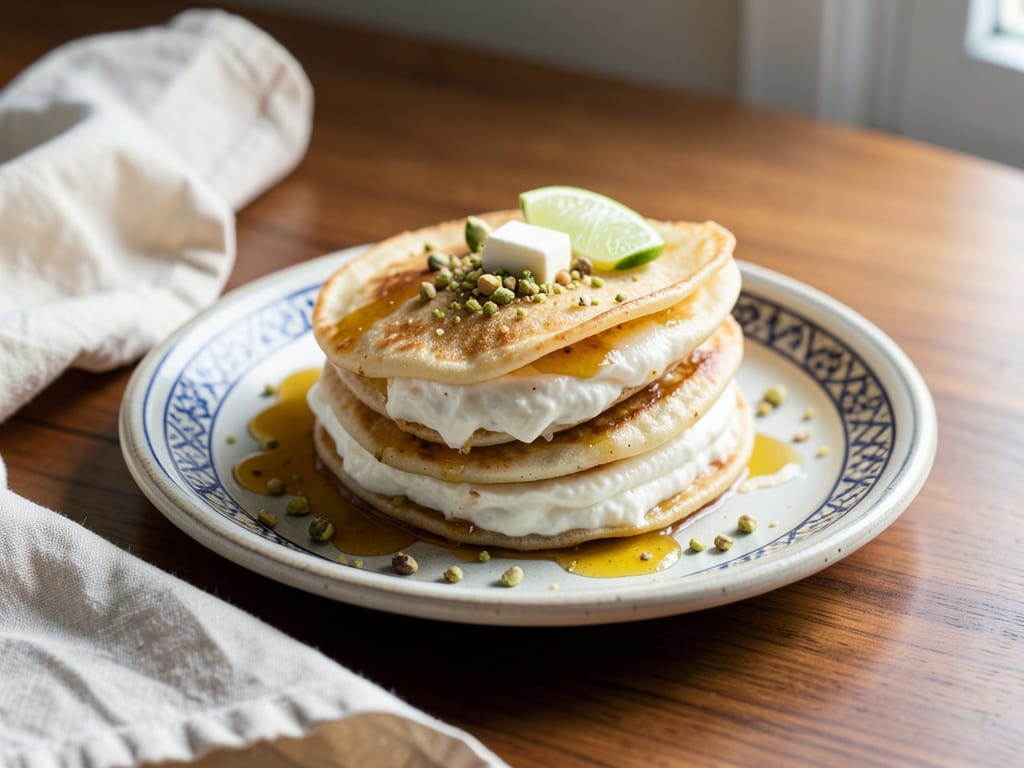
Pisco Lime Atayef with Ashta
Thin, tender atayef pancakes are cooked on one side until golden, folded while warm, and filled with silky ashta cream. A fragrant pisco-lime syrup infused with cinnamon replaces the traditional rose water syrup, bridging Middle Eastern and Peruvian traditions. The result is warm, creamy, and brightened by citrus—an elegant dessert that balances richness with refreshing acidity.
Steps
Before you start
- Have all ingredients measured and at room temperature before you start (except heavy cream, which should stay cold)
- The pisco-lime syrup can be made up to 2 days ahead
- Use a non-stick skillet or crepe pan for best results
- Read through the recipe to understand the parallel timing of syrup, ashta, and dough prep
Make Pisco-Lime Syrup
- In a small saucepan, combine sugar and water (¼ cup / 60 ml).
- Bring to a boil over medium heat, stirring occasionally until the sugar dissolves completely and the liquid is clear, about 2-3 minutes.
- Add the cinnamon stick and simmer gently for 2 minutes to infuse its aroma.
- Remove from heat and let cool for 2-3 minutes, then stir in the pisco and fresh lime juice.
- Add the lime zest and stir well.
- Let the syrup cool to room temperature while you prepare the other components, about 10 minutes.
- (The syrup can be made ahead and stored in an airtight container at room temperature for up to 2 days.)
+ Show details− Hide details
Ready when: Sugar dissolves and mixture is clear; syrup cools to room temperature
Tip: Don't allow the pisco to boil for an extended time, as the alcohol will evaporate and change the flavor. Simmer the syrup very gently after adding the spirits.
Prepare Ashta Filling
- In a small saucepan, whisk together the cornstarch and ¼ cup (60 ml) of the milk to create a smooth paste with no lumps.
- Pour in the remaining milk and the heavy cream, whisking until fully combined.
- Place the saucepan over medium heat and stir constantly with a wooden spoon, scraping the bottom and sides, until the mixture thickens enough to coat the back of a spoon without dripping off, about 8-10 minutes.
- The mixture will steam gently as it approaches the right consistency.
- Once thickened, remove from heat, stir in the sugar, rose water (if using), and a pinch of salt.
- Pour the ashta into a bowl and let it cool for 10 minutes, stirring occasionally.
- The ashta will continue to thicken slightly as it cools.
+ Show details− Hide details
Ready when: Mixture thickly coats the back of a spoon and steams gently when stirred
Tip: Keep stirring constantly to prevent lumps from forming and to avoid the ashta sticking or scorching on the bottom of the pan. If lumps do form, strain the ashta through a fine-mesh sieve before using.
Mix Atayef Dough
- In a medium bowl, whisk together the all-purpose flour, semolina, baking powder, and salt.
- Add the water and melted butter, whisking until the mixture is smooth and free of lumps.
- The batter should be thin and pourable, similar in consistency to crepe batter (much thinner than pancake batter).
- Let the batter rest at room temperature before cooking.
+ Show details− Hide details
Ready when: Batter is smooth and lump-free
Tip: Avoid overmixing; a few very small lumps are fine and won't affect the final texture. The batter will thicken slightly as the semolina hydrates during the rest period.
Rest Dough
- Let the atayef batter rest at room temperature for 10 minutes.
- This allows the semolina to fully hydrate and the baking powder to activate slightly, which will help create the characteristic bubbly texture on the surface of the cooked atayef.
+ Show details− Hide details
Ready when: Batter is uniform and slightly thicker than before
Cook Atayef Pancakes
- Heat a 10-inch (25 cm) non-stick skillet or crepe pan over medium heat for about 5 minutes until it's evenly hot.
- Lightly butter the cooking surface.
- Pour about 2 tablespoons (30 ml) of batter into the center of the hot pan and immediately tilt and rotate the pan to spread the batter into a thin, even circle about 4-5 inches (10-12 cm) in diameter.
- Cook without moving the pan for 1.5-2 minutes, until the bottom is light golden and the surface is set but still slightly moist.
- You'll see small bubbles forming on the top surface, which is characteristic of atayef.
- Do not flip.
- Slide the cooked atayef onto a plate.
- Wipe the pan lightly with a butter-soaked paper towel between each pancake to maintain even heat and prevent sticking.
- Repeat with the remaining batter.
- You should have about 12-13 atayef.
- (They can be stacked on top of each other as they cool; they won't stick together.)
+ Show details− Hide details
Ready when: Bottom is light golden and top surface is set with visible bubbles
Tip: Never flip the atayef—they are cooked on one side only, which keeps them thin and tender. Work quickly and confidently when pouring and tilting the batter; if the pan is hot enough, the batter will spread easily. If you find the first one is too thick or the bottom is too dark, lower the heat slightly for the next batch.
Fold and Fill Atayef
- Working while the atayef are still warm but cool enough to handle (about 1-2 minutes after sliding onto the plate), gently fold each one in half, cooked side facing outward, to create a half-moon shape.
- Using a small spoon or piping bag, carefully fill the pocket created by the fold with about 1.5 tablespoons (22 ml) of the cool ashta.
- Do not overfill, or the ashta will leak out the sides during assembly and serving.
- Arrange the filled atayef on a serving platter as you go.
+ Show details− Hide details
Ready when: All atayef are folded and filled
Tip: If the atayef cool too much and become brittle while you're folding, warm them gently in a low oven (250°F / 120°C) for 20-30 seconds to restore pliability. Have your ashta and syrup ready before you start filling, so you can move quickly.
Pour Syrup and Garnish
- Drizzle the cooled pisco-lime syrup generously over the filled atayef, or pour it evenly across the platter and arrange the atayef on top.
- Sprinkle the chopped roasted pistachios over each atayef or across the platter for color and a subtle nutty crunch.
- Serve immediately, with fresh lime wedges on the side so guests can add extra brightness if they wish.
+ Show details− Hide details
Ready when: Atayef are syruped and garnished
Good to know
Tips
- The key to tender atayef is cooking them on one side only and not flipping—this keeps them delicate and ensures they fold easily. The bubbles on the surface are desirable and add texture.
- If an atayef tears or cracks while folding, simply patch it with a small piece from a broken one or serve it as is—it will still be delicious, and the syrup will hold everything together.
- The temperature contrast between warm atayef and room-temperature pisco-lime syrup creates an elegant eating experience. Serve this dessert warm, not hot.
- For a non-alcoholic version, omit the pisco and increase the water to ½ cup (120 ml). The syrup will be lighter but still delicious with the lime and cinnamon.
Make ahead
The pisco-lime syrup can be made up to 2 days ahead and stored in an airtight container at room temperature. The ashta can be made up to 4 hours ahead and refrigerated; bring it to room temperature or reheat it gently for 30 seconds in the microwave before filling if it has become too stiff.
Storage & reheating
Leftover filled atayef can be stored in an airtight container in the refrigerator for up to 2 days. The syrup will soften the pancakes over time, so they are best enjoyed the same day they are made. To reheat, place on a baking sheet and warm in a 300°F (150°C) oven for 5-8 minutes until warmed through. Do not reheat the syrup in a microwave, as the pisco may separate.
Substitutions
- pisco → Cognac, brandy, or Greek grappa. Each spirit will create a subtly different flavor. Cognac or brandy will be warmer and more caramel-forward; grappa will be more herbaceous. The amount remains the same.
- rose water → Orange blossom water, or omit entirely. Orange blossom water is more floral and citrus-forward, which pairs beautifully with the pisco-lime syrup. If omitted, the ashta will have a more neutral, creamy flavor.
- heavy cream → Whole milk (use 1¾ cups / 420 ml total dairy instead of 1½ cups milk + ½ cup cream). The ashta will be less rich and creamy, but still delicious. Increase the heat slightly and stir constantly to prevent curdling.
- cinnamon stick → Whole cloves, star anise, or cardamom pods. Each spice will impart a different aromatic quality. Use just 2-3 cloves or 1 star anise pod, and taste the syrup before serving to ensure the flavor is not overpowering.
More middle eastern sweets
See all →

Find more like this
- Meal
- Dessert
- Cuisine
- Middle Eastern
- Diet
- VegetarianHalal
- Method
- Stovetop