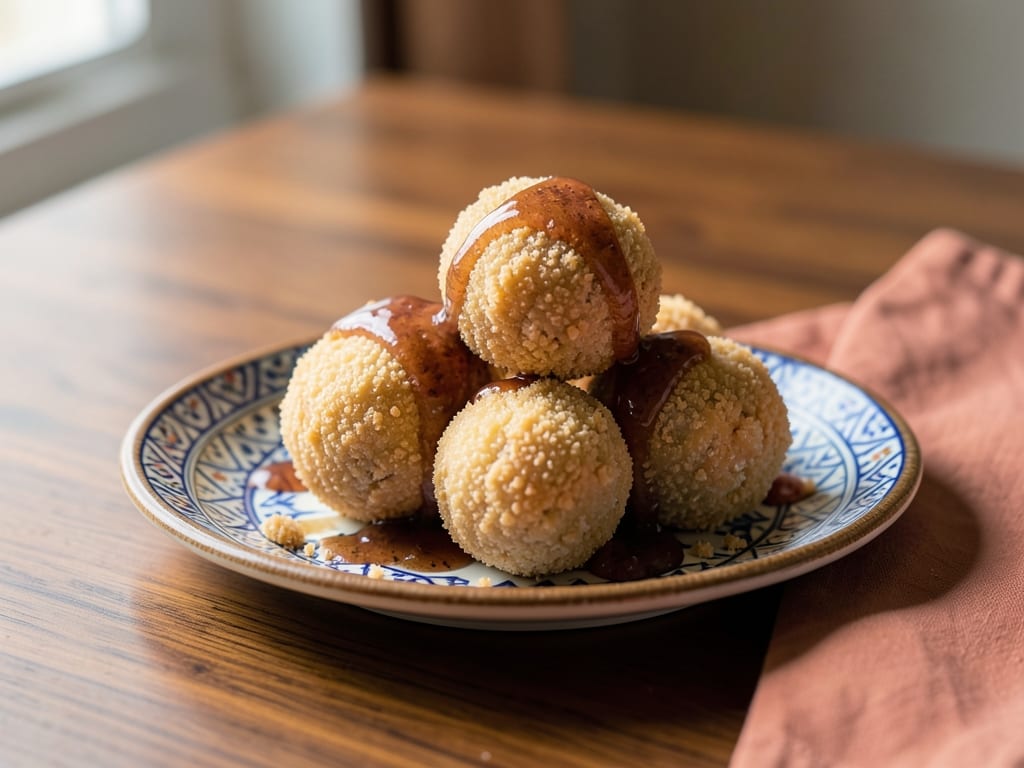
Cassava Awameh with Guava Syrup
Cassava awameh are puffy, golden fried balls made from a light yeast-leavened batter that blends cassava flour and all-purpose flour, creating a delightful Middle Eastern-Caribbean fusion. Served in a velvety, aromatic guava syrup infused with warm cinnamon and cloves, these awameh deliver a hollow, airy interior with a crispy golden exterior. The tropical sweetness of guava complements the subtle, earthy notes of cassava, while the syrup's brightness (from fresh lime juice) balances the richness of the fried dough. Each piece becomes glossy and tender as it absorbs the syrup—an elegant, memorable dessert that bridges culinary traditions with authentic technique and contemporary flavor.
- Prep
- 15 min
- Cook
- 22 min
- Wait
- 1 hr 10 min
- Total
- 1 hr 47 min
- Makes
- About 24 awameh
Steps
Before you start
- Have a candy/deep-fry thermometer on hand—accurate oil temperature (350°F/175°C) is essential for success
- Measure and prepare all ingredients before mixing (mise en place), especially for the dough, which comes together quickly
- Ensure your kitchen is warm (75–80°F/24–27°C) for optimal dough rising; a turned-off oven with the light on works well on cold days
- The guava syrup can be made up to 3 days ahead and refrigerated, cutting total active time to under 30 minutes
Make the guava syrup
- Pour guava pulp, sugar, and water into a medium saucepan.
- If using fresh guava, strain the pulp through a fine-mesh sieve to remove seeds and fibers.
- Add the cinnamon stick and whole cloves if desired—they impart subtle warmth and spice, though they're optional.
- Bring the mixture to a gentle simmer over medium heat, stirring occasionally to dissolve the sugar completely.
- Simmer for 15 to 20 minutes, stirring every 3–4 minutes, until noticeably thickened and darkened to a deep rose or burgundy color.
- The syrup should coat the back of a spoon without running off immediately.
- Remove from heat and stir in the fresh lime juice.
- Let cool to room temperature, then pour through a fine-mesh sieve to remove the cinnamon stick and cloves.
- Transfer to a bowl and set aside.
- The syrup can be made up to 3 days ahead and kept refrigerated in an airtight container.
+ Show details− Hide details
Ready when: Syrup coats the back of a spoon, is noticeably darker and thicker, and measures about 1.5–1.75 cups when cooled
Tip: Don't over-reduce the syrup—it will thicken further as it cools. It should still be pourable at room temperature, not jellylike.
Combine dry ingredients
- In a large mixing bowl, whisk together the cassava flour, all-purpose flour, and salt.
- Whisk for about 30 seconds to ensure the flours are evenly distributed and aerated, and check for any lumps.
- Set the bowl aside.
+ Show details− Hide details
Ready when: Flours are well combined with no visible lumps and appear slightly lighter from aeration
Tip: Whisking the flours together incorporates air, which contributes to the final light, fluffy texture of the awameh.
Activate the yeast
- In a small bowl, combine the warm water (110°F/43°C—use a thermometer to verify), instant yeast, and 1 tablespoon of the sugar.
- Stir gently to combine, then let sit undisturbed for about 5 minutes.
- The mixture will become foamy and fragrant, indicating the yeast is alive and active.
- If it doesn't foam noticeably, your yeast may be expired or the water was too hot (above 120°F/49°C) or too cold; discard and start over with fresh ingredients and properly warmed water.
- Stir in the melted butter and vanilla extract (if using).
+ Show details− Hide details
Ready when: Mixture is visibly foamy, smells distinctly yeasty, and has increased slightly in volume
Tip: Water temperature is critical—a thermometer ensures accuracy. Too hot kills the yeast; too cool and it won't activate, wasting time and ingredients.
Mix the dough
- Pour the yeast mixture into the bowl of dry ingredients.
- Add the remaining 2 tablespoons of sugar.
- Using a wooden spoon or electric hand mixer, stir vigorously for about 1 minute until a thick, sticky batter forms.
- The mixture should resemble thick pancake batter or crêpe batter—it will be cohesive but very sticky, not a stiff dough at all.
- There should be no streaks of dry flour visible.
- The batter should be thick enough to hold its shape on a spoon but thin enough to slowly flow off the spoon.
+ Show details− Hide details
Ready when: Batter is thick, sticky, and completely smooth with no visible flour streaks; holds its shape but flows slowly
Tip: Resist the urge to add flour if the batter seems wet—this thin, sticky consistency is essential for awameh to puff dramatically when fried. A thick dough won't achieve the characteristic hollow centers.
Let the dough rise
- Cover the bowl loosely with a damp kitchen towel or plastic wrap.
- Place the bowl in a warm, draft-free spot (ideally 75–80°F/24–27°C).
- This might be an off but closed oven with the light on, or a warm corner of your kitchen away from windows and air currents.
- After 45 to 60 minutes, the dough should roughly double in volume and appear very puffy and airy, with visible bubbles on the surface.
- Gently poke the dough with your finger—it should feel light, spongy, and aerated, not dense.
+ Show details− Hide details
Ready when: Dough has roughly doubled, looks puffy with visible bubbles, feels light and airy when gently poked, and springs back slowly
Tip: Proper rising is non-negotiable for success. A rushed rise means dense, heavy awameh; a proper rise means hollow, puffed centers. If your kitchen is cold, use the oven trick or place the dough near a heat source.
Heat the frying oilOven 350°F / 175°C
- Place a deep pot (at least 4-quart/4-liter capacity) or wok on the stove.
- Pour in vegetable oil to a depth of about 3 inches (7.5 cm).
- Insert a candy or deep-fry thermometer into the oil, ensuring it doesn't touch the bottom or sides of the pot (which would give a false reading).
- Slowly heat the oil over medium-high heat, monitoring the thermometer closely.
- When the oil reaches 350°F (175°C), adjust the heat to maintain this temperature.
- Have all your tools ready (wet spoons, slotted spoon, paper towels, plate) before the oil is fully hot, so you can begin frying as soon as the target temperature is reached.
+ Show details− Hide details
Ready when: Oil reaches exactly 350°F (175°C) on the thermometer
Tip: Use a thermometer every time—guessing at temperature is the most common cause of failure. Too cool, and awameh absorb excess oil and become greasy; too hot, and they brown before cooking through.
Fry in batches until goldenOven 350°F / 175°C
- Have ready two wet spoons (continuously dipped in a cup of water) and a slotted spoon.
- Working in batches, dip one wet spoon into the risen dough and scoop out a walnut-sized ball (about 1 tablespoon or the size of a large marble).
- Using the second wet spoon, gently push the dough ball into the hot oil.
- Fry 4 to 6 awameh at a time—they need room to expand and float freely.
- Each ball will sink initially; within 30 seconds to 1 minute, it will float and begin to puff up dramatically.
- After 1 to 2 minutes of floating, use the slotted spoon to gently flip each piece and ensure even golden browning on all sides.
- Continue cooking for another 1 to 2 minutes until the entire surface is deep golden brown (rich mahogany-brown, not pale).
- The awameh should feel light and somewhat hollow when gently tapped with the slotted spoon—this indicates they're cooked through inside.
- Transfer each cooked awameh to a paper towel-lined plate to drain excess oil.
- Maintain the oil temperature at 350°F throughout frying by adjusting the heat slightly as needed.
- Repeat with remaining dough in batches until finished.
+ Show details− Hide details
Ready when: Awameh are puffed, hollow inside, and deep golden brown on all sides; feel light when tapped gently with a spoon
Tip: Wet spoons prevent sticky batter from clinging and sticking—far more effective than oiled spoons or wet hands. Dip them in water frequently between scoops. Never crowd the pan; each ball needs space to puff and float.
Serve warm with syrup
- While the awameh are still warm (ideally within 30 minutes of frying), arrange them on a serving platter or individual plates.
- Generously drizzle with the guava syrup, or serve the syrup on the side for dipping—both presentations are traditional.
- Optional garnish: a light sprinkle of toasted sesame seeds or finely crushed roasted pistachios adds richness, texture, and visual appeal.
- Serve immediately while the awameh are warm and the exterior is still slightly crispy.
+ Show details− Hide details
Tip: Awameh are at their best while warm and within the first hour of frying. As they cool, they soften and gradually absorb the syrup—still delicious, but the ideal texture is fresh and warm.
Good to know
Tips
- **Oil temperature is critical**: Use a thermometer at 350°F (175°C) and maintain it throughout frying. This single factor determines success. Too cool, and awameh become greasy and absorb oil; too hot, and they brown outside before the inside cooks through.
- **Wet spoons are the secret**: Keep two spoons continuously dipped in water while scooping dough. This traditional technique prevents sticky batter from clinging and is far more effective than oiled spoons or bare hands. Dip frequently.
- **The dough must rise properly**: Don't rush this phase. A proper 45–60 minute rise at warm temperature develops the yeast gas that makes awameh puff up and become hollow inside. A short rise yields dense, less impressive results.
- **Serve warm immediately**: Awameh are at their absolute best within 30 minutes of frying—warm, crispy outside, tender inside. They soften and absorb syrup as they cool, which some people love, but the ideal experience is fresh and warm from the oil.
Make ahead
The guava syrup can be made up to 3 days in advance and stored in an airtight container in the refrigerator. The awameh themselves are best fried and served warm, ideally within 1–2 hours of frying. However, you can prepare the dough, let it rise, and fry the awameh anytime, then reheat them as described under Storage.
Storage & reheating
**Room temperature**: Awameh are best enjoyed within 1–2 hours of frying, while warm and crispy. They soften as they cool but remain delicious. **Refrigerator**: Store cooled awameh in an airtight container for up to 2 days. To restore crispness, reheat in a 300°F (150°C) oven for 5–8 minutes until warmed through and the exterior re-crisps slightly. **Freezer**: Freeze cooked awameh in an airtight freezer-safe container for up to 1 month. Thaw at room temperature for 1–2 hours, then reheat as above. **Guava syrup**: Keep refrigerated in an airtight container for up to 5 days. Gently reheat on the stovetop over low heat or in the microwave (15–20 seconds) before serving with warm awameh.
Substitutions
- Cassava flour → Tapioca starch (1:1 ratio by weight). Tapioca creates a lighter, more ethereal texture and crispier exterior, but lacks cassava's subtle nutty flavor. Alternatively, use all-purpose flour alone (1:1 by weight), though the result will be less distinctive and the texture less interesting.
- Guava pulp → Canned guava paste (2/3 cup of paste plus 1/4 cup water) or passion fruit pulp, mango purée, or pomegranate syrup. Fresh guava is ideal, but these substitutes offer excellent flavor. Passion fruit and mango create a more tropical profile; pomegranate adds tartness and a beautiful red hue.
- Fresh lime juice → Lemon juice (1:1 ratio) or orange juice. Lemon is a perfect substitution and adds similar bright acidity. Orange juice creates a softer, warmer sweetness; adjust sugar slightly if using orange.
- Instant yeast → Active dry yeast (1.25 teaspoons active dry for every 2.5 teaspoons instant). Dissolve active dry yeast in the warm water and let sit for 10 minutes before adding sugar and butter. Active dry takes slightly longer to activate but produces equally fluffy awameh.
More middle eastern sweets
See all →

Find more like this
- Meal
- Dessert
- Cuisine
- Middle Eastern
- Diet
- VegetarianHalal
- Method
- Stovetop