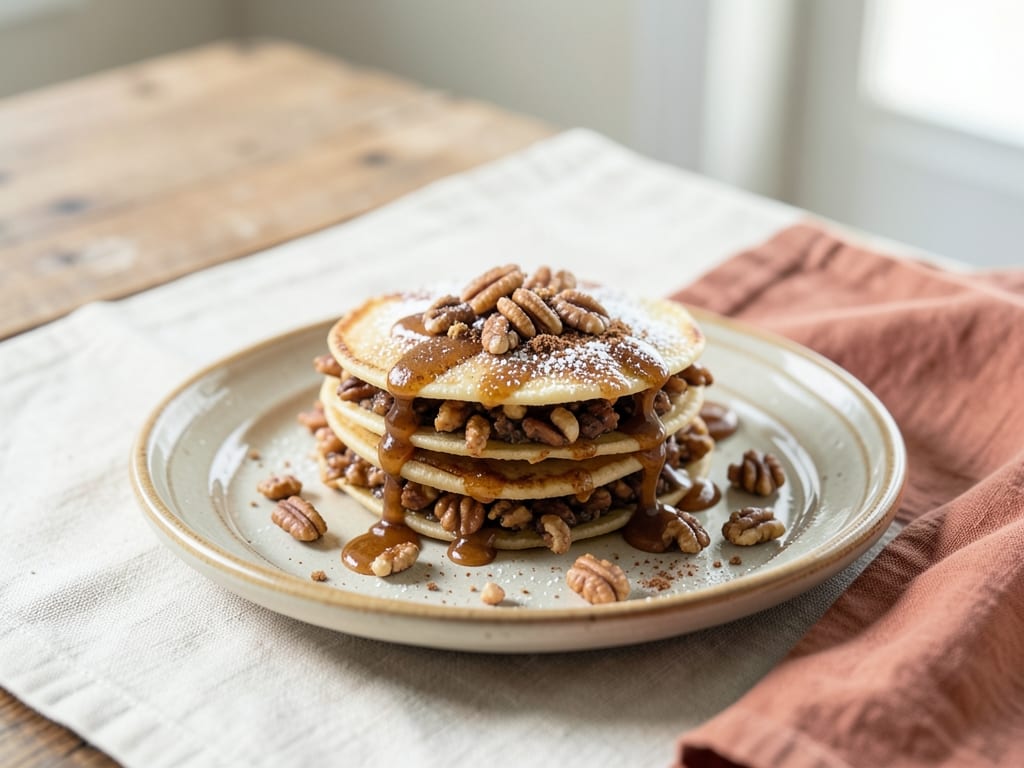
Cajeta Qatayef with Toasted Pecans
A creative Middle Eastern–Mexican fusion of delicate qatayef pancakes filled with toasted pecans and sweet Mexican cajeta, then pan-fried until crispy and golden. Qatayef are traditional semolina pancakes cooked on one side only, creating a tender, crepe-like texture; here they're filled with caramelized condensed milk and crunchy nuts for a sophisticated, decadent dessert.
- Prep
- 15 min
- Cook
- 35 min
- Wait
- 15 min
- Total
- 1 hr 5 min
- Makes
- 12–14 qatayef (3–4 per person)
Steps
Before you start
- Preheat oven to 350°F (175°C) for toasting pecans
- Have cajeta ready (store-bought or homemade)
- Gather all ingredients and read through the method; batter consistency is crucial—thin, like crepe batter
Toast pecans and mix batterOven 350°F / 175°C
- Preheat oven to 350°F (175°C).
- Spread 1 cup (100g) pecans on a baking sheet and toast for 8–10 minutes, stirring halfway through, until fragrant and lightly golden.
- Meanwhile, in a large bowl, whisk together 1 cup (140g) all-purpose flour, 1/2 cup (80g) fine semolina, 1 tsp (5g) baking powder, and 1/4 tsp (1.5g) salt.
- Create a well in the center and pour in 1.5 cups (360ml) water and 1 tbsp (15ml) neutral oil (the oil is optional but helps make the batter slightly richer).
- Whisk until you have a smooth, thin batter with the consistency of crepe batter—it should drip easily from a whisk.
- Cover the bowl and let the batter rest for 15 minutes while the pecans cool on the baking sheet.
+ Show details− Hide details
Ready when: Pecans fragrant and lightly golden brown; batter smooth, thin, and drip-able from a whisk
Tip: Batter consistency is critical. It should be much thinner than pancake batter—almost like crepe batter. If too thick, whisk in water 1 tablespoon at a time until it drips easily. Thin batter creates the delicate, crepe-like texture that makes qatayef special.
Cook qatayef pancakes (one side only)
- Once the batter has rested and the pecans have cooled, coarsely chop the pecans (into roughly 1/4-inch / 6mm pieces) and set aside.
- Heat your 10–12 inch (25–30 cm) non-stick skillet or crepe pan over medium heat for 2–3 minutes.
- Test the heat by flicking a drop of water onto the surface—it should sizzle and evaporate immediately.
- Lightly oil the skillet if needed; you want a thin, shiny film.
- Pour 1/4 cup (60ml) batter into the center of the skillet.
- Working quickly, spread it thinly with the back of a ladle, a crepe spreader, or the flat bottom of a 1/4-cup measure, moving to create a thin, even circle about 4–5 inches (10–13 cm) across.
- Cook for 1 to 1.5 minutes.
- The bottom will turn pale golden and set, while the top stays moist, sticky, and pale white.
- Do not flip—this is intentional.
- The uncooked-looking top is what makes qatayef easy to fold.
- Slide the qatayef onto a plate.
- Repeat with the remaining batter, making 12–14 qatayef total.
- Stack the cooked pancakes on the plate, loosely covered with a kitchen towel to keep them soft and pliable.
- If they cool and harden, they become brittle and impossible to fold cleanly.
+ Show details− Hide details
Ready when: Bottom is pale golden and set; top is moist, sticky, and pale—not browned; batter no longer drips from the edges
Tip: The first qatayef is often a test for temperature—don't worry if it's imperfect. Adjust your heat up or down based on how quickly the bottom browns. Qatayef are cooked on one side only; flipping makes them tough and ruins the characteristic crepe-like texture.
Fill and fold qatayef
- Lay a warm qatayef pale-side down on a clean work surface.
- Mound about 1 tablespoon (15g) of the coarsely chopped pecans in the center, then add 1 teaspoon (5ml) cajeta (caramelized condensed milk).
- Gently fold the qatayef in half to form a semi-circle.
- Press the open edges lightly to seal them—the soft dough will stick to itself, but don't press so hard that you tear it.
- Place the filled qatayef on a clean plate.
- Work quickly.
- If the qatayef begin to firm up and become brittle before you finish filling, loosely cover them with a damp kitchen towel to soften them, or briefly pass them over a low gas flame for a second.
- Repeat until all qatayef are filled.
- You should have 12–14 filled qatayef.
+ Show details− Hide details
Ready when: All qatayef folded and filled; edges gently sealed
Tip: Cajeta is thick and should be used sparingly in the filling (1 teaspoon per qatayef), or it will squish out when you fry. The real generous dose of cajeta comes as a drizzle over the finished qatayef.
Pan-fry until crispy
- Heat 3 tablespoons (45ml) neutral oil or clarified butter in the non-stick skillet over medium-high heat for 1–2 minutes until the surface shimmers.
- Working in batches to avoid overcrowding (which lowers oil temperature), carefully place 3–4 filled qatayef folded-side down into the hot oil.
- Fry for 1 to 1.5 minutes until the bottom is golden brown and crispy, then gently flip each one.
- Fry the other side for 1 to 1.5 minutes until equally golden and crispy.
- The filling inside will warm through.
- Transfer to a paper towel-lined plate to drain excess oil.
- Repeat with the remaining batches of qatayef until all are fried.
+ Show details− Hide details
Ready when: Both sides golden brown and crispy; qatayef sound hollow when tapped; filling warm inside
Tip: Don't overcrowd the skillet—oil temperature will drop, and the qatayef will absorb oil instead of crisping. Frying happens fast, so stay near the pan. If cajeta starts leaking from the seal, your heat is too high or you used too much filling.
Serve warm
- Arrange the warm qatayef on a serving platter.
- Drizzle generously with 2–4 tablespoons (30–60ml) extra cajeta, warming the cajeta gently first if you'd like for easier drizzling.
- Optionally dust each qatayef with a light sprinkle of powdered sugar or a light pinch of ground cinnamon for a subtle spice note.
- Serve immediately while the exterior is still crispy and the interior is warm.
+ Show details− Hide details
Tip: Qatayef are best eaten fresh and warm, while the contrast between crispy exterior and soft interior is at its peak. They lose some crispiness as they cool, though they're still delicious at room temperature.
Good to know
Tips
- Batter consistency is everything: thin like crepe batter, not pancake batter. It should drip freely from a whisk. If too thick, thin with water gradually.
- Only cook qatayef on one side. The uncooked top stays pale and crepe-like, allowing easy folding. Flipping ruins them.
- Keep cooked qatayef warm and covered as you work; they harden when cool and become impossible to fold.
- Toast pecans ahead for convenience and superior flavor. Store toasted pecans in an airtight container up to 2 days.
- Use cajeta sparingly in the filling (1 tsp per qatayef) or it will leak during frying. The drizzle on top is where you're generous.
- Serve qatayef immediately after frying for best crispy-outside, soft-inside contrast.
Make ahead
The qatayef pancakes can be cooked and stacked with parchment between them up to 4 hours ahead; keep covered at room temperature. Pecans can be toasted 1–2 days ahead and stored in an airtight container. Cajeta can be store-bought or made ahead. Fill and fry the qatayef just before serving for best crispiness.
Storage & reheating
Unfilled cooked qatayef: cover and keep at room temperature up to 4 hours, or refrigerate up to 2 days; bring to room temperature before filling. Filled but unfired qatayef: refrigerate up to 2 hours (don't let dough dry out). Finished fried qatayef: store in an airtight container at room temperature up to 4 hours (they lose crispiness over time). To reheat: warm gently in a 300°F (150°C) oven for 5–8 minutes until heated through. Not recommended for freezing; best served fresh.
Substitutions
- pecans → walnuts or pistachios. Use equal weight; toast the same way. Pistachios add lovely color and distinct flavor but are more expensive. Walnuts are slightly more bitter but work beautifully.
- cajeta (caramelized sweetened milk sauce) → dulce de leche or honey-sweetened mascarpone cream. Dulce de leche is very similar (if slightly thinner) and widely available. Warm honey mixed with mascarpone can substitute but will be less caramelized and more delicate.
- neutral oil (such as vegetable, canola, or light olive oil) → clarified butter (ghee) or unsalted butter. Ghee or clarified butter is traditional for qatayef and imparts richer, nuttier flavor. Use the same amounts. Whole butter will brown at high heat; use clarified for best results.
- fine semolina → all-purpose flour. Use 1/2 cup all-purpose flour instead of semolina. The qatayef will be slightly less tender and delicate, but still good. Semolina is traditional and key to the texture.
More middle eastern sweets
See all →
Find more like this
- Meal
- Dessert
- Cuisine
- Middle Eastern
- Diet
- VegetarianHalal
- Quick & Easy
- 5 Ingredients or Less