Spanish Flan Tart with Burnt Sugar Caramel Top
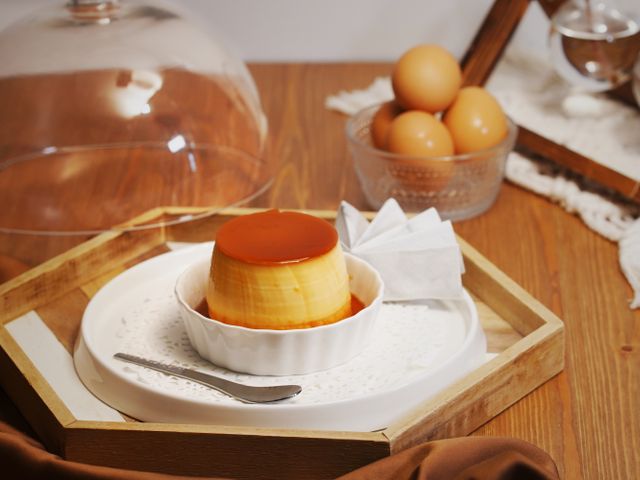
A traditional Spanish dessert featuring a crispy butter pastry tart filled with a rich, creamy flan custard made from eggs, condensed milk, and cream. The showstopping burnt sugar caramel top—torched or broiled until amber and crackling—gives way to silky custard. This elegant tart is impressive enough for special occasions yet straightforward enough for confident home bakers.
- Prep
- 25 min
- Cook
- 50 min
- Wait
- 2 hr
- Total
- 3 hr 15 min
- Makes
- 1 tart (8 slices)
Steps
Before you start
- Remove the pastry from the freezer 10 minutes before rolling
- Bring eggs and heavy cream to room temperature (about 30 minutes)
- Have an ice bath ready (bowl of ice water) for cooling the tart
- If using a torch, ensure it has fuel and test it before starting
Prepare and blind bake the pastryOven 400°F / 205°C
- Preheat your oven to 400°F (200°C).
- On a lightly floured surface, roll out the thawed pastry disk to a 10-inch (25 cm) round, about ⅛ inch (3 mm) thick.
- Transfer it to a 9-inch (23 cm) tart pan with a removable bottom, pressing it gently into the corners and up the sides.
- Trim excess pastry flush with the rim.
- Line the pastry with parchment paper and fill with pie weights or dried beans.
- Bake for 12 minutes until the edges are set and beginning to color.
- Remove the weights and parchment, then return to the oven for 3–4 minutes until the bottom is pale golden and no longer wet.
- Remove and cool slightly while you prepare the filling.
+ Show details− Hide details
Ready when: Pastry edges golden, bottom dry and pale golden, no wet spots
Tip: Do not skip blind baking; it prevents a soggy crust. Keep weights evenly distributed so the bottom doesn't puff.
Whisk the custard filling
- In a large mixing bowl, whisk together the 4 room-temperature eggs until pale and well combined, about 2 minutes.
- Add the sweetened condensed milk and whisk until smooth and homogeneous.
- Pour in the room-temperature heavy cream, vanilla extract, and fine sea salt.
- Whisk until the mixture is uniform with no streaks or lumps.
- Strain the custard through a fine mesh strainer into a clean bowl, pressing gently to remove any bits of cooked egg white or debris.
- This step ensures a silky, lump-free filling.
+ Show details− Hide details
Ready when: Custard is smooth, uniform in color, and all lumps removed after straining
Tip: Straining is crucial for a smooth, restaurant-quality texture. Do not skip it even if the mixture looks smooth.
Pour and water-bath bakeOven 325°F / 165°C
- Reduce the oven temperature to 325°F (160°C).
- Pour the strained custard mixture into the blind-baked pastry shell, filling it almost to the rim.
- Place the tart pan inside a larger roasting pan.
- Pour hot water into the roasting pan until it reaches halfway up the sides of the tart pan (this is your water bath).
- Carefully transfer the roasting pan to the preheated 325°F (160°C) oven.
- Bake for 30–35 minutes until the custard is just set around the edges but still has a slight jiggle in the center (about 1 inch / 2.5 cm diameter).
- The center should reach 170°F (76°C) on an instant-read thermometer inserted 1 inch from the edge.
+ Show details− Hide details
Ready when: Edges are set and opaque; center jiggles slightly when pan is gently shaken; internal temp ~170°F (76°C) at edge
Tip: Overbaking results in a rubbery, cracked custard. Stop baking while the center still has a wobble—it will continue to set as it cools.
Cool in water bath
- Turn off the oven.
- Carefully remove the roasting pan with the tart from the oven, and let the tart cool in the hot water bath for 15 minutes.
- Then transfer the tart pan (still in the water) to the counter and let it cool for another 15 minutes.
- Remove the tart pan from the water and place it on a wire rack or clean countertop.
- Let it cool to room temperature, about 30–40 minutes, until the surface is no longer warm to the touch.
+ Show details− Hide details
Ready when: Tart is completely cool to the touch and surface is no longer warm
Tip: Gradual cooling prevents thermal shock and cracks. Do not rush this step or place it directly in the refrigerator.
Chill and prepare for caramelizing
- Once cooled to room temperature, transfer the tart (still in its pan) to the refrigerator for at least 1 hour and up to 4 hours, until the custard is fully chilled and firm.
- Pat the surface dry with a clean paper towel just before torching to remove any condensation.
- If using a broiler instead of a torch, move the oven rack to the highest position and preheat the broiler to high.
+ Show details− Hide details
Ready when: Custard is firm to a gentle touch; surface is dry
Tip: Chilling makes the caramel top contrast beautifully with the cold custard below. A moist surface will sizzle and brown unevenly under the torch.
Apply sugar and torch the caramel top
- Divide the granulated sugar into 8 equal portions (about 1 tablespoon / 12.5 g each).
- Working quickly, sprinkle one portion of sugar evenly over the tart, covering the entire surface in a thin, even layer.
- Using a culinary torch held 2–3 inches (5–7 cm) from the surface, move it slowly and steadily across the sugar, applying medium-high heat.
- The sugar will melt, bubble, and turn deep amber—this takes 60–90 seconds.
- The goal is an even, dark caramel color with occasional burnt spots for dramatic effect.
- Repeat with the remaining 7 portions of sugar, torching each layer until deeply caramelized and crackly.
- Once finished, the sugar should form a thin, hard shell that cracks when tapped.
+ Show details− Hide details
Ready when: Sugar is deep amber to dark brown with a hard, crackly shell that sounds crisp when tapped
Tip: Multiple thin layers of caramel create a better texture than one thick layer. Keep the torch moving to prevent charring in one spot. If using a broiler, spread all sugar at once 3 inches (7 cm from the element, watching carefully for 3–5 minutes until dark amber.
Rest and serve
- Allow the caramelized tart to rest at room temperature for 5 minutes so the sugar sets completely and the contrast between the cold, creamy custard and warm caramel is ideal.
- Carefully remove the tart from the pan by pushing up on the removable bottom and sliding it onto a serving plate.
- Slice with a sharp, lightly oiled knife, wiping the blade between cuts for clean edges.
- Serve immediately while the caramel is still crackling.
+ Show details− Hide details
Ready when: Caramel is fully set, tart is released from pan cleanly, slices break the caramel shell
Tip: Oil the knife lightly or dip it in hot water and wipe dry between cuts to prevent caramel from sticking and tearing.
Good to know
Tips
- Invest in a culinary torch if you make crème brûlée or caramel-topped desserts regularly; they are affordable and give you more control than a broiler.
- For a foolproof water bath, place the tart pan in a larger roasting pan before adding custard, then pour water around it in the oven rather than trying to carry a filled pan over water.
- If the tart cracks slightly during baking, this is normal and will be hidden under the caramel top. Rest assured the flavor will be perfect.
- Spanish tradition often calls for a cinnamon-dusted caramel or a few drops of brandy in the custard—feel free to add ½ tsp ground cinnamon to the filling or 1 tbsp brandy mixed with the eggs.
Make ahead
The tart can be made completely (including the caramelized top) up to 6 hours ahead. Cover it loosely with plastic wrap and refrigerate. Bring to room temperature for 20 minutes before serving if the caramel has hardened; it will soften slightly and become less brittle, which some prefer. For the crackly texture, torch or broil fresh caramel on the day of serving.
Storage & reheating
Room temperature (up to 4 hours): Store under a cake dome or covered loosely; the caramel will soften slightly. Refrigerator (up to 3 days): Cover loosely with plastic wrap; condensation will soften the caramel top, so re-torch briefly before serving if desired. Freezer: Not recommended; the caramel becomes too brittle and the custard's texture suffers upon thawing.
Substitutions
- frozen all-purpose pie or tart dough → Homemade shortcrust pastry (pâte brisée). Make from 1½ cups all-purpose flour, 6 oz (170 g) cold unsalted butter, 1 egg yolk, ½ tsp salt, and 2–3 tbsp ice water; chill before rolling.
- heavy cream → Evaporated milk. Use ¾ cup (180 ml) evaporated milk in place of heavy cream for a less rich custard; the flavor will be slightly more subtle.
- pure vanilla extract → Vanilla bean paste or seeds from ½ vanilla pod. For deeper vanilla flavor, use 1 tsp vanilla bean paste or scrape seeds from ½ pod; omit the extract.
- granulated sugar → Demerara or turbinado sugar. These coarser sugars caramelize more slowly and create larger, crunchier crystals; torching takes slightly longer but yields dramatic texture.