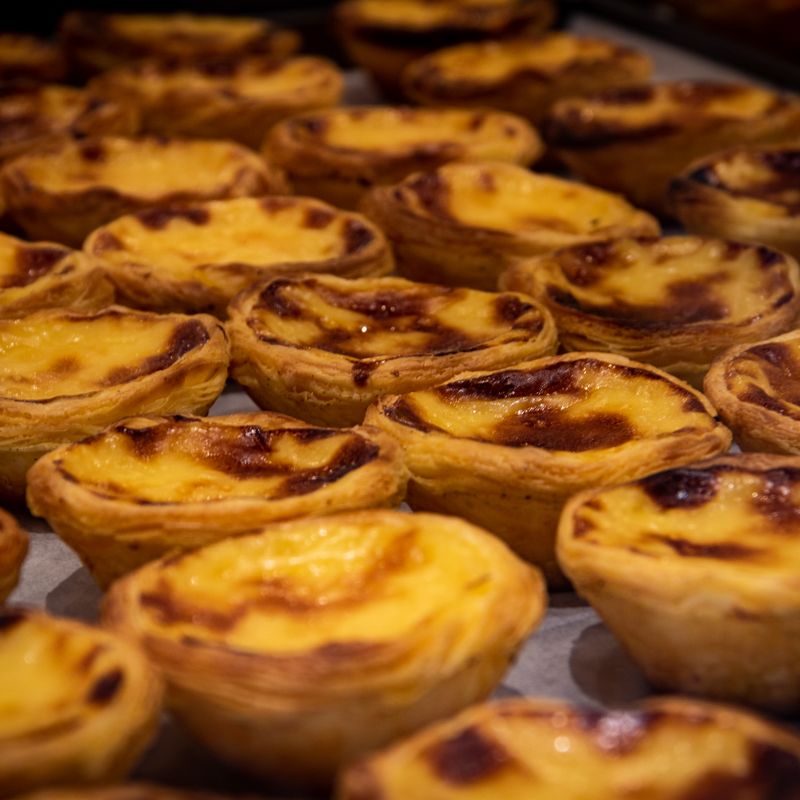
Holiday Eggnog Custard Tart with Nutmeg
A silky, spiced custard tart capturing the flavors of the holiday season. Rich eggnog mingles with cream and eggs to create a tender filling that bakes until just set, topped with freshly grated nutmeg. The buttery pastry crust provides a crisp, tender foundation. Perfect for festive gatherings or as an elegant dessert that can be made a day ahead.
- Prep
- 25 min
- Cook
- 45 min
- Wait
- 2 hr 15 min
- Total
- 3 hr 25 min
- Makes
- 1 tart (8 slices)
Steps
Before you start
- Remove pastry crust from freezer 15 minutes before rolling (if using frozen) or prepare your own and chill for at least 30 minutes
- Preheat oven to 375°F (190°C) for blind baking the crust, then increase to 325°F (163°C) for the custard
- Have all custard ingredients at room temperature for a smooth, lump-free filling
- Line a baking sheet with foil to catch any drips
Prepare and blind bake crustOven 375°F / 190°C
- Remove pastry dough from refrigerator and let it soften slightly at room temperature for 5 minutes.
- Fit into a 9-inch (23 cm) tart pan with removable bottom, pressing gently into the corners and sides; trim excess dough.
- Prick the bottom with a fork in several places.
- Line with parchment paper and fill with pie weights or dried beans.
- Place on the prepared baking sheet and bake at 375°F (190°C) for 12–15 minutes, until the edges are light golden.
- Remove weights and parchment, and bake for another 3–4 minutes until the bottom looks set but is still pale.
- Remove from oven and let cool briefly.
+ Show details− Hide details
Ready when: Edges light golden, bottom feels firm and is pale, not browned
Tip: Don't skip the pie weights—they prevent puffing and ensure an even crust. A soggy bottom is a common pitfall with tarts.
Reduce oven temperatureOven 325°F / 165°C
- While the crust cools, reduce oven temperature to 325°F (163°C).
- This lower temperature ensures the delicate custard sets gently without browning or cracking.
Combine eggnog and creamOven 160°F / 70°C
- In a medium saucepan, whisk together the cold eggnog and heavy cream over medium heat.
- Warm to about 160°F (71°C), stirring occasionally—you want it steaming but not boiling.
- This warming step helps the custard set evenly and prevents curdling.
+ Show details− Hide details
Ready when: Liquid is steaming, small bubbles at the edges, thermometer reads 160°F (71°C)
Tip: Use a instant-read thermometer to hit the target temperature. Overheating can cause the custard to become grainy.
Whisk eggs and sugar
- In a separate bowl, whisk together the 4 large eggs, 1 egg yolk, granulated sugar, vanilla extract, ground nutmeg, and fine sea salt until well combined and pale, about 1–2 minutes.
- The mixture should be smooth and homogeneous with no lumps.
+ Show details− Hide details
Ready when: Mixture is pale, thick, and smooth; no sugar crystals or egg white streaks visible
Tip: Whisking thoroughly incorporates air and helps distribute the spices evenly, ensuring consistent flavor throughout the tart.
Temper the eggs
- Slowly pour the warm eggnog mixture into the egg mixture while whisking constantly.
- Add about one-third of the eggnog first, whisking constantly to bring the eggs up to temperature without scrambling them.
- Once combined, whisk in the remaining eggnog in a steady stream.
+ Show details− Hide details
Ready when: Custard is smooth, uniform in color, with no visible egg streaks or curdled bits
Tip: Tempering prevents scrambled eggs. Keep whisking—this is crucial. Pour slowly and deliberately.
Strain the custard
- Pour the combined custard through a fine-mesh strainer into a clean bowl, pressing gently with the back of a spoon to remove any foam, lumps, or cooked egg bits.
- This ensures a silky-smooth filling with no grit.
- Let the strained custard sit for 1–2 minutes for the bubbles to settle.
+ Show details− Hide details
Ready when: Custard is smooth, translucent, with no foam on top and no particles in the strainer
Tip: Don't skip straining. This step is what separates a silky tart from a gritty one. Be gentle but thorough.
Pour filling and bakeOven 325°F / 165°C
- Pour the strained custard into the partially baked tart shell, filling it to just below the rim.
- Place the tart on the baking sheet and bake at 325°F (163°C) for 30–38 minutes.
- The custard is done when it jiggles just slightly in the center when you give the pan a gentle nudge—the outer inch or so should look set and barely opaque, but the very center should still have a tiny wobble.
+ Show details− Hide details
Ready when: Outer custard is opaque and set, center has a barely perceptible jiggle (about 1 inch diameter). Temperature at the center reaches 165°F (74°C)
Tip: Overbaking creates a rubbery, cracked custard. A slight jiggle is essential—it will continue cooking as it cools and will firm up perfectly.
Cool on rack
- Remove the tart from the oven and let it cool on a rack at room temperature for 30 minutes.
- The carryover heat continues to gently set the custard.
- Do not cover it—steam needs to escape or condensation will make the crust soggy.
+ Show details− Hide details
Ready when: Tart is warm to the touch but no longer steaming; custard is fully set and wobbles only minimally when nudged
Tip: Resist the urge to cover the tart while it cools. Condensation will soften your crust.
Chill and garnish
- Transfer the tart to the refrigerator and chill for at least 1 hour (or up to 8 hours) until completely cold.
- Just before serving, use a microplane or box grater to grate a light layer of fresh nutmeg over the top of the tart.
+ Show details− Hide details
Ready when: Tart is very cold to the touch; custard is firm but creamy when sliced
Tip: Fresh nutmeg grated just before serving is far superior to pre-ground. It looks elegant and tastes vibrant.
Good to know
Tips
- The difference between creamy, silky custard and grainy, overcooked custard is often just 2–3 minutes of baking time and proper tempering of the eggs. Use an instant-read thermometer and trust the gentle jiggle test—it's more reliable than time alone.
- Room-temperature eggs are essential. Cold eggs take longer to heat through and increase the risk of unevenness in the filling. Leave them on the counter for 30 minutes before using.
- Fresh nutmeg grated just before serving delivers a fragrant, warm note that pre-ground nutmeg cannot match. It's worth the small effort.
- If your tart cracks during baking, it's likely overcooked or the oven temperature was too high. The next time, lower the temperature by 10°F and start checking at 28 minutes instead of 30.
Make ahead
The entire tart can be baked and chilled up to 1 day ahead. Wrap loosely in foil and store in the refrigerator. Grate fresh nutmeg over the top just before serving. The pastry crust can also be made and blind-baked up to 2 days in advance; cool completely, wrap, and refrigerate until ready to fill and bake.
Storage & reheating
Room temperature: not recommended. Refrigerator: covered loosely with foil, up to 3 days (the crust softens over time as humidity increases). Freezer: wrap tightly in plastic wrap and foil, up to 2 months; thaw overnight in the refrigerator before serving. Reheat gently in a 275°F (135°C) oven for 10–15 minutes if desired, though the tart is best served cold or at cool room temperature.
Substitutions
- store-bought eggnog, chilled → 1.5 cups (360 ml) whole milk or half-and-half mixed with 1 tablespoon (15 ml) rum or brandy and a pinch of nutmeg. If you prefer a non-alcoholic version or don't have eggnog, this mimics the spiced, creamy flavor. Adjust sweetness with an extra 1–2 teaspoons of sugar if using plain milk.
- heavy cream, cold → 0.75 cup (180 ml) whole milk. Reduces richness and fat content; the custard will be slightly less luxurious but still delicious.
- ground nutmeg → 0.25 teaspoon ground cinnamon or 0.25 teaspoon ground allspice. Nutmeg is quintessential to eggnog flavor, but a warmer spice blend works if you prefer less nutmeg intensity.
- all-purpose flour, unsalted butter, egg yolk, salt, ice water (or 1 pound all-purpose pie dough, thawed if frozen) → 1 store-bought unbaked pie crust (9 inch / 23 cm). Convenient and reliable; thaw according to package directions before lining the tart pan.
More pies & tarts
See all →




Find more like this
- Meal
- Dessert
- Main ingredient
- Eggs
- Diet
- VegetarianHalal
- Method
- Oven
- Occasion
- ChristmasFamily Gatherings