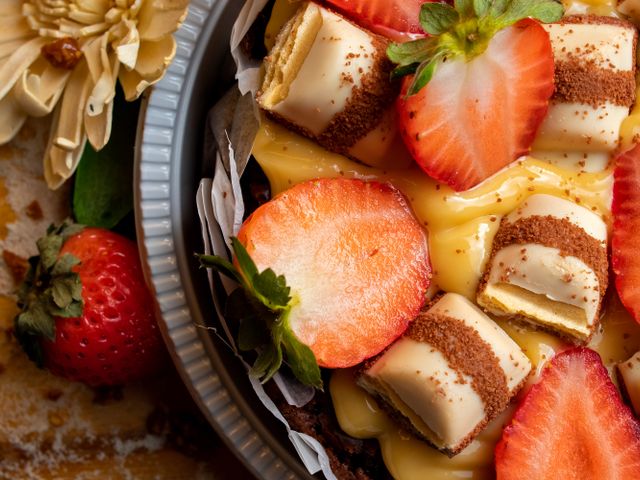
Greek Bougatsa Custard Pastry
A traditional Greek pastry featuring paper-thin phyllo dough layers crisped with melted butter, encasing a velvety custard cream filling made with semolina and eggs. Baked until golden and served warm, often dusted with powdered sugar and cinnamon for a delicate sweet finish. This recipe yields a family-sized pastry that's impressive yet approachable for home cooks.
- Prep
- 25 min
- Cook
- 45 min
- Wait
- 15 min
- Total
- 1 hr 25 min
- Makes
- 1 pastry (8 slices)
Steps
Before you start
- Remove phyllo dough from the refrigerator 30 minutes before baking to allow it to come to room temperature
- Preheat oven to 375°F (190°C) at least 15 minutes ahead
- Have a pastry brush and damp kitchen towel ready to prevent phyllo from drying out
- Read through the phyllo layering process so you work efficiently
Heat milk and prepare eggs
- Pour the milk into a medium saucepan and place over medium heat.
- Warm until small bubbles form around the edges and steam rises, about 5–7 minutes; do not boil.
- Meanwhile, in a large bowl, whisk together the egg yolks, whole eggs, and sugar until the mixture is pale and thick, about 3 minutes of whisking.
- This helps the eggs incorporate evenly into the custard.
+ Show details− Hide details
Ready when: Milk steams and has small bubbles at the edge; egg mixture is pale and thick
Tip: Whisking the eggs and sugar thoroughly prevents lumps in the final custard.
Temper eggs and combine
- Slowly pour the warm milk into the egg mixture while whisking constantly.
- The gradual tempering prevents the eggs from scrambling.
- Once combined, sift the semolina, cornstarch, and salt directly into the bowl and whisk to dissolve any lumps.
- Stir in the vanilla extract.
+ Show details− Hide details
Ready when: Mixture is smooth and free of lumps
Tip: Sifting the dry ingredients prevents clumping that can ruin the custard's texture.
Cook custard until thickOven 170°F / 75°C
- Return the custard mixture to the saucepan and place over medium heat.
- Stir constantly with a whisk, reaching into the corners and edges, for 8–10 minutes until the mixture thickens visibly and reaches about 170°F (76°C) on an instant-read thermometer.
- The custard should coat the back of a spoon.
- Remove from heat and let cool for 5 minutes, stirring occasionally.
+ Show details− Hide details
Ready when: Custard coats the back of a spoon; internal temperature reaches 170°F (76°C)
Tip: Constant stirring prevents lumps and ensures even cooking; the custard will continue to thicken as it cools.
Prepare baking pan
- Brush the bottom and all sides of a 9×13-inch (23×33 cm) baking pan with some of the melted butter, using about 2 tablespoons.
- Make sure corners and edges are well coated to prevent sticking.
+ Show details− Hide details
Ready when: Pan is evenly coated with butter
Tip: A well-buttered pan helps the finished bougatsa release easily.
Layer phyllo base
- Unroll the phyllo dough and cover it loosely with a damp kitchen towel to prevent drying.
- Place 8 sheets of phyllo in the prepared pan, brushing each sheet generously with melted butter before laying it down.
- Phyllo sheets don't need to fit perfectly; they will overlap the edges slightly.
- Use about 3 tablespoons of melted butter for these 8 layers.
+ Show details− Hide details
Ready when: 8 phyllo layers are in the pan, each coated with butter
Tip: Keep phyllo covered except for the sheet you're working with; exposed phyllo dries out quickly and becomes brittle and impossible to layer.
Spread custard filling
- Pour the cooled custard over the phyllo base and spread it into an even layer using a spatula, leaving a small border if desired.
- The filling should be about ½ inch (1.25 cm) thick.
+ Show details− Hide details
Ready when: Custard is spread evenly throughout the pan
Tip: A thin, even layer of custard ensures it cooks through while the phyllo becomes crispy.
Layer phyllo top
- Layer 8 more sheets of phyllo dough on top of the custard, brushing each with melted butter as you did for the base.
- Use another 3 tablespoons of melted butter.
- The final sheet should be brushed butter-side up.
- The pastry doesn't need to be perfectly tucked; a rustic finish is traditional.
+ Show details− Hide details
Ready when: 8 phyllo layers are arranged on top and buttered
Tip: Brush the top layer generously so it browns evenly and crisps up during baking.
Score and bakeOven 375°F / 190°C
- Using a sharp knife or pizza wheel, score the pastry into 8 diagonal or square pieces, cutting through the phyllo but not pressing hard enough to disturb the custard below.
- This allows steam to escape and makes serving easier.
- Brush any remaining melted butter over the scored surface.
- Place the pan in a preheated 375°F (190°C) oven and bake for 35–45 minutes until the phyllo is deep golden brown and crispy.
+ Show details− Hide details
Ready when: Phyllo is deep golden brown and crispy on top; corners are very dark
Tip: Scoring before baking helps the steam escape and prevents the pastry from puffing unevenly.
Cool and finish
- Remove the bougatsa from the oven and let it rest on a wire rack or cooling surface for 15 minutes.
- This resting period allows the structure to set slightly and makes it easier to cut and serve.
- Just before serving, sift the powdered sugar evenly over the top of the pastry, then sprinkle with ground cinnamon in a light, scattered pattern.
+ Show details− Hide details
Ready when: Pastry has cooled enough to cut cleanly
Tip: Sift the powdered sugar just before serving to prevent it from absorbing moisture; sprinkle cinnamon last for the most fragrant result.
Serve
- Cut along your scored lines, place each piece on a plate, and serve while still warm.
- The pastry will be at its crispiest and the custard at its most delicate within the first 1–2 hours of baking.
+ Show details− Hide details
Tip: Serve bougatsa warm and within a few hours of baking for the best texture and flavor.
Good to know
Tips
- Phyllo dough dries out very quickly when exposed to air. Always cover the stack with a damp kitchen towel and uncover only the one sheet you're working with. This is the single most important tip for successful bougatsa.
- The custard must cool slightly before spreading, but should still be warm when you use it. A lukewarm custard spreads smoothly and sets properly during baking. If it cools too much, it becomes too thick to spread.
- Don't skip the resting period after baking. The 15 minutes allows the custard to firm up enough that pieces won't crumble or fall apart when you serve them.
- For an authentic Greek café experience, serve bougatsa with a small glass of Greek coffee or spiced tea. The warm pastry and hot beverage are traditional companions.
Storage & reheating
Store leftovers loosely covered with foil or parchment at room temperature for up to 2 days. Reheat on a baking sheet at 325°F (163°C) for 10–15 minutes to restore crispiness. Do not refrigerate or freeze; the phyllo will become soggy and the custard texture suffers.
Substitutions
- fine semolina flour → all-purpose flour. Use the same weight (50 g). The texture will be slightly less silky, but the pastry will still be delicious.
- cornstarch → potato starch. Use the same weight (16 g). Potato starch creates a similarly smooth, creamy custard.
- vanilla extract → almond extract or a pinch of ground nutmeg. Use half the amount (0.75 teaspoons) if substituting, as these flavors are more potent. Almond provides a classic European pastry flavor; nutmeg adds warmth.
- phyllo dough → spanakopita or filo dough from other sources. Any phyllo dough works; freshness and pliability matter most. Thaw frozen dough completely before use.