Caramelized Onion & Ricotta Pie
A rustic Italian savory pie with a tender, flaky pastry crust filled with deeply caramelized onions folded into a creamy ricotta and Parmesan mixture, fragrant with fresh thyme. The filling is custardy yet set, and best served warm or at room temperature.
- Prep
- 35 min
- Cook
- 1 hr 20 min
- Wait
- 1 hr 10 min
- Total
- 3 hr 5 min
- Makes
- 1 pie (6 slices)
Steps
Before you start
- Keep butter and water ice-cold for the flakiest crust
- Plan ahead: caramelizing onions takes 45–50 minutes, so start early
- Bring ricotta and eggs to room temperature before mixing the filling
- Read through the entire recipe and gather all equipment before beginning
Make the pie crust
- In a medium bowl, combine 1½ cups (190g) all-purpose flour and ¼ tsp salt.
- Cut in 6 oz (170g) cold unsalted butter, cut into cubes, using a pastry cutter or your fingertips until the mixture resembles coarse breadcrumbs with some pea-sized pieces remaining.
- Sprinkle 4–5 tbsp (60–75 ml) ice water over the mixture and gently toss with a fork until the dough just comes together; do not overmix.
- Shape into a flat disk, wrap in plastic wrap, and refrigerate for at least 30 minutes.
+ Show details− Hide details
Ready when: Dough is fully chilled and firm to the touch
Tip: Keep all ingredients as cold as possible and work quickly to avoid tough, dense crust
Slice the onions
- While the dough chills, peel and halve 5 large yellow onions (about 2.5 lbs / 1.1 kg) lengthwise.
- Lay each half cut-side down and slice into ¼-inch (6 mm) half-moons.
- You should have roughly 10 cups of sliced onions.
+ Show details− Hide details
Tip: Consistent slice thickness ensures even cooking
Caramelize the onions
- Heat 2 tbsp (30 ml) olive oil in a large, heavy-bottomed skillet (12-inch / 30 cm) over medium heat.
- Once shimmering, add all the sliced onions and 3 minced garlic cloves.
- Stir to coat with oil.
- Cook, stirring occasionally (roughly every 10 minutes), for 45–50 minutes.
- The onions will first release moisture and become translucent, then gradually turn golden, and finally a deep, rich caramel brown.
- They should be very soft, jammy, and smell intensely sweet.
- Scrape up and stir any browned bits from the bottom of the pan.
+ Show details− Hide details
Ready when: Onions are deep caramel brown throughout, completely soft and jammy; the original volume has reduced by about two-thirds; a spoon through them leaves a trail
Tip: Patience is key—true caramelization cannot be rushed. Medium heat and time develop the natural sugars; high heat will brown them too quickly and they'll taste burnt instead of sweet
Cool the onions
- Remove the skillet from heat and let the onions cool for 10 minutes at room temperature.
- They should be warm but not steaming.
+ Show details− Hide details
Ready when: Onions are warm but no longer steaming
Preheat the ovenOven 375°F / 190°C
- While the onions cool, preheat your oven to 375°F (190°C).
+ Show details− Hide details
Ready when: Oven thermometer or built-in indicator confirms 375°F (190°C) has been reached
Make the ricotta filling
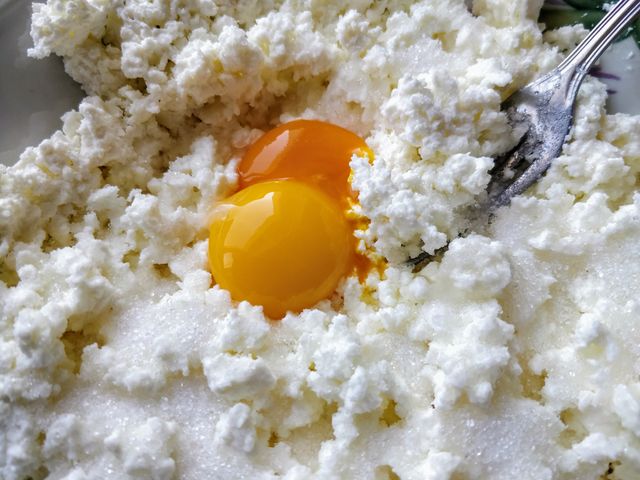
- In a medium bowl, whisk together 15 oz (425g) whole milk ricotta cheese, 2 large eggs (at room temperature), ½ cup (50g) finely grated Parmigiano-Reggiano cheese, 2 tbsp (6g) fresh thyme leaves (finely chopped), ½ tsp salt, and ¼ tsp freshly ground black pepper until smooth and creamy with no visible ricotta lumps.
+ Show details− Hide details
Ready when: Mixture is smooth, creamy, and completely homogeneous
Tip: Full-fat ricotta is essential for creaminess; part-skim varieties will result in a grainy, less luxurious filling
Combine onions and filling
- Fold the cooled caramelized onions into the ricotta mixture with a rubber spatula, folding gently until the onions are evenly distributed throughout.
- Do not overmix.
+ Show details− Hide details
Ready when: Onions are evenly distributed throughout the filling; no large pockets of ricotta remain
Tip: Fold gently to maintain a light, creamy texture; overmixing can make the filling dense and grainy
Roll and line the crust
- Remove the chilled dough from the refrigerator.
- On a lightly floured surface, roll it out to a ⅛-inch (3 mm) thickness.
- Transfer to a 9-inch (23 cm) pie pan, letting the dough drape evenly over the sides.
- Trim the overhang to about ½ inch (1.25 cm) and fold it under to create a standing rim.
- Crimp the edge decoratively with your fingers or a fork.
- Prick the bottom all over with a fork, leaving the sides intact, to prevent puffing.
+ Show details− Hide details
Ready when: Crust is evenly rolled to uniform thickness, fitted to the pan, and crimped
Tip: If the dough tears during rolling or transfer, patch the hole with a small piece of dough moistened with cold water; it will seal during baking
Fill and bake the pieOven 375°F / 190°C
- Pour the onion-ricotta filling into the prepared crust, spreading it in an even layer.
- Place the pie pan on a large baking sheet (to catch any drips) and transfer to the preheated 375°F (190°C) oven.
- Bake for 35–40 minutes.
- The crust should be a deep golden brown and the filling should be set at the edges while still slightly jiggly in the very center when you gently shake the pan.
- An instant-read thermometer inserted into the center should read 160°F (71°C).
+ Show details− Hide details
Ready when: Crust is deep golden brown; filling is set at the edges but the very center jiggles slightly when the pan is gently shaken; internal temperature is 160°F (71°C) at the center
Tip: If the crust edges are browning too quickly, tent them loosely with aluminum foil for the remaining bake time. The filling will continue to set slightly as it cools, so a bit of jiggle is intentional
Cool and rest the pie
- Remove the pie from the oven and let it rest on a wire cooling rack for at least 15 minutes before slicing.
- During this time, the filling will continue to set and will be much easier to serve cleanly.
+ Show details− Hide details
Ready when: Pie is cooled to warm or room temperature; a knife slides cleanly through the filling
Tip: This pie is delicious served warm, at room temperature, or even chilled. Leftovers actually taste better the next day as flavors meld
Good to know
Tips
- True caramelization takes patience and time. Resist the urge to increase heat to speed things up—medium heat and regular stirring yield the best results, with a sweet, jammy final product instead of burnt, bitter onions.
- Keep the crust very cold before baking for maximum flakiness. If it warms up, pop it back in the freezer for 10 minutes before filling.
- This pie is delicious any temperature: serve it warm from the oven, at room temperature for a picnic, or even chilled. Slices are easier to serve if the pie is completely cool.
- Make extra caramelized onions—they're amazing on pizzas, in sandwiches, stirred into pasta, or piled onto crackers with ricotta for an easy appetizer.
Make ahead
The pie can be baked 1–2 days ahead, which actually improves the flavor as the caramelized onions and herbs meld. Alternatively, the pie crust can be made and chilled up to 2 days ahead, and the filling assembled just before baking.
Storage & reheating
Room temperature (up to 4 hours, or serve at room temperature after cooling); Refrigerator: covered, up to 4 days (flavors deepen overnight); Freezer: tightly wrapped, up to 3 months (thaw overnight in fridge, then reheat at 350°F / 175°C for 15–20 minutes until warmed through)
Substitutions
- unsalted butter, cold → Store-bought pie crust (one 9-inch pre-made crust, thawed if frozen). Use this to skip steps 1–2 and save 40 minutes. Simply thaw if needed and fill directly.
- fresh thyme → Dried thyme (1 tsp), or fresh rosemary (1 tbsp chopped), or Italian seasoning (1 tsp). Dried thyme is 3 times as strong as fresh, so reduce the amount. Other herbs like oregano or marjoram work well too.
- Parmigiano-Reggiano cheese → Pecorino Romano (¼ cup, as it's saltier) or Asiago cheese. Pecorino is tangier and more assertive; adjust salt accordingly. Asiago is milder and creamier.
- whole milk ricotta cheese → A mixture of 8 oz mascarpone and 7 oz Greek yogurt. This yields a slightly tangier filling with similar creaminess. Do not use ricotta salata, which is firm and salty.