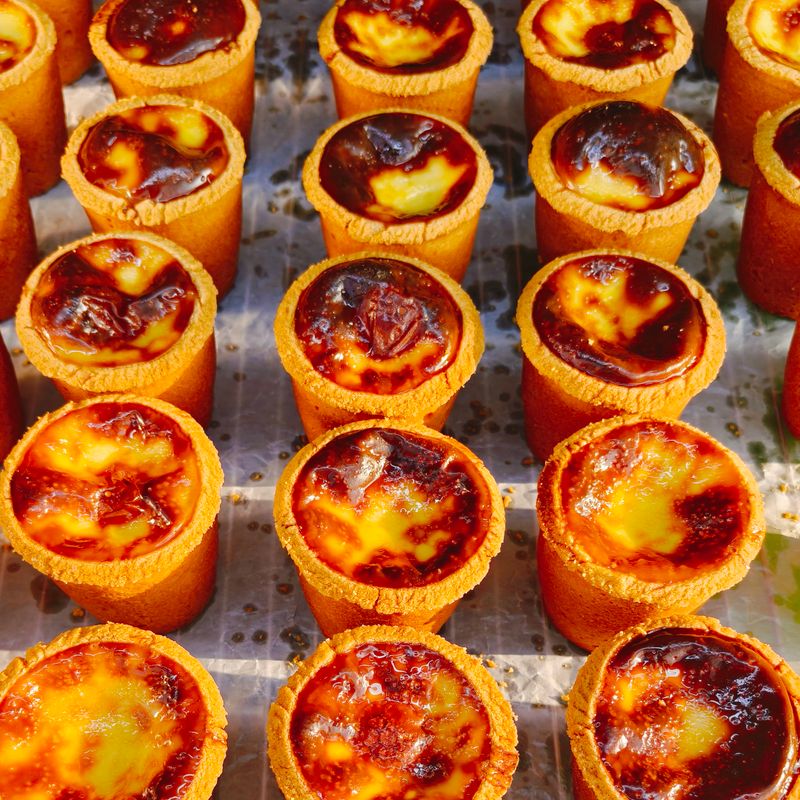
Vietnamese Caramel Custard Tart
A silky, elegant dessert that brings together Vietnamese flavors. Rich dark caramel lies beneath a creamy custard filling made with sweetened condensed milk, all resting on a crispy, buttery graham cracker crust. A whisper of sea salt breaks through the sweetness, creating unexpected depth and balance. Best served chilled for optimal texture and taste.
- Prep
- 20 min
- Cook
- 37 min
- Wait
- 40 min
- Total
- 1 hr 37 min
- Makes
- 1 tart (8 slices)
Steps
Before you start
- Preheat oven to 350°F (175°C) for about 15 minutes before starting
- Have a 9-inch tart pan with removable bottom ready on a baking sheet
- Let eggs come to room temperature for 30 minutes—this ensures a silkier custard
- Measure and organize all ingredients (mise en place) to avoid scrambling
- Have a wet pastry brush nearby for the caramel step
Make and blind bake crustOven 350°F / 175°C
- In a medium bowl, combine 1.5 cups finely crushed graham cracker crumbs, 5 tbsp melted unsalted butter, 2 tbsp granulated sugar, and a pinch of sea salt.
- Stir until the mixture resembles moist sand with no dry spots.
- Press the mixture firmly and evenly into the bottom and sides of a 9-inch tart pan with a removable bottom, building the sides about 1/8 inch thick.
- Use the bottom of a measuring cup to compress the base thoroughly.
- Prick the bottom all over with a fork (about 20–25 pricks) to prevent air bubbles and puffing.
- Place the tart pan on a baking sheet and bake in a preheated 350°F (175°C) oven for 12 minutes until lightly golden and set.
- Remove and let cool for 5 minutes while you proceed with the caramel.
+ Show details− Hide details
Ready when: Crust is light golden brown and feels firm to the touch
Tip: The fork pricks are essential—they prevent the center from puffing up unevenly during baking
Cook caramel until amber
- While the crust bakes, combine 1 cup granulated sugar and 1/4 cup water in a medium saucepan over medium-high heat.
- Bring to a boil without stirring—you can gently tilt and swirl the pan to distribute heat evenly, but resist the urge to stir.
- Watch carefully; after about 8–10 minutes, the sugar will turn light golden, then gradually deepen to a rich amber color like light honey.
- Once it reaches a deep amber (roughly the color of dark iced tea), immediately remove from heat.
- Carefully stir in 3 tbsp cold butter cubes (the mixture will briefly bubble and foam) until fully smooth.
- Slowly pour in 3 tbsp heavy cream while stirring gently (it will bubble up again as you add it) until incorporated.
- Stir in 1/2 tsp sea salt flakes.
- Let the caramel cool for 10 minutes, stirring occasionally, until it thickens slightly but remains pourable.
+ Show details− Hide details
Ready when: Deep amber color achieved; caramel is smooth and pourable after cooling
Tip: If you see sugar crystals forming on the sides of the pan, brush them down with a wet pastry brush. The color is crucial—deep amber tastes complex and rich, while pale amber tastes sugary and light. If in doubt, remove it at a light amber; it continues to darken slightly after leaving the heat.
Whisk custard filling
- In a medium bowl, combine one 14 oz can of sweetened condensed milk (opened and ready), 3 room-temperature large eggs, 1 tsp vanilla extract, and a pinch of sea salt.
- Whisk vigorously for about 1 minute until smooth, pale, and slightly frothy.
- The mixture should have no visible lumps and appear uniform throughout.
+ Show details− Hide details
Ready when: Mixture is pale, smooth, and slightly aerated with no lumps visible
Tip: Room-temperature eggs incorporate more smoothly into the condensed milk and create a silkier final custard. Cold eggs tend to create a slightly grainy texture.
Assemble and bake tartOven 350°F / 175°C
- The prebaked crust should still be warm.
- Carefully pour the slightly cooled caramel into the crust, tilting the pan gently and using an offset spatula if you have one to spread it evenly across the bottom in a thin, even layer.
- Working carefully and slowly, pour the custard mixture over the caramel in a steady stream, filling to about 1/8 inch below the rim of the tart.
- Make sure the baking sheet is positioned in the oven on the middle rack before adding the tart, then carefully transfer the entire sheet into the oven.
- Bake at 350°F (175°C) for 25–30 minutes until the custard is set around the edges but the very center still has a slight jiggle when you gently shake the pan (the center should wobble about 2 inches).
- The top should be pale golden, not browned.
+ Show details− Hide details
Ready when: Edges are set and opaque; center has a slight 2–3 inch jiggle; top is pale golden
Tip: The slightly underbaked, jiggly center is intentional. As the tart cools on the counter and in the refrigerator, carryover heat continues to cook the center, resulting in a silky, creamy custard rather than a rubbery one. If the edges brown significantly before the center is set, loosely tent with aluminum foil.
Cool before serving
- Remove the tart from the oven and let it cool at room temperature on the baking sheet for 30–40 minutes.
- The tart will continue to set as it cools.
- Then carefully transfer it (still in the removable-bottom pan) to the refrigerator and chill for at least 2 hours before serving.
- Chilling is essential—it allows the custard to set fully and improves both texture and flavor.
+ Show details− Hide details
Ready when: Tart is completely cooled and firm enough to slice cleanly
Tip: Don't skip the refrigeration step. A chilled tart is much easier to slice cleanly, and the flavors meld beautifully after a few hours in the cold.
Good to know
Tips
- The caramel is the soul of this tart. It's worth taking extra care with the color—that deep amber is what separates a great tart from a mediocre one. Start checking at 8 minutes and watch closely. If uncertain, remember it continues to darken slightly after you remove it from heat.
- Don't overbake the custard. That slight jiggle in the center is intentional and crucial. Overbaking results in a rubbery, grainy texture. Carryover cooking as it cools finishes the job perfectly.
- Room-temperature eggs are non-negotiable for a silky custard. Set them out 30 minutes before you start, or submerge them in a bowl of warm (not hot) water for 5 minutes to speed up the process.
- This tart is best enjoyed cold or chilled straight from the refrigerator. If you must serve at room temperature, let it sit out for no more than 15 minutes. The cool temperature makes it easier to slice and enhances the flavors.
Make ahead
The tart is best served chilled. After cooling to room temperature (about 40 minutes), wrap the entire tart pan in plastic wrap and refrigerate for at least 2 hours, or up to 8 hours ahead. The chilled tart is easier to slice and has superior flavor. You can also prepare the crust, make the caramel, and prepare the custard filling each up to 4 hours in advance, then assemble and bake just before serving.
Storage & reheating
Room temperature: up to 2 hours (the custard is best served cold). Refrigerator: up to 3 days in an airtight container or covered with plastic wrap. Freezer: up to 1 month (wrap the entire pan well in plastic wrap and then foil). To serve a chilled tart from the fridge, let it sit at room temperature for 10–15 minutes before slicing for easier, cleaner cuts. To reheat from frozen, thaw in the refrigerator overnight, then serve cold.
Substitutions
- graham cracker crumbs → digestive biscuit crumbs or vanilla wafer crumbs. Digestive biscuits (like McVitie's) or vanilla wafers create a slightly different flavor profile but work beautifully. Use the same amount and weight. The tart will be slightly nuttier with digestive biscuits.
- heavy cream → evaporated milk or full-fat coconut cream. Evaporated milk creates a lighter, slightly less rich caramel. Coconut cream adds a subtle tropical note. Both work in equal amounts.
- sweetened condensed milk (one 14 oz can) → 1/2 cup heavy cream whisked with 3 tbsp sweetened condensed milk substitute or 2 tbsp sugar. Not ideal, as the result is less custardy, but this can work in a pinch. The texture will be slightly less smooth.
- vanilla extract → vanilla bean paste (use 1 tsp) or vanilla powder (use 1/2 tsp). Vanilla bean paste provides an intense, speckled vanilla flavor. Vanilla powder is more mellow. You can also omit this entirely for a pure caramel-focused tart.
More pies & tarts
See all →


Find more like this
- Meal
- Dessert
- Cuisine
- Vietnamese
- Main ingredient
- Eggs
- Diet
- VegetarianHalal
- Method
- Oven
- Quick & Easy
- Make Ahead