Chinese Lychee and Rose Custard Tart with Almond Crust
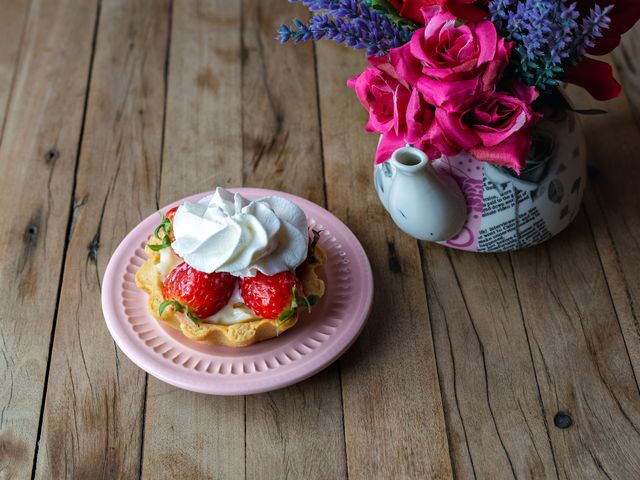
Individual almond flour tarts filled with silky rose-scented custard and topped with fresh lychees, inspired by dim sum pastries. The buttery, nutty crust contrasts beautifully with the delicate floral filling and sweet, perfumed fruit. A showstopper for special occasions that feels indulgent but comes together in about two hours.
- Prep
- 50 min
- Cook
- 35 min
- Wait
- 35 min
- Total
- 2 hr
- Makes
- 6 individual tarts (4-inch / 10 cm diameter)
Steps
Before you start
- Chill the almond crust dough for at least 30 minutes before rolling and lining tart pans
- Peel and halve fresh lychees, removing the pit and any bitter inner kernel
- Have the custard filling ingredients at room temperature so they blend smoothly
- Preheat your oven to 375°F (190°C) about 15 minutes before baking the tart shells
Make the almond crust dough
- In a large bowl, whisk together almond flour (150 g), all-purpose flour (90 g), sugar (25 g), and salt (1.5 g).
- Add the cold butter cubes (75 g) and use your fingertips to rub the mixture together until it resembles coarse breadcrumbs with small pea-sized pieces of butter still visible—do not overmix.
- In a small bowl, whisk the egg yolk (1) with vanilla extract (2.5 ml).
- Pour into the flour mixture and stir gently with a fork until the dough just comes together in a shaggy mass.
- Do not knead.
- Form into a disk, wrap in plastic wrap, and refrigerate for at least 30 minutes.
+ Show details− Hide details
Ready when: Dough is cold and holds together when pressed
Tip: Keep the butter and egg yolk as cold as possible; warm dough will tear when rolled
Line the tart pansOven 375°F / 190°C
- Preheat your oven to 375°F (190°C).
- On a lightly floured surface, divide the chilled dough into 6 equal pieces.
- Roll each piece between two sheets of parchment paper into a thin round about 5.5 inches (14 cm) in diameter, roughly ⅛ inch (3 mm) thick.
- Carefully peel away the top parchment and flip the dough into a 4-inch (10 cm) fluted tart pan with a removable bottom.
- Gently press the dough into the bottom and sides, allowing it to overhang slightly.
- Trim excess dough level with the pan rim using a small paring knife.
- Prick the bottom gently with a fork.
- Repeat with the remaining dough and pans.
- Arrange on a baking sheet.
+ Show details− Hide details
Ready when: All six tart shells are lined and trimmed evenly
Tip: Rolling between parchment prevents sticking; keep dough cool by returning to the fridge if it becomes warm or sticky
Blind bake the tart shellsOven 375°F / 190°C
- Line each tart shell with a small square of parchment paper and fill with ceramic pie weights or dried beans, pressing gently so weights sit flat on the bottom.
- Bake at 375°F (190°C) for 12 to 14 minutes until the edges are light golden but the bottom is still pale.
- Remove the weights and parchment carefully.
- Return to the oven for 2 to 3 minutes more until the bottoms are set and very lightly colored.
- Remove from the oven and let cool slightly on the baking sheet while you prepare the custard filling.
- Reduce the oven temperature to 350°F (175°C).
+ Show details− Hide details
Ready when: Edges are light golden; bottoms are dry to the touch and set
Tip: Do not skip blind baking—it prevents a soggy crust when filled with custard
Cream butter and sugar for custard
- In a medium bowl or the bowl of an electric mixer, beat the soft butter (60 g) and sugar (65 g) together on medium speed for 2 to 3 minutes until pale, fluffy, and nearly white.
- Scrape down the bowl once halfway through.
- The mixture should look like whipped frosting and feel light on your tongue when tasted.
+ Show details− Hide details
Ready when: Mixture is pale, fluffy, and pale cream colored
Tip: Starting with room-temperature butter ensures a smooth, emulsified base for the custard
Incorporate eggs and cornstarch
- Add the room-temperature eggs (2 large) one at a time, beating on medium speed for about 30 seconds after each addition until fully incorporated and the mixture is smooth.
- Scrape down the bowl between additions.
- In a small bowl, whisk together cornstarch (15 g) and milk (180 ml) until smooth and no lumps remain.
- Add the cornstarch mixture to the butter mixture and beat on medium speed for 1 minute until well combined and emulsified.
- Stir in rose water (5 ml) and vanilla extract (1.25 ml) by hand until evenly distributed.
+ Show details− Hide details
Ready when: Custard base is smooth, pale, and creamy with no streaks
Tip: Add eggs slowly to prevent curdling; if the mixture looks broken, increase mixer speed slightly and beat for 30 seconds longer
Fill the tart shells
- Divide the custard filling evenly among the 6 partially baked tart shells, pouring about 3 to 4 tablespoons (45 to 60 ml) into each, filling them almost to the rim.
- The filling should come about ¾ inch (2 cm) from the very top to allow room for setting without overflowing.
- Use a small spoon to distribute it evenly if needed.
- Arrange the filled tart pans back on the baking sheet.
+ Show details− Hide details
Ready when: Each tart is evenly filled with custard about three-quarters full
Tip: Fill carefully to avoid splashing; if you spill custard on the rim, wipe it clean with a damp cloth so it does not brown and mar the finished tart
Bake the custard tartsOven 350°F / 175°C
- Bake the filled tarts at 350°F (175°C) for 18 to 22 minutes until the custard is set at the edges but still has a slight jiggle in the very center when you gently shake a tart—about ¼ inch (6 mm) of jiggle is ideal.
- The center should not be wavy, and the crust edges should be golden brown.
- Do not overbake or the custard will be dry and rubbery.
- Remove from the oven and let cool on the baking sheet for 5 minutes, then transfer each tart to a wire rack to cool completely, about 20 minutes.
+ Show details− Hide details
Ready when: Custard is set at edges with slight jiggle in the center; crust is golden brown
Tip: Use the jiggle test rather than a toothpick—the custard will continue to set as it cools and will firm up perfectly at room temperature
Prepare the glaze
- In a small bowl, whisk together honey (30 ml) and rose water (1.25 ml, optional).
- If the mixture is very thick, warm it gently over low heat or stir in ½ teaspoon (2.5 ml) of warm water to thin it to a pourable glaze consistency.
- It should coat the back of a spoon but still drip slowly.
+ Show details− Hide details
Ready when: Glaze is smooth and pourable but coats the back of a spoon
Tip: Make the glaze just before topping so it is warm enough to brush smoothly over the fruit
Top the tarts with lychees and glaze
- Once the tarts have cooled to room temperature, arrange 3 lychee halves (18 total for 6 tarts) on top of each custard, placing them in a triangle or cluster.
- Gently brush the warm honey-rose glaze over the lychees and the exposed custard filling using a pastry brush or clean small brush.
- Sprinkle the chopped pistachios (15 g, optional) over the top for color and a hint of nuttiness.
- Let the glaze set for 2 to 3 minutes at room temperature before serving.
+ Show details− Hide details
Ready when: Lychees are shiny with glaze; pistachios are evenly scattered
Tip: Arrange the lychees just before serving if you prefer them very fresh and jewel-like; if the tarts sit more than 30 minutes after glazing, the lychees may weep liquid onto the custard
Remove from pans and serve
- Once cooled, press the bottom of each tart pan gently upward to release the tart (the removable bottom will slide out).
- Or, if preferred, serve the tarts directly in the pans.
- Arrange on a serving platter or individual plates.
- Serve at room temperature.
- The custard should be creamy and set, the crust should be crisp and nutty, and the lychees should be cool and refreshing against the warm flavors of rose and almond.
+ Show details− Hide details
Ready when: Tarts release cleanly from pans and are ready to serve
Tip: If the pans are difficult to remove, let the tarts rest at room temperature for another 5 minutes to allow the butter to relax slightly
Good to know
Tips
- Rose water is potent—start with a little and taste as you go; too much will make the custard soapy and unpalatable
- For the most authentic dim sum aesthetic, trim the excess dough flush with the rim of each pan so the finished tart has neat, even edges that showcase the golden crust
- If using frozen or canned lychees (peeled, pitted, and drained), pat them dry gently before arranging on the tarts so excess moisture does not pool on the custard
- The almond crust is best served the same day it is baked, as it softens upon standing; make ahead only through the blind-baking stage
Make ahead
You can prepare the almond crust dough up to 1 day ahead; wrap it tightly in plastic wrap and refrigerate. The blind-baked tart shells can be made up to 8 hours ahead, cooled, and stored in an airtight container at room temperature. Assemble and fill the tarts no more than 3 to 4 hours before serving so the custard stays creamy and the lychees remain fresh and juicy.
Storage & reheating
Store cooled, finished tarts loosely covered with plastic wrap or under a cake dome at room temperature for up to 1 day. Do not refrigerate, as the custard may become dense and the crust will soften. Wrapped tarts can be frozen (without the lychee topping) for up to 2 weeks; thaw at room temperature for 30 minutes before serving, then top with fresh lychees and glaze. Do not attempt to reheat these tarts in the oven, as the custard will separate.
Substitutions
- fresh lychees, peeled and halved → fresh raspberries, blackberries, or red currants. Use 3 to 4 berries per tart instead of lychees. These offer a tart contrast to the sweet custard but lack the delicate floral perfume.
- rose water → 1 teaspoon (5 ml) of fresh lemon zest plus 0.5 teaspoon (2.5 ml) of almond extract. Replace both rose water additions (in the custard and glaze) with this combination for a brighter, earthier flavor profile. Omit the optional rose water in the glaze if using this substitution.
- cornstarch → 1 tablespoon (10 g) of tapioca starch. Tapioca will create a slightly more silken, glossy custard with less starchy taste, though the texture will be subtly less thick.
- almond flour (finely ground) → finely ground pistachios or a 50/50 blend of almond and hazelnut flour. This will deepen the nuttiness and complement the rose flavor beautifully, though the crust may be slightly softer and more delicate to handle.