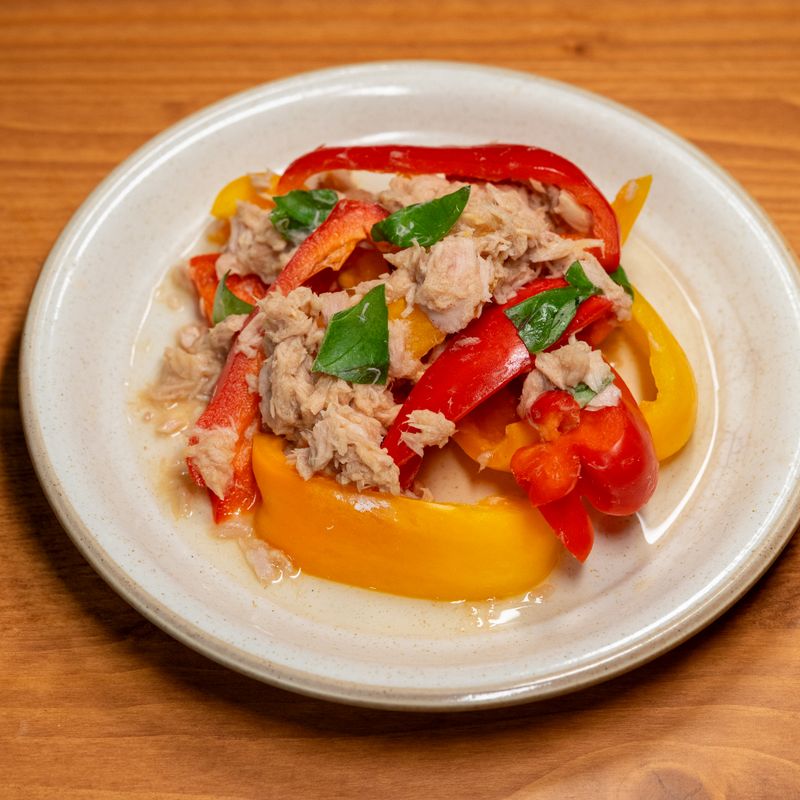
Spanish Empanada Gallega with Tuna and Pepper
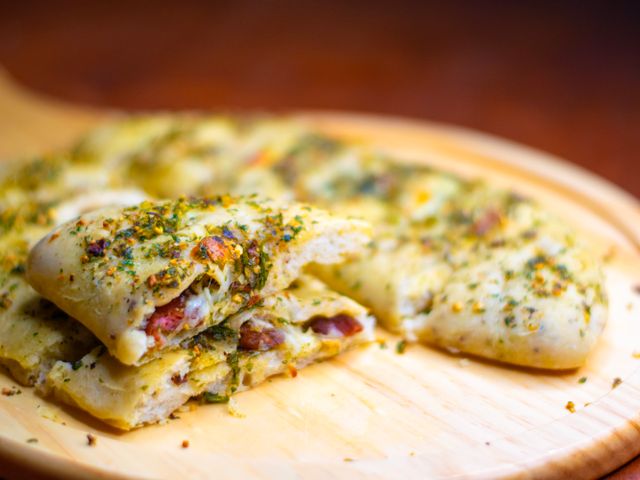
A traditional Galician hand pie with a soft, slightly sweet yeast dough wrapped around a savory filling of flaked tuna, roasted peppers, onions, and garlic. The empanada is baked until golden with a tender, pillowy crust—perfect as a tapa, appetizer, or light lunch. Sliced into wedges and served warm or at room temperature, this is a beloved Spanish classic.
- Prep
- 25 min
- Cook
- 45 min
- Wait
- 1 hr 30 min
- Total
- 2 hr 40 min
- Makes
- 1 empanada (6 to 8 wedges)
Steps
Before you start
- Preheat your oven to 400°F (200°C) about 15 minutes before baking.
- Have all dough and filling ingredients measured and ready.
- If using canned tuna packed in oil, drain it well before measuring.
- Bring milk to room temperature for better dough development.
Mix the dough
- In a large mixing bowl, combine bread flour, instant yeast, salt, and sugar.
- Make a well in the center and add olive oil, warm milk, and warm water.
- Stir with a wooden spoon until a shaggy dough forms, about 2 minutes.
- Switch to kneading by hand (or use a stand mixer with a dough hook on medium speed) for 8 to 10 minutes until the dough is smooth, elastic, and slightly tacky but not sticky.
- It should pull away from the sides of the bowl.
+ Show details− Hide details
Ready when: Dough is smooth, elastic, and slightly tacky, pulling away from the bowl sides
Tip: Water temperature is critical—too hot kills yeast, too cold slows rising. Use a thermometer if unsure.
First rise
- Transfer the dough to a lightly oiled bowl, turning it to coat all sides.
- Cover with a clean kitchen towel or plastic wrap.
- Let it rise at room temperature (68–72°F / 20–22°C) for 45 to 50 minutes, until increased in volume by about one-third (the dough should be puffy but not doubled—this keeps the crust tender).
+ Show details− Hide details
Ready when: Dough is puffy and visibly larger, with small bubbles visible under the surface
Tip: Empanada dough should rise less than sandwich bread for a tender, delicate crust; don't let it double.
Prepare the filling
- While the dough rises, heat olive oil in a 10 to 12-inch skillet over medium heat.
- Add the sliced onion and cook, stirring often, for 5 to 6 minutes until softened and very lightly golden.
- Add minced garlic and paprika, stirring for about 30 seconds until fragrant.
- Add the flaked tuna and roasted pepper strips, folding gently to combine.
- Season with salt and pepper to taste.
- Cook for another 2 to 3 minutes, stirring occasionally, until heated through.
- Taste and adjust seasoning.
- Transfer to a bowl and let cool to room temperature, about 10 minutes.
+ Show details− Hide details
Ready when: Onion is soft and pale gold, filling is hot and well combined
Tip: Cool the filling completely so it doesn't warm the dough or create steam that makes the crust soggy.
Shape the empanada
- Turn the risen dough onto a lightly floured work surface.
- Divide it in half.
- Working with one half at a time, gently shape and stretch it into an 11-inch (28 cm) round (or a 9×13-inch / 23×33 cm rectangle), about ¼ inch (6 mm) thick.
- Place the first round on a baking sheet lined with parchment paper.
- Spread the cooled filling evenly over it, leaving a ½-inch (1.25 cm) border all around.
+ Show details− Hide details
Ready when: Dough is shaped evenly and filling is spread in a thin, even layer
Tip: If dough springs back and resists stretching, let it rest for 3 to 5 minutes, then continue—it needs time to relax.
Seal the empanada
- Place the second dough round on top of the filling.
- Press the edges together firmly, then crimp or flute the border with your fingers or a fork to seal (this keeps the filling inside during baking).
- Trim any excess dough to make the edge neat.
+ Show details− Hide details
Ready when: Edges are firmly sealed and crimped all around
Tip: A tight seal prevents leaking during baking; press harder than feels necessary at the edges.
Apply egg wash and season
- Brush the entire top surface of the empanada generously with beaten egg.
- Sprinkle coarse sea salt over the top if desired (this adds a traditional finish and subtle texture).
- Let the empanada rest on the baking sheet for 10 to 15 minutes at room temperature.
+ Show details− Hide details
Ready when: Egg wash is evenly applied and coarse salt is visible on top
Tip: The rest time before baking helps prevent the edges from shrinking and reopening during baking.
Score and final prep
- Using a sharp knife, score the top of the empanada with shallow diagonal lines (about ⅛ inch / 3 mm deep), creating a crosshatch or parallel-line pattern.
- This allows steam to escape gradually and signals where to slice for serving.
- It also looks decorative.
+ Show details− Hide details
Ready when: Surface is evenly scored with visible lines
Tip: Score just the top layer—don't cut all the way through to the filling.
Bake until goldenOven 400°F / 205°C
- Preheat oven to 400°F (200°C).
- Place the baking sheet in the preheated oven on the middle rack.
- Bake for 25 to 30 minutes, rotating the baking sheet halfway through (at about 15 minutes) for even browning.
- The top should be deep golden brown with a slight sheen from the egg wash, and the edges should be dry to the touch.
+ Show details− Hide details
Ready when: Top is deep golden brown, crust is firm, and no steam emerges from the score marks when you look closely
Tip: If the top browns too quickly, loosely tent it with foil for the final 10 minutes, but remove it at the end so the crust crisps.
Cool and rest
- Remove the empanada from the oven and let it rest on the baking sheet for 5 to 10 minutes.
- This allows the crust to set and the filling to firm slightly, making it easier to slice cleanly.
- Then transfer it to a cutting board.
+ Show details− Hide details
Ready when: Empanada is warm but no longer steaming, and the crust holds its shape when lifted
Tip: Cutting too soon causes the filling to spill out; this rest is essential for a neat slice.
Slice and serve
- Using a sharp knife (or a serrated bread knife), slice the empanada into 6 to 8 wedges following the score marks.
- Serve warm or at room temperature, with a squeeze of fresh lemon juice if desired, and perhaps a small green salad on the side.
+ Show details− Hide details
Ready when: Slices are clean and filled with evenly distributed tuna and peppers
Tip: A serrated bread knife cuts through the crust without squashing the soft dough.
Good to know
Tips
- Empanada dough should never over-rise (it should increase by only one-third, not double) or the crust will be tough and bread-like rather than tender and pillow-soft.
- Drain canned tuna very well—excess oil makes the filling wet and can cause the crust to soften or become greasy.
- The filling must be completely cooled before assembly, or it will make the dough warm and sticky, leading to a dense, pale crust.
- For an extra-special touch, brush the baked empanada with a little more olive oil immediately after it comes from the oven—it adds shine and keeps the crust tender as it cools.
Make ahead
Assemble the empanada up to 4 hours ahead, cover it tightly with plastic wrap, and refrigerate. Brush with egg wash and bake as directed (add 2 to 3 minutes to baking time if baking from chilled). Alternatively, bake the empanada, cool it completely, wrap it well, and refrigerate for up to 3 days. Reheat, wrapped loosely in foil, at 325°F (160°C) for 12 to 15 minutes until warm throughout.
Storage & reheating
Room temperature (covered, up to 6 hours): Empanada stays tender and moist. Refrigerator (airtight container, up to 3 days): Reheat gently as described above. Freezer (well wrapped in plastic wrap and foil, up to 2 months): Thaw in the refrigerator overnight, then reheat at 325°F (160°C) for 15 to 20 minutes. Do not freeze after baking from an unbaked state, as the crust may become tough.
Substitutions
- canned tuna in olive oil → Canned or fresh flaked white fish (cod, haddock, or halibut). Use the same weight. Fresh fish should be poached or steamed first, then flaked. Canned white fish works beautifully and is more economical.
- roasted red peppers → Roasted green peppers, or a mix of roasted red and green peppers. The flavor will be slightly different but equally authentic. Green peppers have a slightly vegetal, less sweet taste.
- bread flour → All-purpose flour (use 5% less by weight, about 355 g or 2¾ cups). Bread flour creates a slightly chewier crust; all-purpose will be more tender and soft. Both are acceptable in traditional empanada.
- sweet smoked paprika → Spanish saffron (a pinch, about ¼ tsp) steeped in a little warm water, or omit entirely. Saffron is more luxurious and traditional in some Galician kitchens; omitting paprika leaves a cleaner tuna flavor.
More flatbreads
See all →


Find more like this
- Meal
- Lunch
- Cuisine
- Spanish
- Main ingredient
- Canned Tuna
- Diet
- Halal
- Method
- Oven