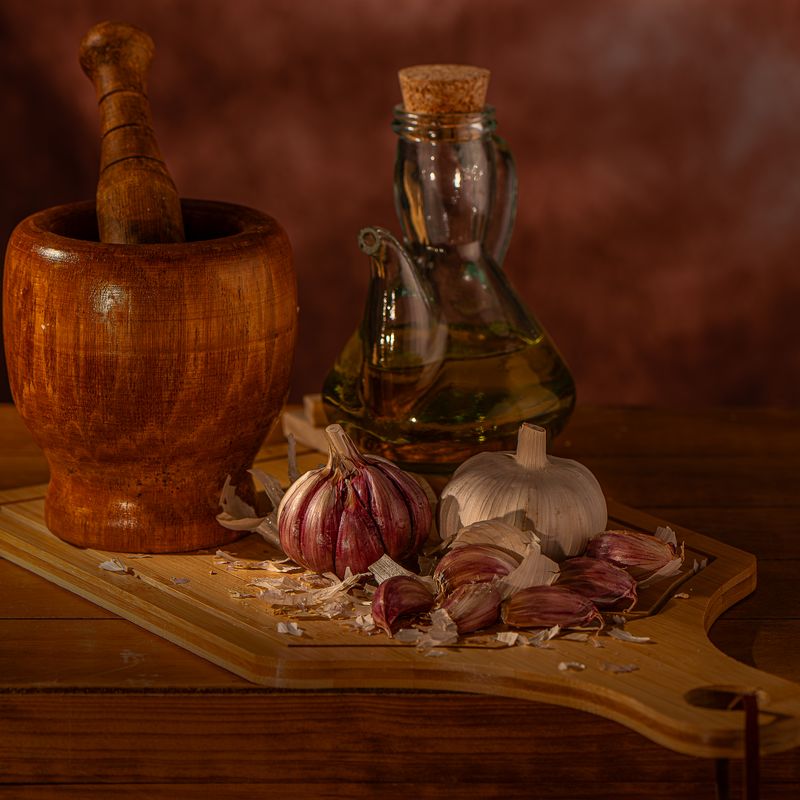
Spanish Ajada Saffron Garlic Oil
A silky, fragrant Spanish garlic oil infused with saffron threads, paprika, and just a whisper of heat. Ajada is a classic drizzle for soups, seafood, roasted vegetables, and bread—the garlic mellows into sweet, golden richness while saffron adds sophistication. Ready in minutes, it transforms simple dishes into something special.
Steps
Before you start
- Warm ¼ cup water (60 ml) in a small bowl—not hot, just warm to the touch
- Measure all ingredients before starting; the cooking happens quickly
- Have a fine-mesh strainer ready near your stove
Bloom the saffron
- Place the saffron threads in the warm bowl of water and let them steep for 5 minutes.
- The water will turn golden and the threads will soften and release their flavor and color.
+ Show details− Hide details
Ready when: Water is deep golden and threads are fully softened
Tip: Using warm (not boiling) water preserves saffron's delicate floral notes and prevents bitterness.
Prepare the garlic
- While the saffron blooms, thinly slice the 8 garlic cloves lengthwise into uniform slices about ⅛ inch (3 mm) thick.
- Thinner slices cook more evenly and turn golden faster.
+ Show details− Hide details
Tip: Use a sharp knife and slice on a stable cutting board. Uniform thickness ensures the garlic cooks evenly—no burnt edges and pale centers.
Combine oil and garlic
- Pour the 180 ml (¾ cup) olive oil into a small saucepan over medium heat.
- Once the oil is warm and shimmers (about 1 minute), add all the sliced garlic.
- Stir often with a spoon.
+ Show details− Hide details
Ready when: Oil shimmers and garlic begins to sizzle gently
Tip: Don't let the oil smoke or the garlic will burn. Medium heat is key; the garlic should sizzle quietly, not pop.
Toast the garlic slowly
- Continue cooking over medium heat for 4–5 minutes, stirring every 30 seconds.
- The garlic will gradually turn pale golden, then darker golden.
- You want a light honey color throughout, fragrant and sweet.
+ Show details− Hide details
Ready when: Garlic is uniformly light to medium golden, fragrant and slightly crispy at the edges; no dark brown or burnt bits
Tip: Stir constantly toward the end to prevent the garlic on the bottom from burning. If you see dark specks, the oil is too hot—lower the heat slightly.
Add spices
- Remove the saucepan from the heat.
- Add the ½ teaspoon (1.5 g) paprika, ¼ teaspoon (1.5 g) salt, and the whole dried chili pepper if using.
- Stir well for about 30 seconds until the paprika is evenly distributed.
+ Show details− Hide details
Ready when: Paprika is fully incorporated and no streaks remain
Tip: Remove from heat before adding paprika to avoid burning it—paprika scorches easily and becomes bitter.
Pour in saffron water
- Pour the golden saffron water (including any loose threads) slowly into the oil while stirring gently.
- The oil will bubble and hiss slightly.
- Stir until everything is combined, about 1 minute.
+ Show details− Hide details
Ready when: Oil is evenly golden, with visible saffron threads and garlic suspended throughout
Tip: Add the saffron water slowly to prevent splashing. The water will briefly cloud the oil, but it will settle and clarify as it cools.
Strain (optional) and cool
- If you prefer a smooth oil without visible garlic pieces, carefully pour the ajada through a fine-mesh strainer into a clean glass jar, pressing gently on the solids.
- If you like texture and visible garlic, simply transfer the whole mixture to your jar.
- Let it cool to room temperature, about 10 minutes, then cover.
+ Show details− Hide details
Ready when: Oil is clear, fragrant, and at room temperature
Tip: Straining is personal preference—the oil is delicious either way. If you leave the solids in, they'll settle to the bottom and can be redispersed with a shake.
Good to know
Tips
- Use this oil to finish soups (especially seafood bisques or chickpea soups), drizzle over roasted vegetables, or swirl into creamy dips. A small spoonful goes a long way.
- The flavor deepens and mellows over the first few hours as it cools—don't judge it while it's still hot.
- For a silkier texture, use very fresh garlic; older, dried-out cloves can turn bitter and won't soften as nicely.
- If you accidentally burn the garlic, start over—there's no salvaging burnt garlic oil, and it will taste acrid. Low and slow is the mantra.
Storage & reheating
Store in a sealed glass jar at room temperature for up to 1 week, or in the refrigerator for up to 3 weeks. The oil may cloud when cold—this is normal and it will clear again at room temperature. To reheat, simply let it sit on the counter for 20 minutes or warm gently in a small saucepan over low heat for 1 minute. Do not freeze, as the oil will separate from the water content.
Substitutions
- sweet smoked paprika → Hot smoked paprika or cayenne pepper. Use the same amount for more heat, or ¼ teaspoon (0.75 g) of cayenne for a sharper kick. Sweet paprika can be replaced with regular sweet paprika if smoked is unavailable.
- saffron threads → Turmeric. Use ⅛ teaspoon (0.25 g) turmeric for color and earthiness, though you'll lose saffron's floral complexity. Stir turmeric into the warm water in step 1 before blooming.
- dried red chili pepper → Pinch of crushed red pepper flakes or a dash of hot sauce. Red pepper flakes (¼ teaspoon / 0.5 g) provide heat without the whole-pepper texture. Omit entirely if you prefer mild.
- extra virgin olive oil → Light or regular olive oil. Extra virgin has the most flavor, but regular olive oil will work and won't be masked by the garlic and saffron. Avoid oils with lower smoke points.
More sauces
See all →


Find more like this
- Cuisine
- Spanish
- Method
- Stovetop
- Quick & Easy
- 30-Minute5 Ingredients or LessEasy