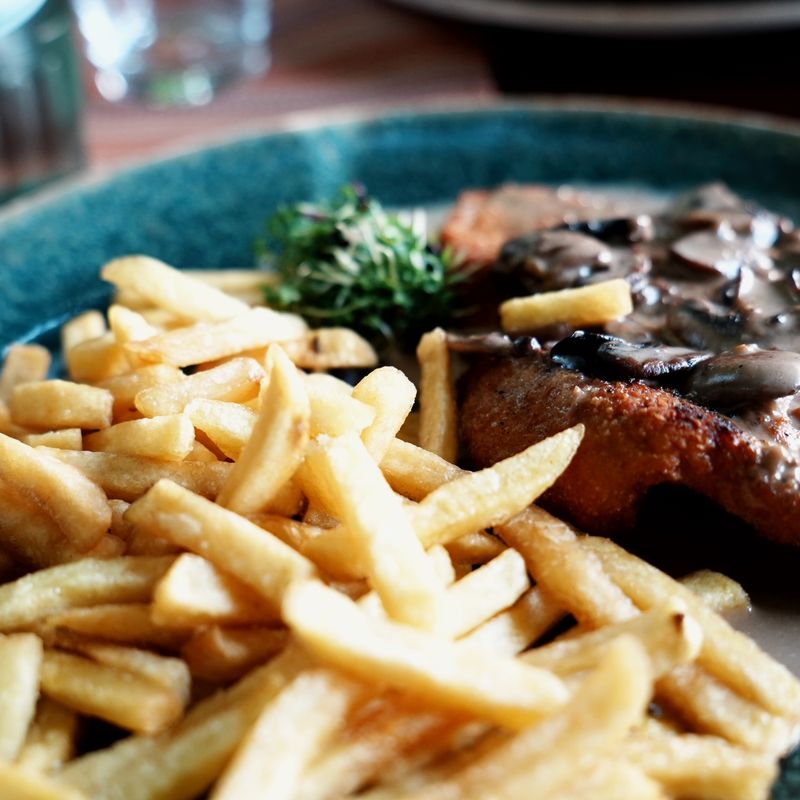
French Espagnole Brown Sauce
Espagnole, one of the five French mother sauces, is a rich, velvety brown sauce built on a dark roux, mirepoix, and beef stock, enriched with tomato paste and simmered until it coats the back of a spoon. This foundational sauce is used as a base for dozens of derivative sauces and meat dishes. The key to excellent Espagnole is patience: a slow simmer allows the flavors to meld and the sauce to achieve its signature silky texture through gradual reduction.
- Prep
- 15 min
- Cook
- 1 hr
- Wait
- 45 min
- Total
- 2 hr
- Makes
- About 2 cups (480 ml)
Steps
Before you start
- Measure all ingredients before starting—you'll be moving quickly once the roux begins.
- Use beef stock that is warm or at room temperature so it incorporates smoothly into the roux.
- Have a fine-mesh strainer ready for the final pass.
Make the dark roux
- Melt the butter in a heavy-bottomed 3-quart saucepan over medium heat.
- Once foaming, add the flour all at once, stirring constantly with a wooden spoon.
- Keep stirring for 8–10 minutes until the roux turns a deep mahogany brown—it should smell nutty and toasted, never burnt.
- Watch carefully; roux can scorch quickly.
- The roux must be this dark color to give Espagnole its characteristic rich brown hue.
+ Show details− Hide details
Ready when: Roux is deep mahogany brown and smells nutty
Tip: Stir constantly to prevent scorching. If the roux smells burnt (acrid, not toasty), start over with fresh butter and flour.
Add the stock gradually
- Remove the pan from heat for 1 minute to let the roux cool slightly.
- Slowly pour in the warm beef stock, whisking constantly to break up any lumps.
- Start with ½ cup (120 ml) and whisk until smooth before adding more.
- Once all the stock is incorporated and the mixture is smooth, return the pan to medium heat and bring to a simmer, stirring occasionally.
+ Show details− Hide details
Ready when: Mixture is smooth and simmering gently
Tip: Adding stock slowly prevents lumps from forming. Cold stock added to hot roux will seize; room-temperature stock incorporates smoothly.
Build the mirepoix base
- Add the onion pieces, carrot pieces, celery pieces, tomato paste, thyme sprigs, bay leaf, and black peppercorns to the simmering stock mixture.
- Stir well to combine and distribute the tomato paste evenly throughout the sauce.
+ Show details− Hide details
Ready when: Vegetables and herbs are submerged and distributed
Tip: The unpeeled onion adds color and depth; don't remove the skin. The large vegetable pieces infuse the sauce and are strained out later.
Simmer and reduce
- Reduce the heat to medium-low and let the sauce simmer gently for 45–50 minutes.
- Skim off any foam or impurities that rise to the surface during the first 10 minutes, using a spoon or ladle.
- The sauce should simmer gently—never a rolling boil.
- After skimming, stir occasionally.
- The sauce will reduce and intensify in flavor, becoming slightly thicker and darker.
+ Show details− Hide details
Ready when: Sauce is noticeably thicker, coats a spoon lightly, and flavors are rich and deep
Tip: A gentle simmer, not a boil, prevents the sauce from becoming cloudy or breaking. Skimming in the early stages produces a clearer, more refined sauce.
Strain the sauce
- Set a fine-mesh strainer over a clean saucepan or bowl.
- Pour the sauce through the strainer, pressing gently on the vegetables and herbs with the back of a spoon to extract all liquid and flavor.
- Discard the solids.
- The strained sauce should be smooth, glossy, and deep brown.
+ Show details− Hide details
Ready when: Sauce is smooth and free of particles
Tip: Don't force the vegetables through the strainer; gentle pressure extracts maximum flavor without clouding the sauce.
Season and finish
- Taste the strained sauce and adjust seasoning with kosher salt as needed.
- The sauce should taste rich, savory, and well-balanced.
- If it seems thin, return it to the stovetop over medium-low heat and simmer for another 5–10 minutes to reduce further.
- The finished Espagnole should coat the back of a spoon lightly and have a silky, velvety texture.
+ Show details− Hide details
Ready when: Sauce coats the back of a spoon and tastes well-seasoned and savory
Tip: Season carefully at the end; it's easier to add salt than remove it. Remember that if you're using this sauce as a base for other dishes, you may not need full saltiness here.
Good to know
Tips
- Espagnole is a mother sauce that forms the foundation for dozens of derivative sauces like Madeira, Périgueux, and Poivrade. It is also the base for demi-glace when reduced further and combined with additional stock.
- The quality of your beef stock makes a huge difference. Homemade stock will produce a more flavorful, silky sauce than store-bought, though good-quality store-bought works well too.
- Unpeeled vegetables add color and depth to the sauce. Don't peel the onion or carrot; their skins contribute to the rich brown hue and flavor.
- A true Espagnole should have a silky, velvety mouthfeel, which comes from proper emulsification during the roux stage and gentle simmering. Never let it boil aggressively.
Make ahead
This sauce is best made ahead. It keeps for up to 4 days in the refrigerator and freezes beautifully for up to 2 months, so feel free to prepare it in larger batches and store for use in other dishes.
Storage & reheating
Refrigerator: Cover and store in an airtight container for up to 4 days. Freezer: Freeze in ice cube trays for easy portioning, then transfer cubes to a freezer bag for up to 2 months. Reheating: Thaw in the refrigerator and warm gently over low heat on the stovetop, stirring occasionally, or reheat in a microwave in 30-second intervals, stirring between each.
Substitutions
- beef stock, unsalted or lightly salted → chicken stock or vegetable stock. The sauce will be lighter in color and flavor. Chicken stock produces a lighter brown sauce suitable for lighter meat dishes; vegetable stock makes a vegetarian version.
- unsalted butter → neutral oil such as canola or vegetable oil (use 2 tablespoons / 30 ml). Use oil to make a dairy-free or vegan version. The flavor will be slightly less rich, but the technique remains the same.
- fresh thyme sprigs → 1 teaspoon dried thyme or oregano. Dried herbs are more concentrated; use half the amount. Fresh herbs produce a cleaner flavor, but dried work if that's what you have on hand.
- tomato paste → 2 tablespoons of tomato purée or 1 tablespoon of double-concentrate tomato paste. Tomato paste adds acidity and umami; if omitted, the sauce will be less complex but still functional as a brown sauce.
More sauces
See all →



Find more like this
- Meal
- Dinner
- Cuisine
- French
- Diet
- HalalSugar-Free
- Method
- Stovetop