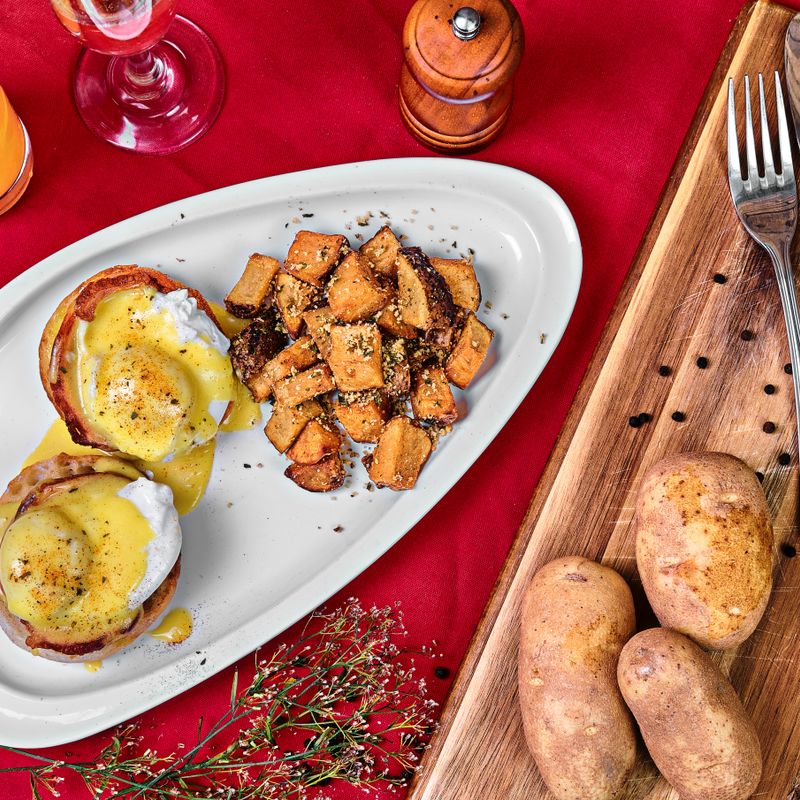
Easy Blender Hollandaise Sauce
A silky, lemony, buttery hollandaise made in a blender in about 10 minutes. Hot melted butter streams into egg yolks for a stable, foolproof emulsion with no double boiler and no constant whisking.
- Prep
- 8 min
- Cook
- 4 min
- Total
- 12 min
- Makes
- About ¾ cup (180 ml) sauce, enough for 4 servings
Steps
Before you start
- Separate the eggs and measure everything before you start. The butter must be poured while it is still hot, so there is no time to measure mid-recipe.
- Use pasteurized eggs if serving to young children, pregnant people, older adults or anyone with a weakened immune system. The hot butter only gently warms the yolks.
- Fill a mug or small bowl with hot tap water to warm for holding the sauce, and pour it out before serving.
- Use a blender with a removable center cap in the lid, or a small blender jar. Large jars work but a narrow one blends 3 yolks better.
Prepare the blender
- Place the 3 egg yolks, 4 teaspoons lemon juice, ¼ teaspoon salt and ⅛ teaspoon cayenne in the blender jar.
- Fit the lid with the center cap removed or loosened so you can pour through it.
- Pour the hot water out of your warming mug if you filled one.
+ Show details− Hide details
Ready when: Everything is in the jar and the lid is ready.
Tip: Yolks at room temperature emulsify more easily. If cold, set them in a bowl of warm tap water for 5 minutes.
Melt the butter hot
- Put the 12 butter pieces in a small saucepan over medium heat, stirring occasionally.
- Heat until completely melted and bubbling or foaming at the edges, about 3 to 4 minutes.
- Remove from the heat.
- The butter should be very hot, around 180–200°F (82–93°C).
+ Show details− Hide details
Ready when: Butter is fully liquid and foaming, with milk solids just starting to separate. Do not let it brown.
Tip: Hot butter is what thickens the yolks. Lukewarm butter gives a thin, runny sauce.
Whip the yolk base
- Blend the yolk mixture on medium-high speed for about 10 seconds, until it looks pale yellow and slightly frothy.
+ Show details− Hide details
Ready when: Yolk mixture is pale yellow, slightly frothy and smooth.
Stream in the butter
- With the blender running on medium speed, slowly pour the hot butter through the lid opening in a thin, steady stream, taking about 30 to 45 seconds.
- Begin with a trickle for the first few tablespoons, then pour a little faster.
- Leave behind the milky white solids at the bottom of the pan if you want a clearer sauce.
+ Show details− Hide details
Ready when: The sauce thickens and the blender sound changes to a deeper hum. The final sauce is thick, glossy and pale yellow, and coats a spoon.
Tip: Pouring all the butter at once can break the emulsion. Go slowly at the start.
Taste and adjust
- Stop the blender and taste the sauce.
- Add a pinch more salt, a few more drops of lemon juice or a little more cayenne if needed.
- If the sauce is thicker than heavy cream, add 1 tablespoon hot water and blend for 5 seconds.
- Add the water only if needed.
+ Show details− Hide details
Ready when: Sauce is smooth, pourable but thick, and tastes bright and buttery.
Tip: If the sauce looks split or greasy, blend in 1 tablespoon hot water on low speed; this usually brings it back.
Serve right away
- Pour the sauce into the warmed mug or a small warm bowl and serve immediately over poached eggs, asparagus, fish or steamed vegetables.
- To hold it, keep it in a warm (not hot) spot, such as a thermos or a bowl set over warm water, stirring occasionally, for up to 1 hour.
+ Show details− Hide details
Ready when: Sauce is warm and pourable, not hot enough to steam heavily.
Tip: Too much heat will scramble the yolks or break the sauce, so hold it gently.
Good to know
Tips
- Pour the butter very hot and very slowly at first. These two things matter most for a stable emulsion.
- If the sauce is too thick, blend in hot water 1 teaspoon at a time. If too thin, blend in 1 more yolk plus the sauce, or re-blend a fresh yolk and slowly add the broken sauce.
- Make the sauce in a narrow jar so the blades reach the yolks; in a wide jar, double the recipe.
- Add a teaspoon of chopped tarragon or chives after blending for a bearnaise-style variation.
Make ahead
"Hollandaise is best made fresh, but it can be held warm in a thermos or a bowl over warm water for up to 1 hour. Stir occasionally."
Storage & reheating
"Room temperature: no more than 1 hour, kept warm. Fridge: airtight up to 2 days, though the texture will be firm and may separate. Freezer: not recommended. To reheat, whisk in 1 tablespoon warm water in a bowl set over warm (not simmering) water, or microwave in 5-second bursts at 30% power, stirring between each, until just warm and smooth."
Substitutions
- fresh lemon juice → White wine vinegar or white wine vinegar mixed with lemon. Use 1 tablespoon white wine vinegar for a sharper, more classic tang.
- cayenne pepper → Pinch of white pepper or a few dashes of hot sauce. Gives gentle heat without visible flecks (white pepper) or a vinegary kick (hot sauce).
- unsalted butter → Ghee, melted. Ghee gives a nutty flavor and is already clarified, so the sauce is slightly thinner. Add salt to taste.
- fine salt → Salted butter in place of unsalted butter. If using salted butter, omit the added salt and season at the end.