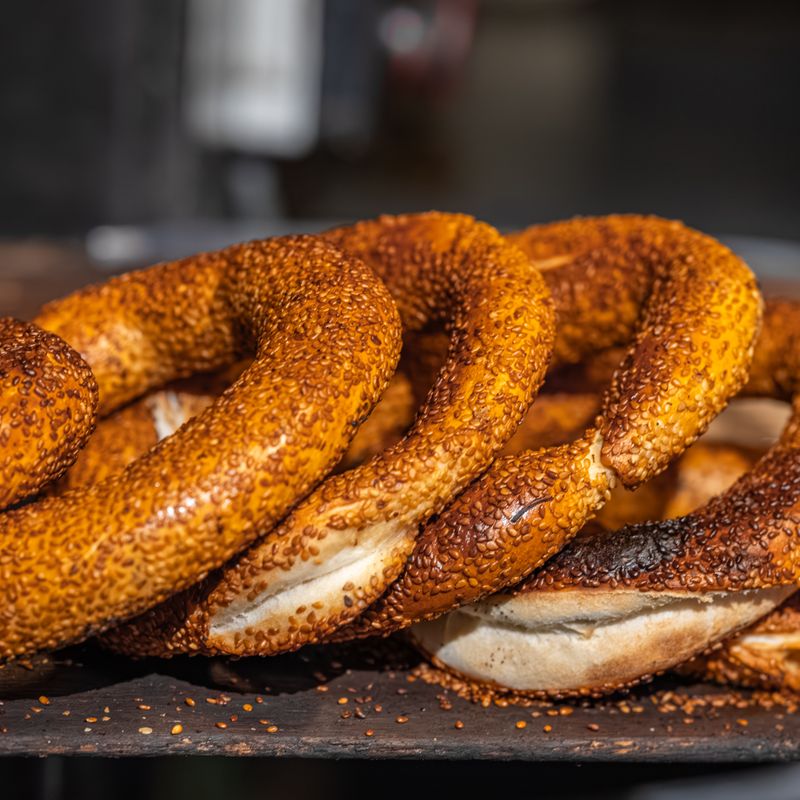
Sourdough Turkish Black Cumin and Roasted Sesame Breadstick Twists
Crispy, golden breadstick twists made with active sourdough starter and studded with nigella (black cumin) seeds and nutty roasted sesame. A tangy, satisfying accompaniment to soups, dips, or cheese boards, inspired by Turkish and Middle Eastern baking traditions. The dough ferments overnight for complex flavor, then each stick is hand-twisted, brushed with olive oil, and topped before baking until deeply golden and crunchy.
- Prep
- 30 min
- Cook
- 22 min
- Wait
- 9 hr 30 min
- Total
- 10 hr 22 min
- Makes
- 16 breadstick twists
Steps
Before you start
- Sourdough starter should be fed and bubbly (active with visible bubbles), not cold from the fridge.
- Use an instant-read thermometer to verify final dough temperature is 75–78°F (24–26°C).
- Line two baking sheets with parchment paper before shaping.
- Preheat the oven to 425°F (220°C) about 15 minutes before baking.
Mix and autolyse dough
- In a large bowl, combine sourdough starter, water, and all-purpose flour.
- Stir with a wooden spoon or wet hand until there are no dry flour streaks and the mixture is shaggy and cohesive (about 2 minutes).
- Cover the bowl loosely with a damp towel or plastic wrap.
- Let rest at room temperature for 30 minutes.
- This autolyse step allows the flour to fully hydrate and makes the dough easier to work with.
+ Show details− Hide details
Ready when: Dough is shaggy and no dry flour remains
Tip: Use room-temperature water; cold water will extend fermentation unpredictably.
Add salt and knead
- Sprinkle sea salt and nigella seeds over the dough.
- Using wet hands or a bench scraper, fold the dough over itself repeatedly (inward from all four sides) for about 8 minutes, incorporating salt and seeds evenly.
- The dough will transition from sticky to smoother and slightly elastic.
- It should still feel soft and a little tacky, not a tight ball.
+ Show details− Hide details
Ready when: Dough is smooth, elastic, and slightly tacky; salt and seeds are evenly distributed
Tip: Wet your hands rather than adding more flour—this prevents a dry, crumbly dough.
Bulk ferment overnight
- Cover the bowl and let the dough rise at room temperature (68–72°F / 20–22°C) for 12–14 hours.
- The dough should increase in volume by about 50–75% and show visible bubbles on the surface and sides.
- It will smell noticeably tangy and fermented.
- If your kitchen is warmer (75°F / 24°C or above), reduce fermentation to 10–12 hours to prevent overproofing.
+ Show details− Hide details
Ready when: Dough has increased 50–75% in volume, with visible bubbles and strong sourdough aroma
Tip: Cooler fermentation yields more sour flavor and better digestibility. If overnight fermentation isn't convenient, you can refrigerate the dough after 4 hours at room temperature, then finish fermentation in the fridge for 8–16 hours.
Toast sesame seeds
- About 20 minutes before you plan to shape the dough, spread raw sesame seeds in a dry skillet over medium heat.
- Stir frequently for 3–4 minutes until they are golden, fragrant, and beginning to pop.
- Immediately transfer to a small plate to cool.
- Watch closely—sesame burns quickly.
+ Show details− Hide details
Ready when: Sesame seeds are golden, fragrant, and some are popping; no brown or dark seeds
Tip: Toast sesame shortly before use to retain maximum aroma and crunch.
Preheat oven and prepare workspaceOven 425°F / 220°C
- Preheat your oven to 425°F (220°C).
- Line two large rimmed baking sheets with parchment paper.
- Lightly dust a clean counter or work surface with flour.
- Have a small brush ready for applying olive oil.
+ Show details− Hide details
Ready when: Oven reaches 425°F (220°C)
Tip: Preheat at least 15 minutes ahead so the oven is fully stable when you load the breadsticks.
Shape breadsticks
- Turn the fermented dough onto a lightly floured counter.
- Using a bench scraper, divide it into 16 roughly equal portions (each around 1.3 oz / 37 g).
- Take one piece and, with your hands, gently roll and stretch it into a rope about 8 inches (20 cm) long.
- Lay it on a prepared baking sheet.
- Pick up both ends and give the rope a gentle twist (1–2 full rotations), then press the ends onto the sheet so it doesn't unwind.
- Repeat with remaining dough pieces, arranging them about 1.5 inches (4 cm) apart.
+ Show details− Hide details
Ready when: All 16 breadsticks are twisted and arranged on baking sheets
Tip: Don't over-stretch the dough—gentle handling preserves the bubbles and produces a lighter crumb. If the dough springs back, let it rest 2 minutes and gently stretch again.
Proof shaped breadsticks
- Cover the baking sheets loosely with damp towels or plastic wrap.
- Let rest at room temperature for 45–60 minutes.
- The breadsticks should increase visibly in volume (but don't need to double—they'll rise more in the oven).
- You'll see small bubbles forming under the surface.
+ Show details− Hide details
Ready when: Breadsticks have visibly puffed and feel light; they indent gently when poked
Tip: If your kitchen is cool (below 70°F / 21°C), proofing may take up to 75 minutes. If it's very warm (above 76°F / 24°C), watch carefully after 40 minutes—overproofing causes a flat, dense result.
Brush and top breadsticks
- Uncover the breadsticks.
- Using a small brush, lightly coat each one with extra-virgin olive oil (about 1 teaspoon / 5 ml per breadstick, distributed across both sides).
- Sprinkle the toasted sesame seeds over the oil, pressing them gently so they adhere.
- Finish with a small pinch of coarse sea salt on each stick, if desired.
+ Show details− Hide details
Ready when: All breadsticks are evenly coated with oil and topped with sesame and salt
Tip: Oil applied to dough that's not completely dry can cause breadsticks to stick together; work quickly and gently.
Bake breadsticksOven 425°F / 220°C
- Transfer the baking sheets to the preheated 425°F (220°C) oven, placing one on the middle rack and one on the upper-middle rack.
- Bake for 22–26 minutes, rotating sheets top-to-bottom and front-to-back halfway through (around 11–13 minutes).
- The breadsticks are done when deeply golden brown on the exterior, crispy on the outside, and cooked through (a peek at the cross-section should show no raw dough).
- The sesame seeds and nigella should be darker and fragrant.
+ Show details− Hide details
Ready when: Breadsticks are deep golden brown, crispy on the outside, and internal texture is cooked (no raw dough)
Tip: Rotating the sheets ensures even browning. If the sesame begins to darken too much before the dough is fully baked, lower the oven temperature to 400°F (204°C) and extend baking by a few minutes.
Cool and serve
- Transfer breadsticks to a wire cooling rack.
- They will crisp further as they cool (about 15–20 minutes).
- Once cooled, they can be served warm or at room temperature.
- They are best eaten the same day but will remain crispy for up to 2 days in an airtight container.
+ Show details− Hide details
Ready when: Breadsticks are cool to the touch and feel very crispy
Tip: Cooling on a rack allows steam to escape, keeping them crunchy. Stacking them on a plate while warm traps moisture and softens them.
Good to know
Tips
- Sourdough fermentation is temperature-sensitive. At 70°F (21°C), expect 12–14 hours; at 75°F (24°C), 10–12 hours. Plan your timeline accordingly, or use the overnight method for consistency.
- Toasting the sesame seeds just before topping dramatically improves their aroma and flavor compared to using raw seeds. Don't skip this step.
- For extra crunch, brush the shaped breadsticks with a thin egg white mixed with 1 teaspoon water before topping with sesame and salt.
- If you don't have nigella seeds, the recipe is equally delicious with just sesame and salt—adjust the nigella to 0 and add a pinch of dried oregano or thyme mixed into the dough instead.
Make ahead
"Dough can be made and bulk fermented in the refrigerator for up to 3 days: mix and autolyse as directed, then refrigerate after 4 hours at room temperature. Shape and bake directly from the cold dough (add 10–15 minutes to the final proof and 2–3 minutes to baking time)."
Storage & reheating
"Room temperature: up to 2 days in an airtight container, keeping them crispy. Refrigerator: wrap cooled breadsticks in foil and store for up to 5 days; rewarm in a 350°F (175°C) oven for 5–7 minutes to restore crispness. Freezer: freeze cooled breadsticks in a single layer, then transfer to a freezer bag for up to 3 months; thaw and rewarm as for refrigerated breadsticks."
Substitutions
- nigella seeds (black cumin seeds) → za'atar (ground sumac, thyme, and sesame blend). Use the same amount. Za'atar adds a tangy, herbaceous note that complements the sourdough; reduce added salt slightly since za'atar often contains salt.
- raw white sesame seeds → poppy seeds or a mix of poppy and white sesame. Toast poppy seeds the same way (they brown quickly). The flavor will be earthier and less nutty.
- all-purpose flour → bread flour (or a mix of 80% all-purpose and 20% whole-wheat flour). Bread flour yields a chewier crumb; reduce water slightly to 170 ml (0.7 cup) since bread flour absorbs more. Whole-wheat adds nuttiness but requires slightly more water—increase to 190 ml (0.8 cup).
- extra-virgin olive oil → vegetable oil or melted butter. Olive oil imparts characteristic flavor; vegetable oil is neutral, and melted butter adds richness. Both work equally well for crisping.
More yeast breads
See all →

Find more like this
- Meal
- Snack
- Method
- Oven
- Quick & Easy
- Make Ahead