Sourdough Indian Cardamom and Semolina Halwa Loaf
A fragrant sourdough loaf infused with the warm spice of green cardamom and the nutty richness of roasted semolina, sweetened with jaggery and enriched with ghee. The slow fermentation develops deep flavor while the halwa-inspired swirl creates pockets of spiced sweetness throughout. Crushed cardamom seeds toast in ghee before folding into the dough, creating an aromatic crumb that's both complex and comforting.
- Prep
- 30 min
- Cook
- 45 min
- Wait
- 9 hr
- Total
- 10 hr 15 min
- Makes
- 1 loaf (10–12 slices)
Steps
Before you start
- Ensure your sourdough starter is fed and active (bubbly, doubled in volume) 4–8 hours before mixing
- Have all ingredients at room temperature (68–72°F / 20–22°C)
- Toast the semolina in a dry skillet over medium heat for 3–4 minutes until fragrant and light golden, then cool completely
- Preheat your oven with a Dutch oven inside to 450°F (232°C) about 30 minutes before scoring and baking
Mix dough
- In a large bowl, combine the active sourdough starter, bread flour, water, and salt.
- Using a bench scraper or your hand, mix until all flour is hydrated and a shaggy dough forms (about 2 minutes).
- There should be no dry flour visible.
- Let rest for 20 minutes uncovered at room temperature (autolyse phase).
+ Show details− Hide details
Ready when: Dough is cohesive with no dry streaks
Tip: Mixing without salt first allows the flour to fully hydrate, resulting in better gluten development.
Incorporate semolina and fold
- After autolyse, gently fold the cooled toasted semolina into the dough using a bench scraper, turning and folding the dough over itself 4–5 times until the semolina is evenly distributed.
- The dough will feel slightly tacky and alive.
- It should pass the windowpane test (a small piece stretches thin without tearing).
+ Show details− Hide details
Ready when: Semolina is fully incorporated; dough passes windowpane test
Tip: Use wet hands to prevent sticking if needed; the semolina adds nutty complexity and a slight grainy texture.
Bulk fermentation—first set of folds
- Cover the bowl loosely with a damp towel.
- After 30 minutes at room temperature (68–72°F / 20–22°C), perform the first set of stretch-and-folds: wet your hand, grab one side of the dough, stretch it up and fold it over the center, rotate the bowl 90°, and repeat 4 times.
- This builds strength without kneading.
+ Show details− Hide details
Ready when: Dough shows slight volume increase and feels stronger
Tip: Wet hands prevent tearing; stretch gently to avoid deflating the dough.
Continue bulk fermentation—second and third folds
- At 30 minutes and 60 minutes into bulk fermentation (total 60 and 90 minutes elapsed from step 1), repeat the stretch-and-fold sequence.
- By the third set, the dough should feel noticeably stronger and less sticky.
- Continue fermenting uncovered for another 60–90 minutes until the dough has increased by about 50% in volume and jiggles slightly when the bowl is gently shaken.
+ Show details− Hide details
Ready when: Dough is 50% larger, jiggles, and has visible bubbles on the surface
Tip: Room temperature and starter strength affect timing; watch the dough, not the clock. Slower fermentation yields better flavor.
Prepare halwa filling
- While dough ferments, gently warm the ghee in a small skillet over medium heat (do not let it brown).
- Add the crushed cardamom seeds and sauté for 1–2 minutes until fragrant.
- Remove from heat and stir in the jaggery, untoasted semolina, salt, and crumbled cinnamon until combined.
- The mixture should resemble wet sand.
- Spread on a plate and let cool to room temperature before using.
+ Show details− Hide details
Ready when: Filling is fragrant, well combined, and cool to the touch
Tip: Do not overheat the ghee or it will brown and taste bitter. The filling should be moist but not oily.
Shape and add filling
- Turn the fermented dough onto a lightly floured work surface.
- Gently stretch it into a rectangle roughly 10×8 inches (25×20 cm).
- Spread the cooled halwa filling evenly over the dough, leaving a ½-inch (1.3 cm) border on all sides.
- Starting from one long edge, tightly roll the dough into a log, pinching the seam closed.
- Shape into a round boule by tucking the sides underneath to create tension.
+ Show details− Hide details
Ready when: Dough is evenly rolled with no air pockets and feels tense
Tip: Tight shaping ensures even distribution of filling throughout the loaf and creates an open crumb structure.
Final proof in banneton
- Place the shaped dough seam-side up in a floured banneton or bowl lined with a kitchen towel.
- Cover loosely with a damp towel or plastic wrap.
- Proof at room temperature for 2–3 hours, or until the dough springs back slowly (not instantly, not completely flat) when you gently poke it with a floured finger.
- Alternatively, refrigerate overnight (8–12 hours) for deeper flavor and easier scoring.
+ Show details− Hide details
Ready when: Poke test: dough slowly springs back halfway
Tip: Cold overnight proofing is easier to score and develops richer flavor. If proofing at room temp, watch carefully—overproofing causes dense, gummy crumb.
Preheat oven and scoreOven 450°F / 230°C
- About 30 minutes before baking, preheat your oven to 450°F (232°C) with a Dutch oven inside.
- If the dough was refrigerated, let it sit at room temperature for 15 minutes before scoring.
- Turn the dough out onto parchment paper, seam-side down.
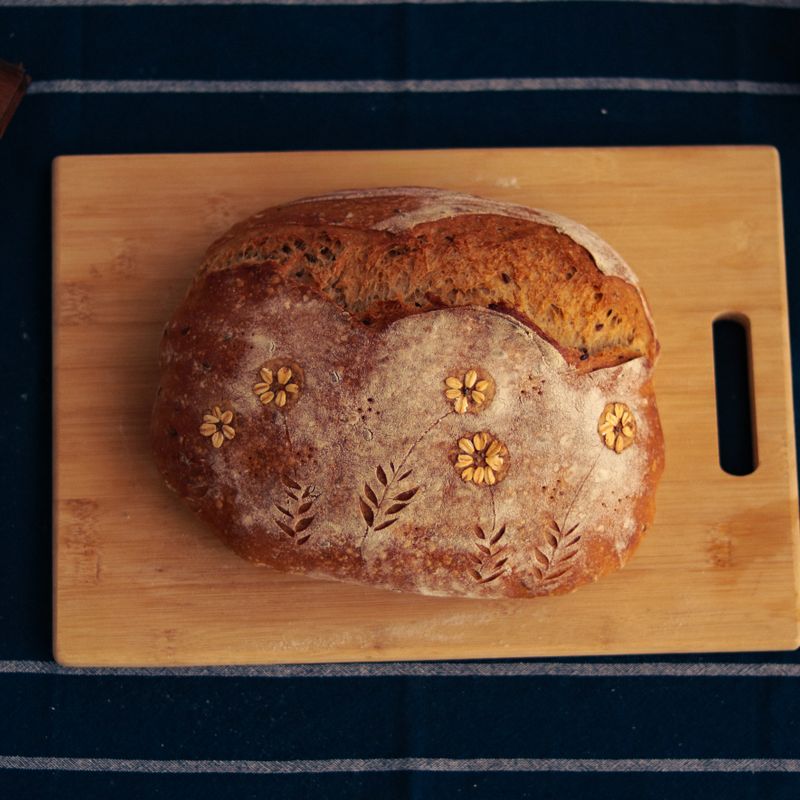
- Using a sharp lame or knife, score the top with a bold slash (1/4-inch / 0.6 cm deep) at a 30° angle.
+ Show details− Hide details
Ready when: Oven is preheated and holding 450°F (232°C); score is clean and deep
Tip: Scoring controls where the loaf expands; a confident slash yields an attractive ear and open crumb.
Bake with steamOven 450°F / 230°C
- Carefully remove the hot Dutch oven from the oven.
- Lay parchment with the scored dough inside (the paper helps you remove it later).
- Place the Dutch oven back in the oven, cover with its lid, and bake for 30 minutes at 450°F (232°C).
- The steam trapped inside will create a crisp crust.
+ Show details− Hide details
Ready when: Bread has risen and the visible portion is light golden
Tip: Do not remove the lid during this time; steam is essential for a shatteringly crisp crust.
Finish baking uncoveredOven 450°F / 230°C
- Remove the Dutch oven lid and bake for another 12–15 minutes at 450°F (232°C) until the loaf is deep golden brown on all sides and sounds hollow when tapped on the bottom.
- The internal temperature should reach 210°F (99°C).
+ Show details− Hide details
Ready when: Loaf is deep golden, hollow-sounding, and internal temp is 210°F (99°C)
Tip: Baking uncovered allows the crust to deepen in color and crisp fully. An underbaked loaf will be gummy inside.
Cool completely
- Transfer the loaf to a wire rack and cool for at least 1 hour at room temperature before slicing.
- The interior will continue to set as it cools.
- This ensures the crumb structure is stable and flavors have settled.
+ Show details− Hide details
Ready when: Loaf feels light and sounds hollow; it is cool to the touch
Tip: Slicing a warm loaf compresses the crumb; patience yields better texture. Admire the cardamom and jaggery swirl as you slice.
Good to know
Tips
- Toast the semolina for the dough deliberately in a dry pan—this draws out its nutty flavor and differentiates it from the untoasted semolina in the filling. The two create layers of texture and flavor.
- If your sourdough starter is less vigorous, add 1/4 tsp instant yeast to the dough to ensure reliable fermentation, though pure sourdough fermentation is preferred for deeper flavor.
- The halwa filling imparts spice and sweetness, but remember that fermentation will mellow its intensity. Do not hold back on the cardamom or cinnamon—they should be bold.
- This loaf is wonderfully sliced fresh and toasted the next day; the nutty semolina and cardamom flavors deepen when warm, and the jaggery becomes caramelized-tasting.
Make ahead
Prepare the halwa filling up to 24 hours ahead; store in an airtight container at room temperature. Bulk fermentation can be interrupted; place the dough in the refrigerator after the second or third fold, allow 8–12 hours, then continue with shaping. Overnight cold fermentation in the banneton develops richer flavor and makes scoring easier.
Storage & reheating
Room temperature (up to 2 days): Wrap the cooled loaf loosely in a kitchen towel. Refrigerator (up to 5 days): Wrap tightly in plastic wrap or place in an airtight container. Slice before storing for easier access. Freezer (up to 3 months): Wrap the whole cooled loaf in plastic wrap, then foil. Thaw at room temperature for 2–3 hours or toast slices directly from frozen. Reheat wrapped loaf at 350°F (175°C) for 10–15 minutes to refresh crust and warm interior.
Substitutions
- jaggery, grated or crumbled → muscovado sugar or brown sugar. Jaggery adds molasses-like warmth; muscovado is a close substitute. Use the same weight. Avoid refined white sugar, which lacks the depth.
- ghee (clarified butter) → unsalted butter or brown butter. Ghee brings a rich, nutty flavor. Butter works but lacks the complexity. Brown butter is closer to ghee's depth. Use the same weight.
- green cardamom pods → ground cardamom (1 tsp / 2 g) or ½ tsp cardamom pod. Use 1 tsp ground cardamom if whole pods are unavailable, but grinding pods fresh yields superior aroma and flavor.
- bread flour → all-purpose flour. Bread flour yields a more open crumb due to higher protein; all-purpose will produce a tighter, denser crumb but is still acceptable.