Sourdough Holiday Chestnuts and Brown Butter Rosemary Dinner Rolls
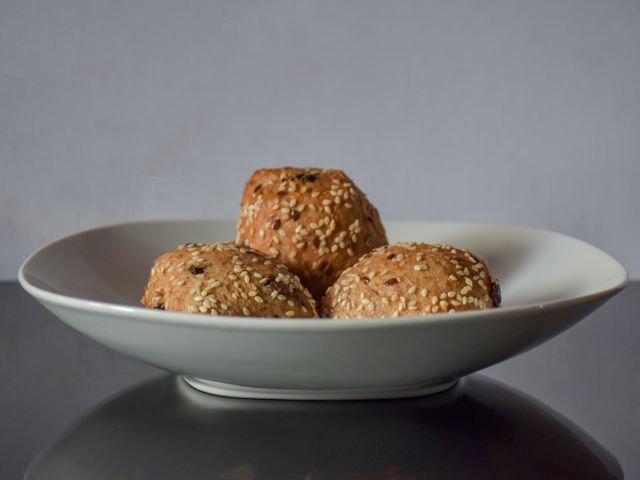
Rustic sourdough dinner rolls enriched with roasted chestnuts and finished with fragrant brown butter and crispy fresh rosemary. The tangy sourdough base provides depth while the nutty chestnuts add texture and subtle sweetness—perfect for holiday tables. Slightly crispy exteriors with soft, open crumbs inside.
Steps
Before you start
- Ensure your sourdough starter is active and bubbly (fed 4–6 hours before mixing)
- Bring all ingredients to room temperature
- Have a steam setup ready for the oven (boiling water in a shallow pan or spray bottle)
Mix dough
- In a large bowl or stand mixer, combine the active sourdough starter, bread flour, and water.
- Mix until shaggy and all flour is hydrated (about 3 minutes by hand or 2 minutes on low speed).
- Let rest for 30 minutes at room temperature (autolyse).
+ Show details− Hide details
Ready when: All flour is hydrated and dough is shaggy
Tip: An autolyse helps develop extensibility without extra mixing, which is ideal for open crumb structure.
Add salt and knead
- Add kosher salt to the rested dough and knead for 8–10 minutes on medium speed (or 10–12 minutes by hand using the stretch-and-fold method) until the dough is smooth, elastic, and slightly tacky.
- The dough should pass the windowpane test (a small piece stretches thin without tearing).
+ Show details− Hide details
Ready when: Dough is smooth, elastic, passes windowpane test
Tip: Don't rush this step—proper gluten development ensures good rise and structure in the rolls.
Fold in chestnuts
- Gently fold the chopped roasted chestnuts into the dough until evenly distributed.
- The dough should remain slightly tacky but cohesive.
- Transfer to a lightly oiled bowl, cover loosely with a damp towel or plastic wrap.
+ Show details− Hide details
Ready when: Chestnuts are evenly distributed throughout
Tip: Fold gently to maintain the dough's aeration and avoid deflating the gluten network.
Bulk fermentation
- Let the dough rise at room temperature (68–72°F / 20–22°C) for 4–5 hours, performing 4 stretch-and-fold turns during the first 2 hours (every 30 minutes).
- The dough should increase by about 50–75% in volume and show visible air pockets when you gently poke it.
+ Show details− Hide details
Ready when: Dough increases 50–75%, slight jiggle when bowl is nudged, visible air pockets
Tip: Bulk fermentation is slower with sourdough; patience develops the characteristic tang and strength. If your kitchen is cool, add 30–60 minutes.
Pre-shape dough
- Lightly flour a work surface.
- Gently turn the dough out (do not degas forcefully).
- Divide into 12 equal pieces (about 80 g each).
- Pre-shape each piece into a tight round by gently pulling the edges toward the center and rotating.
- Cover loosely and let rest for 15 minutes.
+ Show details− Hide details
Ready when: Dough pieces are gently rounded and begin to relax
Tip: Pre-shaping helps you handle the dough without excessive degassing; the rest prevents tearing during final shape.
Final shape
- Working with one pre-shaped piece at a time, flip it seam-side up, fold the edges in toward the center, and flip seam-side down.
- Using your hands, gently roll the dough toward you on the bench to create surface tension.
- Place seam-side up into the 8×8-inch baking vessel (or place all 12 rolls in a single layer, nestled snugly for slightly denser crumbs, or space them ½ inch apart for more defined edges).
+ Show details− Hide details
Ready when: Rolls are smooth and held in shape
Tip: Snug rolls will be tender and pull apart easily; spaced rolls will have more defined, crisper sides. Choose your preference.
Final proof
- Cover the rolls with a damp towel or plastic wrap.
- Let them rise at room temperature for 2–3 hours (or overnight in the refrigerator, 8–12 hours, for deeper flavor and easier scoring).
- The rolls should increase by about 50% and feel puffy when gently poked; if refrigerated, remove and let sit at room temperature for 30 minutes before baking.
+ Show details− Hide details
Ready when: Rolls are puffy; gentle poke leaves a slow-filling indentation
Tip: Cold fermentation intensifies flavor and makes the dough easier to handle; plan for this if you prefer deeper tang.
Preheat and scoreOven 450°F / 230°C
- Preheat your oven to 450°F (232°C) for at least 30 minutes.
- If using a Dutch oven or baking stone, place it in the oven to preheat.
- Just before baking, score the top of each roll with a sharp knife (a single ½-inch slash or an X shape).
- If you prepared a steam setup, have boiling water ready.
+ Show details− Hide details
Ready when: Oven is fully preheated and steaming vessel is hot
Tip: Scoring allows controlled expansion and helps create a better crust; a wet blade slides cleanly.
Bake with steamOven 450°F / 230°C
- Carefully place the rolls in the preheated 450°F (232°C) oven.
- Immediately add steam by pouring boiling water into a shallow pan on the lower rack (or quickly misting the walls with a spray bottle).
- Bake for 20–25 minutes, until the rolls are deep golden brown and the internal temperature reaches 205–210°F (96–99°C) at the center.
- Remove the steam source after 12 minutes if using a pan.
+ Show details− Hide details
Ready when: Rolls are deep golden brown; internal temp 205–210°F (96–99°C); sound hollow when tapped on bottom
Tip: Steam is crucial for sourdough—it keeps the crust flexible during oven spring, yielding a better rise and crust structure.
Brown the butter
- While the rolls bake, melt the cold unsalted butter in a small saucepan over medium heat.
- Stir occasionally and watch carefully.
- The butter will foam, then the milk solids will begin to sink and toast, turning golden brown and releasing a nutty aroma (3–5 minutes total).
- Once golden brown (not dark), remove from heat immediately and let cool slightly.
+ Show details− Hide details
Ready when: Butter is golden brown with a nutty aroma; milk solids are toasted but not burnt
Tip: Watch constantly during browning—it goes from perfect to burnt quickly. If it smells burnt, discard and start fresh.
Finish with rosemary and salt
- Remove the hot rolls from the oven and transfer them to a wire rack.
- Immediately brush or drizzle the warm brown butter generously over the tops of the rolls.
- Scatter the chopped fresh rosemary leaves and a pinch of fleur de sel over each roll.
- Let cool for 5 minutes before serving (they'll crisp up slightly as they cool).
+ Show details− Hide details
Ready when: Rolls are brushed with butter and garnished; exterior begins to firm
Tip: Apply butter and rosemary while the rolls are still hot so the butter absorbs into the crumb; fleur de sel adds a final textural and flavor accent.
Cool and serve
- Allow rolls to cool completely on the wire rack (about 20 minutes).
- Serve warm or at room temperature.
- Rolls are best eaten the same day but can be rewarmed.
+ Show details− Hide details
Ready when: Rolls are cooled and ready to serve
Tip: Sourdough rolls dry out more slowly than commercial yeast breads due to the starter's natural acids; store properly for best results.
Store and reheatOven 325°F / 165°C
- Keep cooled rolls in an airtight container or bread bag at room temperature for up to 2 days.
- To reheat, wrap in foil and warm in a 325°F (163°C) oven for 8–10 minutes.
- Do not refrigerate unless freezing.
+ Show details− Hide details
Ready when: Storage instructions recorded
Good to know
Tips
- Cold fermentation is optional but highly recommended: bulk ferment in a cool spot (65–68°F / 18–20°C) for 6–8 hours, then shape and refrigerate overnight. This develops deeper sourdough complexity.
- If you don't have a steam setup, create a makeshift one by placing a metal bowl over a sheet pan of boiling water, or use a pizza stone and spray bottle to mist the oven walls every 2 minutes for the first 10 minutes of baking.
- Roasted chestnuts are widely available jarred or vacuum-sealed from October onward. If using raw chestnuts, roast at 400°F (204°C) for 30 minutes, shell, and cool before chopping.
- Brown butter can be made ahead and stored in the refrigerator for up to 1 week; reheat gently over low heat or microwave for 15–20 seconds just before brushing on the warm rolls.
Make ahead
Dough can be bulk fermented, shaped, and placed in the refrigerator for up to 12 hours before the final proof. This cold fermentation deepens the sourdough tang. Alternatively, bake rolls completely, cool, and freeze in an airtight container for up to 3 weeks; reheat wrapped in foil at 325°F (163°C) for 12–15 minutes.
Storage & reheating
Room temperature (airtight container or bread bag): 2 days. Refrigeration not recommended (accelerates staling). Freezer (in airtight container or freezer bag): up to 3 weeks. Reheat frozen rolls wrapped in foil at 325°F (163°C) for 12–15 minutes, or thaw at room temperature and reheat for 5–8 minutes.
Substitutions
- roasted chestnuts, roughly chopped → toasted walnuts, pecans, or almonds (roughly chopped). Nuts will add earthiness and texture but won't have the subtle sweetness of chestnuts. Use the same weight.
- fresh rosemary sprigs → fresh thyme, sage, or a combination of dried Herbes de Provence. Use half the amount if substituting dried herbs, as they are more concentrated.
- active sourdough starter (freshly fed) → ½ cup (120 ml) active sourdough starter + 1 tbsp (12 g) instant yeast mixed into the flour. This creates a hybrid dough with faster fermentation but less sourdough tang. Reduce bulk fermentation to 2–3 hours.
- unsalted butter → clarified butter infused with sage or thyme, or plain unsalted butter melted with a drizzle of truffle oil. Adjust based on your preference for richness and flavor intensity.