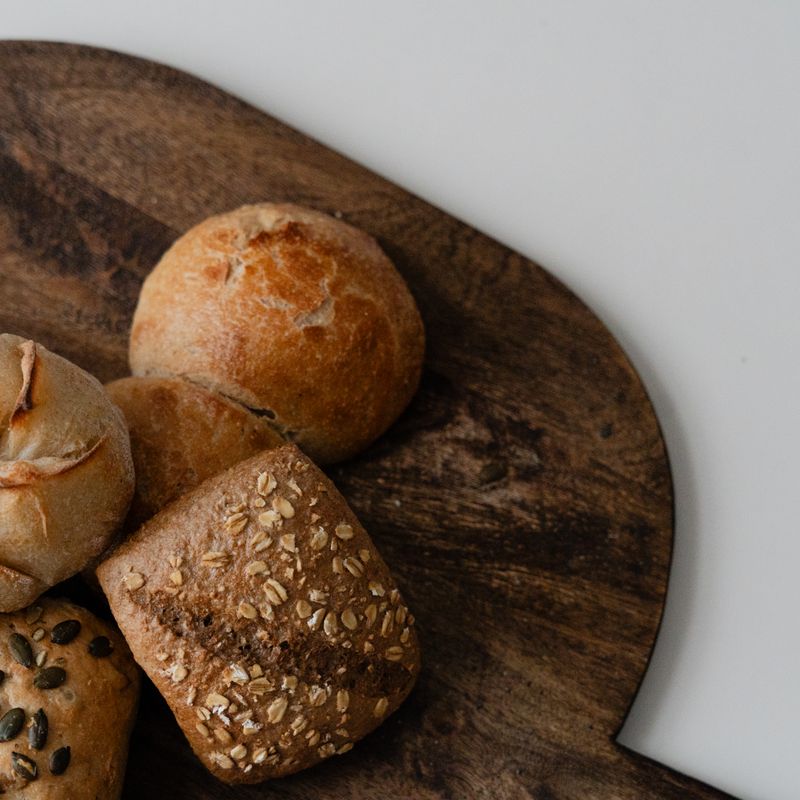
Sourdough Charred Leek and Farro Discard Rolls
Tender, hearty rolls that blend sourdough discard with farro flour for a nutty depth, studded with charred leeks and fresh thyme. The discard gives these rolls their characteristic tang and slight sourness without requiring a long fermentation. Perfect for breakfast, lunch, or alongside dinner.
- Prep
- 25 min
- Cook
- 30 min
- Wait
- 1 hr 30 min
- Total
- 2 hr 25 min
- Makes
- 12 rolls
Steps
Before you start
- Have sourdough discard at room temperature (not cold from the fridge)
- Preheat oven to 425°F (220°C) about 15 minutes before baking
- Weigh ingredients if possible for best consistency, especially the flours
- Read through the charring step so you know what to expect
Char the leeks
- Heat a large skillet over medium-high heat until very hot, about 2 minutes.
- Add olive oil and salt.
- Arrange the prepared leek pieces cut-side down in a single layer.
- Do not move them—let them sit undisturbed for 4–5 minutes until the cut surface turns deep golden brown and slightly blackened at the edges.
- Flip, season the browned side with thyme and black pepper, and cook the other side for 3–4 minutes until tender and caramelized.
- Transfer to a plate to cool.
+ Show details− Hide details
Ready when: Leeks are golden brown and very tender, with charred edges on both sides
Tip: Don't stir the leeks—they need uninterrupted time to develop that caramelized crust. The browning is the flavor.
Mix the dough
- In a large bowl, combine the room-temperature sourdough discard, all-purpose flour, farro flour, water, salt, and instant yeast.
- Stir with a wooden spoon or use a stand mixer with the dough hook until all flour is incorporated and the mixture comes together into a shaggy dough.
- The texture should be slightly sticky but workable.
- Mix for 2–3 minutes until mostly smooth.
+ Show details− Hide details
Ready when: Dough is mixed and mostly smooth, slightly tacky but holds together
Tip: The farro flour will feel slightly wetter than regular flour dough—that's normal. Don't add more flour unless it's actually sticky.
Rough rest and prep filling
- Cover the dough bowl and let it sit at room temperature for 20 minutes.
- While it rests, chop the cooled charred leeks into bite-sized pieces (about ½-inch / 1 cm).
- You should have roughly 1.5 cups of chopped leeks.
+ Show details− Hide details
Ready when: Dough looks slightly puffy and feels a bit softer
Tip: Prepping the leeks while the dough rests keeps you on schedule.
Incorporate leeks into dough
- Turn the rested dough onto a lightly floured surface.
- Gently stretch and fold it in on itself 2–3 times to strengthen it slightly.
- Sprinkle the chopped charred leeks evenly over the dough and fold and knead gently for 1–2 minutes until the leeks are distributed throughout.
- Work quickly but gently so the dough stays cohesive.
+ Show details− Hide details
Ready when: Leeks are evenly scattered through the dough with no large pockets
Tip: Work gently here—overmixing will toughen the dough. A few rough folds are enough.
Divide into portions
- Divide the dough into 12 equal portions (about 65–70 g each).
- Using a light touch, gently shape each portion into a loose ball by pulling the edges toward the center and rolling slightly.
- Place each ball seam-side down into a muffin cup (if using a muffin tin) or in rows on a 9×13-inch (23×33 cm) pan lined with parchment paper, spacing them about 1 inch (2.5 cm) apart.
+ Show details− Hide details
Ready when: 12 evenly portioned dough balls, gently rounded and sitting seam-side down
Tip: Keep the balls loose—overworking them at this stage can make the final rolls tough. A gentle hand is key.
First rise
- Cover the pan loosely with plastic wrap or a damp kitchen towel.
- Let the rolls rise at room temperature for 45–50 minutes until they are noticeably puffy and have expanded by about half.
- They should look light and airy but still hold their shape when gently poked.
+ Show details− Hide details
Ready when: Rolls are about 50% larger, light and airy, and spring back slowly when poked
Tip: Exact timing depends on room temperature—warmer kitchens may rise faster. Watch the dough, not the clock.
Preheat oven and prepare for bakingOven 425°F / 220°C
- About 10 minutes before the rolls finish rising, preheat your oven to 425°F (220°C) with a rack in the center.
- If using a muffin tin, no prep is needed.
- If baking on a sheet pan, the parchment paper is already in place.
+ Show details− Hide details
Ready when: Oven is fully preheated and at 425°F (220°C)
Tip: A preheated oven is essential for good oven spring and crust development.
Bake the rollsOven 425°F / 220°C
- Place the pan in the preheated 425°F (220°C) oven.
- Bake for 20–25 minutes until the rolls are deep golden brown on top and sound hollow when tapped on the bottom.
- If baking in a muffin tin, check one of the rolls by tapping it gently.
- The internal temperature should reach about 210°F (99°C) at the center.
+ Show details− Hide details
Ready when: Golden-brown crust, hollow sound when tapped, internal temperature 210°F (99°C), and a faint sourdough aroma
Tip: If the tops are browning too quickly before the insides are done, loosely tent with foil for the final 5 minutes.
Cool and finish
- Remove the pan from the oven and let the rolls cool in the pan for 5 minutes.
- Turn them out onto a wire rack to cool further.
- While still warm, brush the tops lightly with melted butter if desired, and sprinkle with a tiny pinch of fleur de sel for a subtle salty finish.
- Serve warm or at room temperature.
+ Show details− Hide details
Ready when: Rolls are firm enough to pick up without falling apart but still warm to the touch
Tip: Brush with butter while the rolls are warm so it absorbs into the crust for better flavor.
Good to know
Tips
- Sourdough discard works best when it's fed 2–4 hours ahead, then left unfed and bubbly—this gives it more active bacteria and a better tang. However, even unfed discard works; it will just be slightly more sour.
- Charring the leeks is non-negotiable for flavor—it caramelizes their natural sugars and adds a subtle bitterness that balances the tang of sourdough. Don't skip this step.
- The farro flour adds a warm, nutty complexity to the crumb. If you can't find it, substitute whole wheat or spelt, but the final flavor will be different.
- These rolls taste even better the next day as the sourdough flavor develops and mellows slightly. They're excellent for toast.
Make ahead
You can prepare the dough and leeks up to 8 hours ahead. After shaping (step 5), cover and refrigerate overnight. In the morning, let them come to room temperature for 30–40 minutes before baking—they'll rise faster because the cold fermentation has already started. Alternatively, bake fully, cool, wrap in plastic, and freeze for up to 3 months; reheat in a 350°F (175°C) oven for 10–15 minutes.
Storage & reheating
Room temperature: up to 2 days in an airtight container or bread box. Refrigerator: up to 5 days in an airtight container; reheat in a 300°F (150°C) oven for 8–10 minutes. Freezer: up to 3 months wrapped individually in plastic wrap and stored in a freezer bag; thaw at room temperature or reheat frozen in a 350°F (175°C) oven for 12–15 minutes.
Substitutions
- farro flour → whole wheat flour or spelt flour. Use the same amount by weight. Both will create a slightly earthier, more robust crumb. Whole wheat may need an extra 1–2 tablespoons of water.
- instant yeast → active dry yeast or fresh yeast. Use the same weight (2 g). Fresh yeast should be slightly warmed before mixing; active dry may need an extra 5 minutes of rising time.
- large leeks (white and light green parts) → scallions, garlic scapes, or ramps. Use 2–3 scallions per leek or 4–5 ramps. Char the same way, then chop. You'll lose some of the leek's sweetness but gain a brighter allium flavor.
- fresh thyme leaves → rosemary or marjoram. Use the same amount. Rosemary is more assertive—start with half and add to taste. Marjoram is milder and earthier.
More rolls & buns
See all →



Find more like this
- Meal
- Breakfast