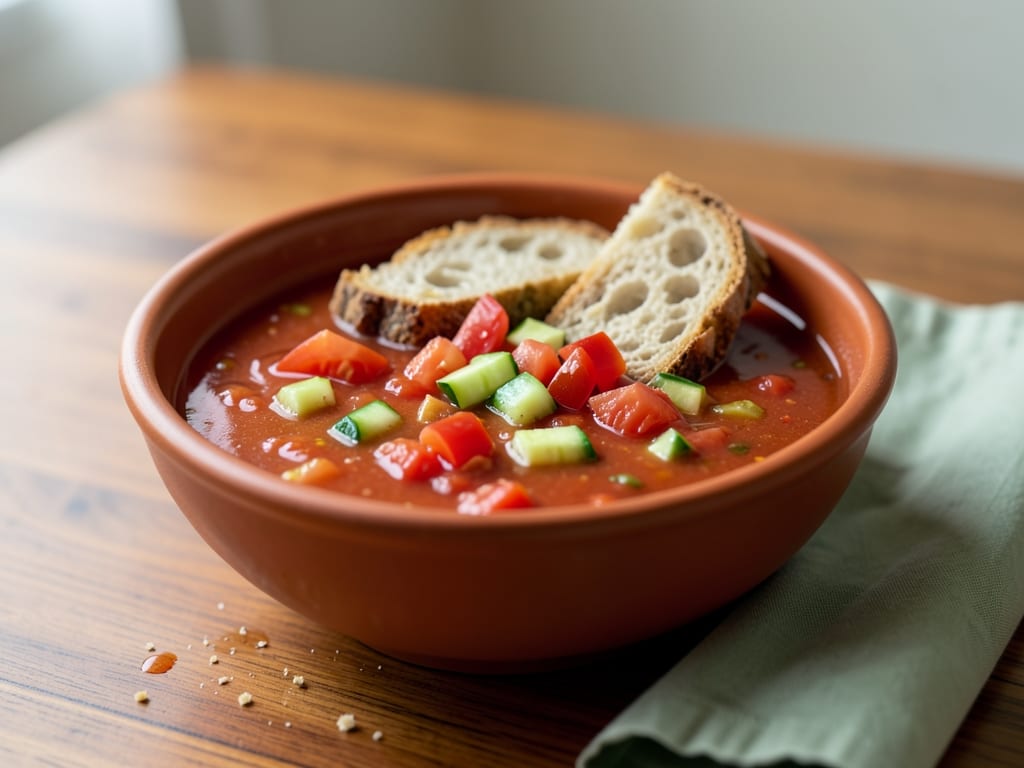
Sourdough Gazpacho Andaluz with Bread
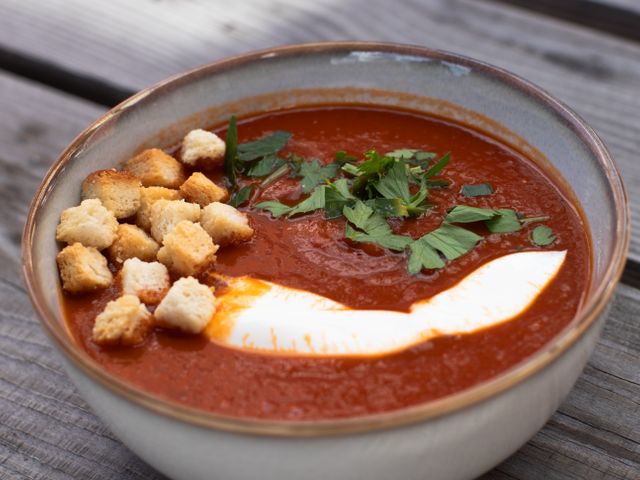
A traditional Spanish cold soup from Andalusia that celebrates simplicity and perfect tomatoes. Stale sourdough bread becomes the soul of this dish—it thickens the soup naturally without heaviness while adding subtle tang. Bright with sherry vinegar and rich with olive oil, this gazpacho is refreshing on summer days and tastes even better made ahead. Crispy sourdough croutons and fresh diced vegetables complete the bowl.
- Prep
- 20 min
- Cook
- 10 min
- Wait
- 30 min
- Total
- 1 hr
- Makes
- 4 servings (about 2 cups per serving, 8 cups total)
Steps
Before you start
- Chill your serving bowls in the refrigerator or freezer for 10 minutes before serving
- Use stale sourdough bread that is 2–3 days old; if you only have fresh bread, lightly toast it at 300°F (150°C) for 5 minutes to dry it out
- Choose the ripest, most flavorful tomatoes available, or use high-quality canned San Marzano tomatoes if fresh ones are not in season
- Read through the timing: most of this recipe is passive chilling and infusing time
Prepare the vegetables
- Cut the tomatoes in half and roughly chop them (or if using canned, drain excess liquid and break into chunks).
- Peel the cucumber, cut it in half lengthwise, and use a small spoon to scoop out the seeds if desired—this reduces excess water and makes a less diluted soup.
- Roughly chop the seeded cucumber.
- Remove the stem and seeds from the red bell pepper and roughly chop it into 1-inch pieces.
- Mince the garlic finely.
- Arrange all prepped vegetables and garlic near your blender, ready to combine.
+ Show details− Hide details
Ready when: All vegetables are prepped and arranged, ready to blend
Tip: Choose the ripest tomatoes you can find—their quality makes a huge difference in this simple soup. If peak tomatoes aren't available, San Marzano canned tomatoes are a reliable substitute.
Soak the stale bread
- Tear the stale sourdough into 1-inch pieces (you should have about 2 cups loosely packed).
- Place the bread pieces in a small bowl and cover them with ¼ cup of the cold water.
- Let sit for 2–3 minutes until the bread is fully softened and pliable but still holds some shape.
- The goal is to hydrate the bread without turning it to mush—it should feel like a soft sponge.
+ Show details− Hide details
Ready when: Bread is soft and pliable, easily squeezed without crumbling into a paste
Tip: Stale bread is essential—it thickens the soup naturally without making it gluey. If your bread is too fresh, toast it at 300°F (150°C) for 5 minutes to dry it out first.
Blend the soup base
- Add the soaked bread and its soaking water to your blender along with the chopped tomatoes, cucumber, bell pepper, minced garlic, sherry vinegar, and 4 tbsp of the olive oil.
- Blend on high speed for 1–2 minutes until the mixture is smooth and silky with no large vegetable pieces remaining.
- Stop and taste—if you prefer a slightly more textured soup, blend just until well combined rather than silky-smooth; if you want perfectly smooth, continue blending another 30 seconds.
+ Show details− Hide details
Ready when: Soup is smooth and pourable with no large vegetable chunks visible
Tip: Don't over-blend if you prefer some texture; gazpacho should feel fresh and alive, not over-processed.
Strain and adjust consistency
- Pour the blended soup through a fine-mesh sieve or chinois into a large bowl, pressing gently on the solids with the back of a spoon to extract as much flavorful liquid as possible (this step is optional but creates a silkier, more refined texture).
- Add the remaining 1 cup of cold water gradually, stirring after each addition to reach a pourable soup consistency—it should flow easily from a spoon like heavy cream but be light and refreshing, not thick or starchy.
- If too thick, add more cold water in ¼-cup increments.
+ Show details− Hide details
Ready when: Soup flows easily from a spoon but is substantial and creamy-looking, not thin or watery
Tip: Add water gradually—you can always add more, but you cannot remove it. Taste as you go and stop when you reach your ideal consistency.
Season to taste
- Taste the gazpacho carefully.
- Add sea salt and freshly ground black pepper to taste, stirring well to distribute evenly.
- Start with ½ teaspoon of salt and adjust from there.
- If you like, add ¼ teaspoon of ground cumin for subtle warmth and depth that complements the tomatoes without being obvious.
- The soup should taste bright and tangy from the vinegar, rich and silky from the olive oil and bread, and well-seasoned overall.
- Add a pinch more vinegar if it needs more pop, or more salt if the flavors seem muted.
+ Show details− Hide details
Ready when: Soup tastes bright, well-seasoned, and balanced between tangy, rich, and savory
Tip: Cold temperatures mute flavors, so season gazpacho slightly more boldly than you would a hot soup. You want the flavors to sing when it's cold.
Chill the gazpacho
- Transfer the gazpacho to a serving pitcher or into individual bowls and refrigerate for at least 30 minutes, though 1–2 hours is ideal.
- The soup needs to be very cold to taste its best—the flavors also continue to meld and develop as it sits chilled.
- If making ahead, cover and refrigerate for up to 3 days (the flavors actually improve overnight).
+ Show details− Hide details
Ready when: Soup is very cold, at least 40°F (4°C), and flavors have developed
Tip: Gazpacho tastes significantly better made a day ahead. If you have time, make it the evening before serving for the best depth of flavor.
Toast sourdough croutonsOven 375°F / 190°C
- While the soup chills, prepare the optional croutons if desired.
- Cut the fresh sourdough bread into ½-inch cubes (about 2 cups).
- Toss the cubes with 1 tbsp of the remaining olive oil and a small pinch of sea salt.
- Spread them in a single layer on a baking sheet and toast at 375°F (190°C) for 8–10 minutes, stirring halfway through, until the croutons are deep golden brown and crispy when tapped.
- Remove from the oven and let cool on the baking sheet—they will crisp further as they cool.
+ Show details− Hide details
Ready when: Croutons are deep golden brown and crisp when tapped, not soft
Tip: Make croutons while the soup chills—the timing works perfectly. If short on time or prefer a lighter soup, serve the gazpacho with crusty bread on the side instead of croutons.
Serve the gazpacho
- Ladle the chilled gazpacho into cold bowls (use the bowls you chilled earlier for the best experience).
- Top each serving generously with a handful of the toasted croutons, a small handful of diced fresh tomato, and a small handful of diced fresh cucumber.
- Finish each bowl with a light drizzle of extra virgin olive oil—about 1 tsp per bowl.
- Serve immediately while still cold.
+ Show details− Hide details
Tip: Serve immediately in chilled bowls. If the soup sits at room temperature for even a few minutes, it will warm up and lose the refreshing quality that makes gazpacho special in summer.
Good to know
Tips
- Stale sourdough is essential to this recipe—it acts as both a thickener and a source of subtle flavor. Fresh bread will make the soup gummy; if you only have fresh bread, lightly toast it at 300°F (150°C) for 5 minutes to drive off moisture.
- Gazpacho absolutely improves with time. If you can make it a day ahead, do so. The flavors meld, deepen, and become more complex overnight.
- Temperature matters enormously. Serve this soup in bowls that have been chilled in the refrigerator or freezer. Cold soup served in a warm bowl loses its magic within minutes.
- This recipe is endlessly customizable: add more cold water for a lighter, more liquid consistency; add more sherry vinegar for extra tang; add another clove of garlic for punchiness; add a tiny pinch of red pepper flakes or hot sauce for heat. Taste and adjust to your preferences.
Make ahead
Gazpacho tastes significantly better made a day or two ahead, as the flavors deepen and blend. Make the soup through step 6 (chill) up to 3 days in advance; cover and refrigerate. Toast croutons fresh just before serving for the best crunch. Reheat? Don't—this is a cold soup and should be served directly from the refrigerator, very cold.
Storage & reheating
Refrigerator: Keep gazpacho in an airtight container for up to 3 days. Stir well before serving as it may have separated slightly. Freezer: Gazpacho can be frozen for up to 1 month in an airtight container, though the texture of blended vegetables may be slightly different after thawing. Thaw overnight in the refrigerator, stir well, and add a splash of cold water if the consistency is too thick. Croutons are best made fresh and don't freeze well; store leftovers in an airtight container at room temperature for up to 2 days and re-crisp in a 300°F (150°C) oven for 3–5 minutes if needed.
Substitutions
- ripe tomatoes (or one 28-oz can San Marzano tomatoes, drained) → One 28-oz (800g) can of San Marzano tomatoes, drained. Canned tomatoes work beautifully when fresh tomatoes are out of season. Drain well before blending to avoid a watery soup. San Marzano tomatoes have superior flavor and lower water content than standard canned tomatoes.
- english cucumber → One regular garden cucumber (about 8 oz / 225g), seeded. Regular cucumbers have more seeds and water content than English cucumbers. Scoop out the seeds more thoroughly to prevent a diluted, watery soup.
- sherry vinegar → Red wine vinegar (use 2.5 tbsp instead of 3 tbsp). Red wine vinegar is sharper and more acidic than sherry vinegar. Start with less and taste as you adjust, as you can always add more but can't take it out.
- stale sourdough bread → Stale French bread, ciabatta, or white bread (same amount). Any stale bread will work, though sourdough adds a pleasant tanginess that is harder to replicate. If using milder bread, consider adding 1 additional clove of garlic or a touch more vinegar to boost flavor.
More vegetable soups
See all →


Find more like this
- Meal
- Lunch
- Cuisine
- Spanish
- Main ingredient
- TomatoesBell Peppers
- Method
- No-Cook
- Quick & Easy
- EasyMake Ahead
- Season
- Summer