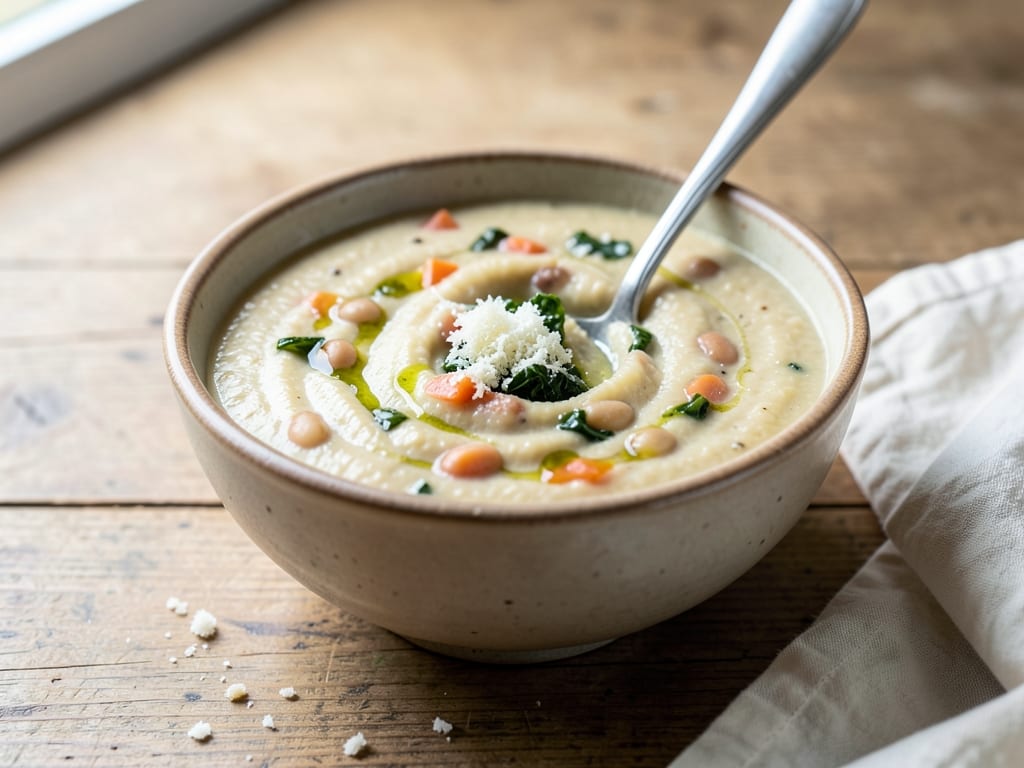
Italian Ribollita (Tuscan Bean, Kale and Bread Soup)
A thick, spoon-standing Tuscan soup of creamy cannellini beans, lacinato kale, carrots and tomatoes, thickened with stale bread and finished with good olive oil. It tastes even better reheated the next day, which is how ribollita ("reboiled") got its name.
- Prep
- 30 min
- Cook
- 2 hr 10 min
- Wait
- 8 hr 10 min
- Total
- 10 hr 50 min
- Makes
- About 3 quarts (2.8 L), 6 generous bowls
Steps
Before you start
- Start the bean soak the evening before, or in the morning if you plan to cook at night. The soak takes 8 to 12 hours, and nearly all of the 650 minutes total is unattended.
- Use bread that is truly stale and dry (2 to 3 days old). If yours is fresh, tear it into 1-inch (2.5 cm) pieces and spread them on a baking sheet at room temperature while the beans soak, 8 to 12 hours, until hard and dry. No oven is needed for this soup.
- Strip the kale leaves from the tough stems and chop the vegetables before you start the soffritto, so nothing burns while you cut.
- Short on time? Swap the dried beans for three 15-oz (425 g) cans of cannellini, drained and rinsed. See Substitutions.
Soak the beans
- Dissolve 1 tbsp (18 g) kosher salt in 6 cups (1.5 L) cold water in a large bowl.
- Add the rinsed cannellini beans, making sure they are covered by at least 2 inches (5 cm) of water.
- Soak at room temperature for 8 to 12 hours, then drain in a colander and discard the soaking water.
+ Show details− Hide details
Ready when: Beans are plump, roughly double in size, and have no hard white core when one is bitten in half
Tip: Salting the soak seasons the beans through and helps keep their skins from splitting.
Simmer the beans
- Put the drained beans in the Dutch oven with 6 cups (1.5 L) fresh cold water, the sage sprigs and the 2 smashed garlic cloves.
- Bring to a boil over high heat, skim off any foam, then reduce to low so the water barely bubbles.
- Partially cover and cook for 60 to 75 minutes.
- Stir in 1 tsp (6 g) salt for the last 15 minutes.
- Remove and discard the sage.
- Do not drain: you need the bean cooking liquid.
+ Show details− Hide details
Ready when: Beans are completely tender and creamy inside, and mash easily when pressed against the side of the pot with a spoon
Tip: Keep the simmer gentle. Hard boiling bursts the skins, and old beans can take up to 30 minutes longer, so top up with hot water if the level drops below the beans.
Cook the soffritto
- Pour the beans and their liquid into a large bowl and set aside.
- Wipe out the Dutch oven, then heat ¼ cup (60 ml) olive oil over medium heat.
- Add the onion, carrots and celery with 1½ tsp (9 g) salt.
- Cook, stirring every minute or so, for 10 to 12 minutes.
+ Show details− Hide details
Ready when: Vegetables are soft, the onion is translucent and sweet-smelling, and nothing has browned
Tip: If the vegetables start to brown, lower the heat. Gentle cooking gives sweetness, while browning gives a harsher flavor.
Bloom aromatics and paste
- Add the sliced garlic, tomato paste, thyme sprigs, black pepper and red pepper flakes (if using).
- Stir constantly for 2 to 3 minutes.
+ Show details− Hide details
Ready when: The tomato paste darkens to brick red and smells sweet and toasty; the garlic is fragrant but not browned
Tip: Stir without stopping, because garlic and tomato paste scorch quickly and turn bitter.
Add the tomatoes
- Add the hand-crushed tomatoes with their juices.
- Scrape up any browned bits from the bottom of the pot.
- Simmer, stirring occasionally, for 5 minutes.
+ Show details− Hide details
Ready when: The mixture looks thicker and jammy, and the oil begins to separate at the edges
Blend some beans, simmer
- Scoop out about 2 cups of the beans with some liquid and blend until smooth (use an immersion blender in a tall container, or a regular blender).
- Add the puree, the remaining whole beans, all of their cooking liquid (about 5 cups / 1.2 L), the stock and the Parmesan rind (if using) to the pot.
- Bring to a boil, then lower to medium-low and simmer, partially covered, for 15 minutes.
+ Show details− Hide details
Ready when: The broth looks creamy and slightly thickened, with a gentle bubble at the surface
Tip: Pureeing some of the beans is what gives ribollita its velvety body, so don't skip it.
Cook the kale
- Stir in the kale ribbons a handful at a time, letting each wilt before adding more.
- Simmer, partially covered, over medium-low heat, stirring occasionally, for 20 to 25 minutes.
+ Show details− Hide details
Ready when: The kale is dark green, silky and tender with no chewy resistance when bitten
Tip: Lacinato kale holds its shape well. Cook it fully, as undercooked kale tastes tough and grassy in this soup.
Stir in the bread
- Remove the thyme stems and the Parmesan rind.
- Turn off the heat, add the torn bread and fold gently until all pieces are submerged.
- Cover and let stand for 10 minutes.
- Stir vigorously to break the bread down into the soup.
+ Show details− Hide details
Ready when: The soup is very thick and stew-like, and a spoon stands up in it; the bread has mostly dissolved into soft, porridge-like pieces
Tip: If the soup is thicker than you like, stir in ½ cup (120 ml) hot water at a time until it reaches your preferred consistency.
Season and serve
- Taste and add salt and pepper as needed (it usually needs another ½ tsp).
- Ladle into warm bowls, drizzle each with 1 tbsp (15 ml) good olive oil and sprinkle with grated Parmesan, if using.
- For traditional ribollita, cool and refrigerate overnight, then reheat as described under Make Ahead.
+ Show details− Hide details
Ready when: The soup tastes well seasoned, rich and savory, with no flat or bland notes
Tip: Don't skimp on the finishing oil. It adds a fruity, peppery aroma that cooking mutes.
Good to know
Tips
- Use the bean cooking liquid, not only stock. It is starchy and flavorful and gives the soup its body.
- Season in layers (soak, bean pot, soffritto, final taste) so the salt goes all the way through rather than sitting on the surface.
- Don't add the tomatoes to the beans while they are cooking. Acid keeps bean skins from softening.
- Add the bread off the heat so it softens evenly rather than scorching on the bottom of the pot.
Make ahead
Make the soup through step 8, cool for up to 1 hour, then refrigerate in a covered container overnight or up to 3 days. The next day, reheat in the Dutch oven over medium-low heat for 10 to 15 minutes with ½ to 1 cup (120 to 240 ml) water, stirring often, until it is steaming hot and bubbling gently. This is the classic 'reboiled' version. Beans can be cooked up to 3 days ahead and stored in their liquid in the refrigerator.
Storage & reheating
Room temperature: no more than 2 hours. Refrigerator: up to 4 days in an airtight container (it thickens, so thin with water when reheating). Freezer: up to 3 months in freezer-safe containers with ½ inch (1.25 cm) headspace; thaw overnight in the refrigerator. Reheat on the stovetop over medium-low heat until steaming hot, adding water as needed, and finish with fresh olive oil.
Substitutions
- dried cannellini beans → three 15-oz (425 g) cans cannellini or great northern beans, drained and rinsed. Skip steps 1 and 2. Add 5 cups (1.2 L) extra stock or water in step 6 in place of the bean cooking liquid, and simmer an extra 10 minutes. The soup will be a little less rich.
- lacinato (Tuscan) kale → Savoy cabbage or Swiss chard, or a mix. Cabbage needs the full 25 minutes. Chard cooks faster, so cut the kale time to 10 to 12 minutes.
- low-sodium vegetable stock → water. Use plain water if needed, and increase the salt slightly and add the Parmesan rind for depth.
- stale country bread → day-old ciabatta or sourdough. Avoid soft sandwich bread, which turns gluey. Gluten-free bread works but breaks down faster, so add it only when serving.
More vegetable soups
See all →

Find more like this
- Meal
- Dinner
- Cuisine
- Tuscan
- Main ingredient
- White BeansTomatoes
- Diet
- HalalSugar-Free
- Method
- Stovetop
- Quick & Easy
- EasyMake AheadBudget