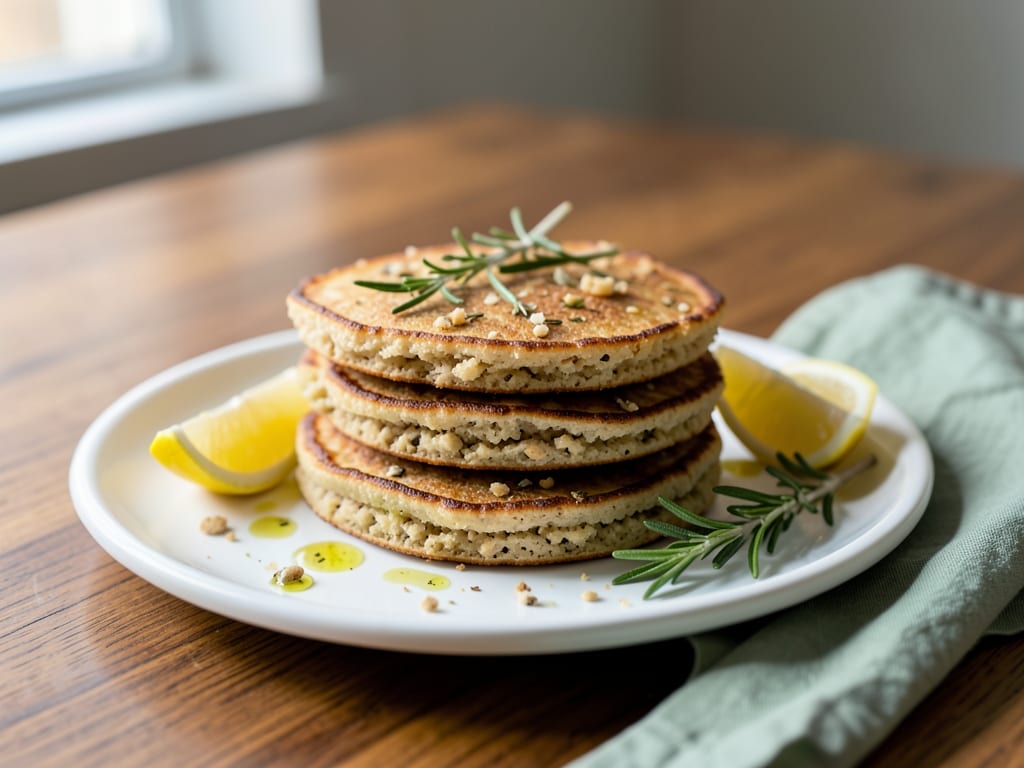
Sourdough Discard Socca-Style Pancakes with Rosemary
Crisp-edged, tender-centered savory pancakes that blend nutty chickpea flour with tangy sourdough discard, perfumed with rosemary, garlic, and good olive oil. They come together in one bowl and make a great snack, side, or light meal.
- Prep
- 10 min
- Cook
- 20 min
- Wait
- 30 min
- Total
- 1 hr
- Makes
- 8 pancakes (about 4½ inches / 11 cm each)
Steps
Before you start
- Use unfed sourdough discard at about 100% hydration (equal weights flour and water) that is pourable like thick pancake batter. Cold from the fridge is fine; it can be any age up to a couple of weeks.
- The batter needs a 30-minute rest so the chickpea flour hydrates fully. Start the rest before you preheat anything.
- Use fresh rosemary if possible; dried is much harsher (see substitutions).
- Have a wire rack set on a baking sheet ready for keeping finished pancakes warm and crisp.
Prep the aromatics
- Pull the rosemary leaves from the stems and chop them very finely, nearly to a paste, so there are no sharp needles in the pancakes.
- Peel the garlic and grate it on a Microplane.
- Cut the lemon into 4 wedges and grate the Parmesan, if using, and set both aside.
+ Show details− Hide details
Ready when: Rosemary is in tiny flecks and garlic is a moist, fluffy pulp.
Tip: Chopping the rosemary small matters; large pieces turn woody and stiff when pan-fried.
Whisk the batter
- In a medium bowl, whisk the sourdough discard, water, and 3 tablespoons (45 ml) olive oil until smooth.
- Add the chickpea flour, fine salt, pepper, rosemary, and garlic.
- Whisk for about 1 minute, pressing out any lumps against the side of the bowl.
+ Show details− Hide details
Ready when: Batter is smooth and thick but pourable, like heavy cream or thick pancake batter, and slowly drips off the whisk in a ribbon.
Tip: If it is stiff (some discard is thicker), whisk in water 1 tablespoon at a time until pourable.
Rest the batter
- Cover the bowl and let the batter rest at room temperature for 30 minutes.
- The chickpea flour absorbs the liquid and loses its raw, beany taste, and the batter thickens slightly.
- Stir briefly before using; it may look a little foamy and that is fine.
+ Show details− Hide details
Ready when: Batter looks thicker and slightly puffy on the surface, with no dry flour specks.
Tip: Resting up to 2 hours at room temperature is fine and adds a little extra tang.
Set up the warming ovenOven 200°F / 95°C
- Near the end of the rest, heat the oven to 200°F (95°C).
- Set a wire rack on a baking sheet and put it on the middle rack.
- Finished pancakes will wait here without steaming and going soft.
+ Show details− Hide details
Ready when: Oven reaches 200°F (95°C).
Tip: Use a rack, not a flat tray, so air circulates under the pancakes and keeps the bottoms crisp.
Heat the skillet
- Set a 12-inch (30 cm) skillet over medium heat for 2 minutes.
- Add 2 teaspoons (10 ml) of the pan olive oil and tilt to coat.
- Heat until the oil shimmers and flows like water.
+ Show details− Hide details
Ready when: Oil shimmers, and a drop of batter sizzles immediately.
Tip: If the oil smokes, lower the heat; olive oil burns easily and tastes bitter.
Cook the first side
- Stir the batter, then pour ¼ cup (60 ml) per pancake into the skillet, making 3 pancakes about 4½ inches (11 cm) wide with space between.
- Cook without moving them for 2 to 3 minutes.
+ Show details− Hide details
Ready when: Edges look dry and set, small bubbles pop on the surface and stay open, and the underside is deep golden brown when you lift an edge.
Tip: Don't flip early. If the pancake tears when you lift it, give it another 30 seconds.
Flip and finish
- Flip each pancake with a thin spatula and cook the second side for 1½ to 2 minutes, pressing gently with the spatula once to ensure contact with the pan.
- Sprinkle a pinch of Parmesan over each as they come off, if using.
+ Show details− Hide details
Ready when: Both sides are golden brown with darker lacy spots, and the center springs back when pressed lightly.
Tip: If the outsides brown before the centers set, drop the heat to medium-low.
Repeat with remaining batterOven 200°F / 95°C
- Transfer the pancakes to the rack in the warm oven.
- Wipe out any dark bits, add another 2 teaspoons (10 ml) oil, and repeat in 2 more batches (3 pancakes, then 2) until all batter is used, adjusting the heat between medium and medium-low as needed.
- Stir the batter before each batch because the chickpea flour settles.
+ Show details− Hide details
Ready when: You have 8 evenly golden pancakes on the rack.
Tip: The first batch is often the pale one; the pan evens out after that.
Season and serve
- Sprinkle the hot pancakes with flaky sea salt and an extra drizzle of olive oil if you like.
- Serve right away with lemon wedges for squeezing.
+ Show details− Hide details
Ready when: Pancakes are crisp at the edges and fragrant with rosemary.
Tip: Salt just before serving so the surface stays crisp.
Good to know
Tips
- Use a nonstick or well-seasoned cast-iron pan; a hot, lightly oiled surface is what creates the crisp lacy edges.
- Keep pancakes about ¼ inch (6 mm) thick. Thicker ones stay gummy in the middle.
- Serve with yogurt, tzatziki, roasted tomatoes, or a soft egg for a light meal.
- Chickpea batter settles quickly, so stir before every batch for consistent pancakes.
Make ahead
The batter can be made up to 24 hours ahead and refrigerated, covered; stir well and let it sit 15 minutes at room temperature, adding a splash of water if it has thickened. Cooked pancakes can be made a day ahead and re-crisped.
Storage & reheating
Room temperature: up to 2 hours. Fridge: airtight container with parchment between pancakes, up to 4 days. Freezer: up to 2 months, frozen flat then bagged. Reheat in a dry skillet over medium heat for 1 to 2 minutes per side, or in a 375°F (190°C) oven for 6 to 8 minutes, until hot and crisp.
Substitutions
- fresh rosemary leaves → fresh thyme leaves (1 tbsp) or 1 tsp dried rosemary, crumbled fine. Dried rosemary is stronger, so use only 1 teaspoon and crush it well.
- extra-virgin olive oil → avocado oil. Higher smoke point if your pan runs hot, but you lose some of the Mediterranean flavor.
- Parmesan cheese → nutritional yeast or crumbled feta. Nutritional yeast keeps it vegan; feta adds salty tang, so skip some of the flaky salt.
- unfed sourdough discard (100% hydration) → 1 cup (240 g) discard from a whole-wheat starter. Works at the same 100% hydration and gives a slightly nuttier, denser pancake.
More pancakes & waffles
See all →
Find more like this
- Meal
- Breakfast
- Cuisine
- Mediterranean
- Main ingredient
- Chickpeas
- Method
- Stovetop
- Quick & Easy
- Easy