Sourdough Discard Pasta with Garlic, Parmesan and Olive Oil
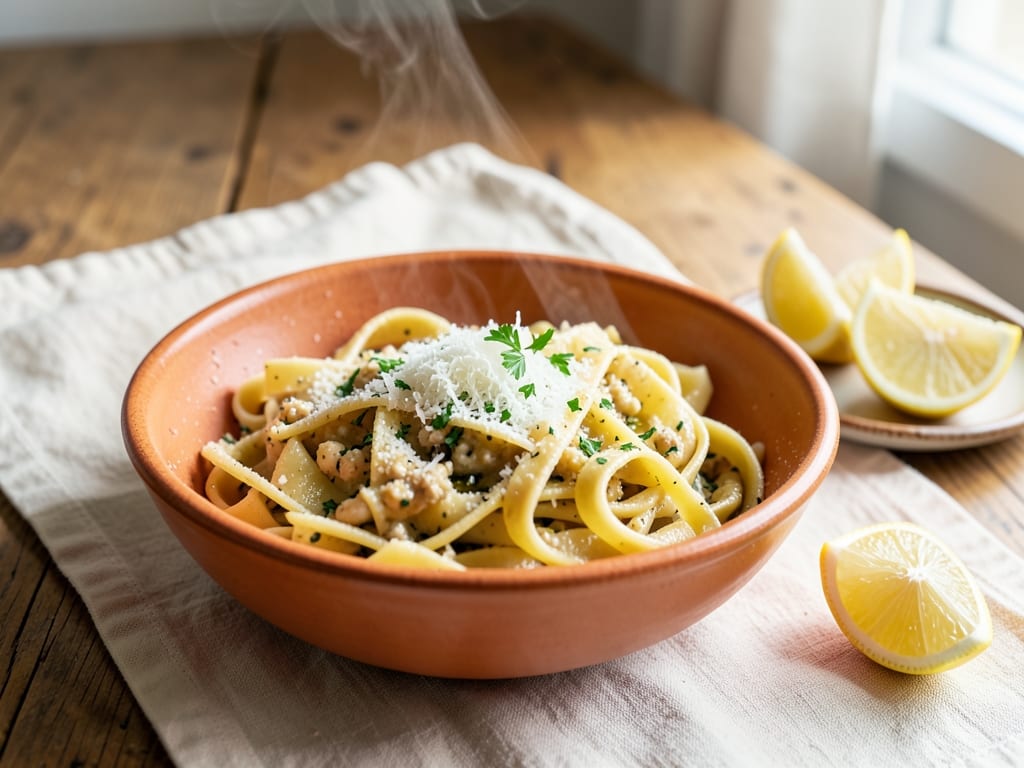
Fresh tagliatelle made with unfed sourdough discard, semolina and a single egg. The dough has a subtle tang and a chewy bite. It cooks in about 3 minutes on the stovetop and is tossed in a simple garlic, butter and Parmesan sauce.
- Prep
- 45 min
- Cook
- 15 min
- Wait
- 30 min
- Total
- 1 hr 30 min
- Makes
- About 600 g fresh pasta (4 main-course servings)
Steps
Before you start
- Use unfed sourdough discard at 100% hydration (equal weights flour and water), cold from the fridge or at room temperature. Stir it well and weigh it. Discard that is more than 2 weeks old or has a layer of pink or orange liquid should be thrown out.
- Take the egg out of the fridge 30 minutes ahead so it is at room temperature.
- The dough needs a 30-minute rest. Start heating the pasta water about 15 minutes before the rest ends. No oven is needed for this recipe; everything happens on the stovetop.
- Set up a clean work surface and a large tray dusted with semolina for the cut pasta before you begin rolling.
Mix the dough
- On a clean counter or in a large bowl, combine 240 g semolina, 120 g all-purpose flour and 3 g fine salt.
- Make a well in the center.
- Add the 120 g sourdough discard, the egg, 14 ml olive oil and 15 ml (1 tbsp) water to the well.
- Beat the wet ingredients with a fork, gradually pulling in flour from the walls of the well, until a shaggy mass forms.
- Use your hands to press it together.
+ Show details− Hide details
Ready when: Most of the flour is hydrated and the dough clumps when squeezed, with few dry crumbs left.
Tip: Add the remaining water 1 tsp at a time only if the dough will not hold together. This dough should feel stiff, not sticky. Discard varies in thickness.
Knead until smooth
- Knead firmly with the heel of your hand for 8 to 10 minutes: push the dough away, fold it over and turn it a quarter.
- It will start out dry and rough.
- If it stays crumbly after 2 minutes, wet your hands (or add the remaining water 1 tsp at a time) and keep kneading.
- If it sticks, dust lightly with all-purpose flour.
- Shape into a ball and press it with a finger.
+ Show details− Hide details
Ready when: The dough is smooth, firm and elastic, and a fingertip press springs back slowly.
Tip: Don't skip the full kneading time. It builds the gluten that keeps the noodles from tearing in the water.
Rest the dough
- Wrap the dough tightly in plastic wrap or place it under an inverted bowl.
- Let it rest at room temperature for 30 minutes.
- Resting relaxes the gluten so the dough rolls out without springing back.
+ Show details− Hide details
Ready when: The dough feels softer and less tight, and it stretches without snapping back.
Tip: Wrapping well matters. An exposed surface dries out and makes brittle flecks in the pasta.
Roll the sheets
- Cut the dough into 4 equal pieces and keep the rest wrapped.
- Flatten one piece into a rectangle about ½ inch (1 cm) thick and dust with semolina.
- Pass it through a pasta machine on the widest setting.
- Fold in thirds like a letter and pass it through again, repeating 3 times.
- Then narrow the setting one notch at a time, passing once on each, until you reach setting 6 of 7 (about 1.5 mm thick).
- Without a machine, roll out on a lightly floured counter with a long rolling pin into a rectangle about 1/16 inch (1.5 mm) thick.
- Dust each finished sheet with semolina and lay it on the counter.
+ Show details− Hide details
Ready when: Each sheet is smooth, about 12 inches (30 cm) long, and thin enough that you can faintly see your hand's shadow through it.
Tip: If a sheet feels sticky or tacky, dust it with semolina rather than all-purpose flour. Semolina is coarser and won't gum up the dough.
Cut and nest
- Let the sheets dry on the counter for 5 minutes so they are leathery but still pliable.
- Cut each sheet in half crosswise.
- Loosely roll each piece into a flat cylinder and slice crosswise into ⅜-inch (1 cm) ribbons with a sharp knife, or use the tagliatelle attachment.
- Shake out the strands, toss them in semolina and gather them into loose nests on the semolina-dusted tray.
+ Show details− Hide details
Ready when: The strands separate easily when shaken and don't stick to each other.
Tip: Keep the nests loose. Tightly packed nests glue together and cook unevenly.
Boil the water
- Fill a large 6-quart (6 L) pot with 4 quarts (4 L) of water and bring it to a rolling boil over high heat, about 10 to 12 minutes (start this when the dough has 10 minutes of rest left if you want to save time).
- Meanwhile, slice the garlic, chop the parsley, grate the Parmigiano and zest the lemon if using.
- When the water is boiling hard, stir in 30 g kosher salt.
+ Show details− Hide details
Ready when: Large bubbles break constantly across the whole surface of the water.
Tip: Use plenty of water. Crowded pasta releases starch, turns gummy and sticks together.
Start the sauce
- Just before the pasta goes in, set a 12-inch (30 cm) skillet over medium-low heat.
- Add 45 ml olive oil and the sliced garlic.
- Cook, stirring often, for 2 to 3 minutes.
- Add a few grinds of black pepper and remove from the heat if the garlic colors before the pasta is ready.
+ Show details− Hide details
Ready when: The garlic is fragrant and pale gold at the edges, with small bubbles around the slices.
Tip: Burnt garlic turns bitter and can't be saved. If it browns past light gold, start over with fresh slices.
Boil the pasta
- Lower the nests into the boiling water and stir gently with tongs to separate the strands.
- Cook at a steady boil for 2 to 3 minutes, tasting a strand at 2 minutes.
- Before draining, ladle out and reserve 1 cup (240 ml) of the starchy pasta water.
- Lift the pasta straight into the skillet with tongs.
+ Show details− Hide details
Ready when: The pasta floats and is tender but still slightly chewy at the center, with no raw, floury taste.
Tip: Fresh sourdough pasta cooks very fast and goes soft if left in. Check it early.
Toss and finish
- Set the skillet over medium heat.
- Add the pasta, butter, ½ cup (120 ml) of the reserved pasta water and half the Parmigiano.
- Toss with tongs for 1 minute until the butter melts and the sauce turns glossy and clings to the noodles.
- Add more pasta water 1 tbsp at a time if it looks dry or tight.
- Stir in the parsley and the lemon zest if using.
+ Show details− Hide details
Ready when: The sauce is creamy and coats the strands rather than pooling in the pan.
Tip: The starch in the pasta water is what binds the oil and cheese into a sauce, so don't skip reserving it.
Serve right away
- Divide the pasta among 4 warm bowls, twirling it into nests.
- Top with the remaining Parmigiano, extra black pepper and a lemon wedge if using.
- Serve immediately, since fresh pasta firms up and sticks as it cools.
+ Show details− Hide details
Ready when: The pasta is glossy, steaming and loosely coated with sauce.
Good to know
Tips
- Weigh the flour and discard rather than measuring by cup. Pasta dough depends on accurate hydration.
- The dough should feel stiff, much firmer than bread dough. If it is sticky, knead in a little extra semolina, 1 tbsp at a time.
- Salt the water generously. It is the only seasoning the pasta itself gets.
- The sourdough tang is mild. Lemon zest and Parmigiano bring it forward, so don't leave them out unless you want a more neutral flavor.
Make ahead
Make the dough up to 24 hours ahead: wrap tightly and refrigerate, then let it sit at room temperature for 30 minutes before rolling. You can also cut and nest the pasta up to 2 hours ahead and leave it uncovered on a semolina-dusted tray at room temperature.
Storage & reheating
Cooked, sauced pasta keeps in an airtight container in the fridge for up to 2 days. Reheat in a skillet over medium-low heat with a splash of water, tossing until hot. Uncooked fresh nests keep in the fridge for up to 2 days on a semolina-dusted tray, loosely covered. For longer storage, freeze the nests on a tray until firm (about 1 hour), then bag them and keep for up to 2 months. Cook from frozen, adding 1 minute to the boiling time. Not recommended at room temperature for more than 2 hours.
Substitutions
- semolina flour → Additional all-purpose flour or 00 flour (240 g). The pasta will be softer and less chewy, and the dough may need slightly less water.
- large egg → 2 tbsp (30 ml) extra water plus 1 tbsp (14 ml) extra olive oil. Gives a vegan-style dough that is a bit less rich and a little more fragile. Roll it slightly thicker.
- unsalted butter → Extra olive oil (1 tbsp / 14 ml). Makes the sauce dairy-free apart from the cheese. Use vegan hard cheese or nutritional yeast to make it fully dairy-free.
- unfed sourdough discard (100% hydration) → Active, fed sourdough starter (120 g). Works fine with a slightly milder tang. Rest the dough no longer than 30 minutes, since a lively starter can make it gassy.