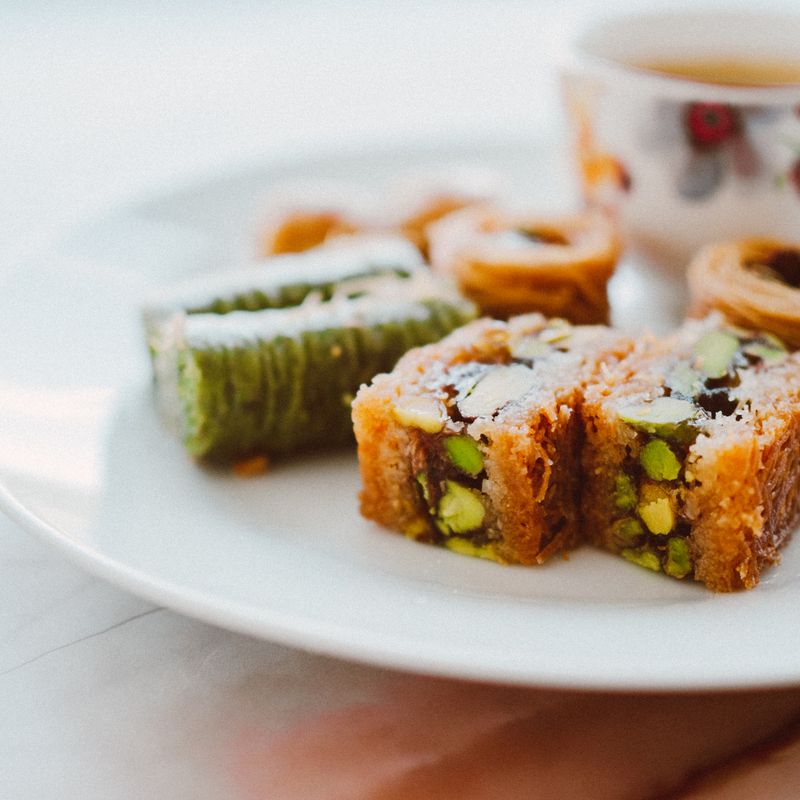
Sourdough Discard Eid Pistachio Honeyed Knots
These tender, twisted pastries combine tangy sourdough discard with fragrant roasted pistachios and a warm glaze of ghee and honey—a modern interpretation of Middle Eastern sweets, perfect for Eid celebrations. The dough is soft and cake-like from the sourdough and egg, while the pistachio filling and honey-ghee glaze add richness and complex flavor.
- Prep
- 25 min
- Cook
- 25 min
- Wait
- 2 hr 30 min
- Total
- 3 hr 20 min
- Makes
- 12 knots
Steps
Before you start
- Have active sourdough discard ready (unfed, with visible bubbles at the top)
- Set out butter and egg to reach room temperature (about 1 hour)
- Measure flour accurately by spooning into measuring cup and leveling, or use a kitchen scale
- Preheat oven to 375°F (190°C) during the second rise
Mix dough
- In a large bowl, combine 1 cup (227g) sourdough discard, 2.5 cups (312g) flour, 3 tablespoons (38g) sugar, and 1/2 teaspoon (3g) salt.
- Whisk to combine.
- Add 3 tablespoons (43g) softened butter, 1 large egg, 1/4 cup (59ml) warm milk, and 1/2 teaspoon (2.5ml) vanilla extract.
- Stir with a wooden spoon until a shaggy dough forms, about 1 minute.
- Turn onto a lightly floured surface and knead by hand for 10 minutes (or use a stand mixer with dough hook for 6 minutes) until the dough is smooth, elastic, and slightly sticky to the touch.
- The dough should feel soft and pillowy, not stiff.
+ Show details− Hide details
Ready when: Dough is smooth, elastic, and springs back when poked
Tip: If your sourdough discard is sluggish (few bubbles), feed it 4–6 hours before and let it become active. Active discard is key to good rise and tang.
First rise
- Lightly oil a large bowl and transfer the dough to it, turning to coat all sides.
- Cover with a damp kitchen towel or plastic wrap.
- Let rise at room temperature (68–72°F / 20–22°C) for about 90 minutes, until roughly doubled in volume.
- To test: gently poke the dough with a floured finger; it should spring back slowly, leaving a slight indentation.
+ Show details− Hide details
Ready when: Dough has roughly doubled, and a gentle poke springs back slowly, leaving a small indent
Prepare filling
- While the dough rises, coarsely chop 1 cup (115g) roasted pistachios so that pieces are visible (not finely ground).
- Place in a small bowl and stir in 2 tablespoons (42g) honey and 1/4 teaspoon (0.5g) ground cardamom if using.
- Mix gently until the honey coats the pistachios.
- Set aside.
+ Show details− Hide details
Ready when: Pistachios are coarsely chopped and evenly coated with honey
Tip: Chop the pistachios by hand or pulse briefly in a food processor; you want texture, not a paste.
Shape dough
- Turn the risen dough onto a lightly floured surface (about 2 tablespoons flour).
- Using a rolling pin or your hands, gently roll or pat the dough into a 10×14-inch (25×35 cm) rectangle, roughly 1/4 inch (6mm) thick.
- The dough should be pliable but not sticky; dust with flour as needed.
+ Show details− Hide details
Ready when: Dough is an even 10×14-inch rectangle about 1/4 inch thick
Fill dough
- Spread the pistachio-honey mixture evenly over the dough, leaving about 1/2 inch (1cm) of bare dough on all edges.
- Use a small offset spatula or the back of a spoon to distribute the filling gently without tearing the dough.
+ Show details− Hide details
Ready when: Filling is evenly spread with a 1/2-inch border of bare dough visible
Cut strips
- Using a sharp knife or pastry wheel, cut the filled dough into 12 equal strips.
- Cut lengthwise to create 4 long strips, then cut each strip into 3 pieces (about 1 inch / 2.5cm wide).
- Each piece should be roughly 7 inches (17.5cm) long and filled.
+ Show details− Hide details
Ready when: 12 strips of roughly equal size, each 1 inch wide and 7 inches long
Tie knots
- Working with one strip at a time, hold both ends gently between your fingers.
- Twist once (a half-turn), then tie the strip into a simple overhand knot, tucking one end underneath or through the loop to secure it loosely.
- The knot doesn't need to be tight—a gentle, loose knot looks better and keeps the filling from rupturing.
- Place each tied knot onto a parchment-lined baking sheet, spacing them about 2 inches (5cm) apart.
+ Show details− Hide details
Ready when: All 12 strips are tied into loose knots and arranged on baking sheets 2 inches apart
Tip: Don't pull too tight when tying—a loose knot is more forgiving and allows the dough to rise evenly. Tight knots can trap filling and create uneven texture.
Second riseOven 375°F / 190°C
- Cover the baking sheets loosely with damp kitchen towels or plastic wrap.
- Let the knots rise at room temperature for 45–60 minutes, until they are puffy and have increased noticeably in volume.
- They should feel light and airy when gently touched.
- While they rise, preheat your oven to 375°F (190°C).
+ Show details− Hide details
Ready when: Knots are puffy and light, visibly increased in volume but still holding their shape
Tip: Avoid overproofing; the knots should rise and feel airy, but shouldn't collapse or look flattened. If your kitchen is warm (above 75°F / 24°C), they may rise faster.
Bake knotsOven 375°F / 190°C
- Bake the knots at 375°F (190°C) for 20–25 minutes, until they are golden brown on top and around the edges.
- The knots should feel set and springy when lightly pressed (not hard, but no longer doughy).
- If they brown too quickly, loosely tent with foil for the last 5 minutes.
+ Show details− Hide details
Ready when: Knots are golden brown, feel springy and set to the touch, and smell fragrant
Tip: Oven temperatures vary; if your oven runs hot, check at 18 minutes. Knots are done when they feel firm but still slightly yielding, not hard.
Make glaze
- While the knots bake, combine 3 tablespoons (42g) ghee and 3 tablespoons (64g) honey in a small saucepan.
- Warm over low heat, stirring gently until the ghee melts and the honey thins out, about 2–3 minutes.
- Don't let it boil or brown.
- Remove from heat and let cool for 1–2 minutes so it's warm but not steaming.
+ Show details− Hide details
Ready when: Ghee is melted and blended with honey into a pourable, warm liquid
Tip: If the ghee and honey separate, stir gently off heat until smooth. Don't overheat—high heat will make the glaze bitter.
Glaze knots
- As soon as the knots come out of the oven, use a pastry brush to generously coat each one with the warm ghee-honey mixture.
- Work quickly while the knots are still hot so the glaze soaks in and doesn't slide off.
- If you like, sprinkle a tiny pinch of fleur de sel or Maldon sea salt on each while the glaze is still wet for a sweet-salty contrast.
+ Show details− Hide details
Ready when: All knots are shiny and well coated with glaze; salt (if using) clings to wet glaze
Tip: Work fast but gently—the hot knots are fragile. If the glaze cools and thickens, warm it gently for a few seconds.
Cool
- Let the glazed knots cool on the baking sheets for 10 minutes, then transfer to a wire rack if you have one (or leave on the sheet) to cool a bit more.
- The glaze will set and become sticky as they cool.
- Serve warm or at room temperature—they are delicious either way, though still-warm knots showcase the aroma and texture best.
+ Show details− Hide details
Ready when: Knots are warm and the glaze has set to a tacky, shiny coating
Good to know
Tips
- Active sourdough discard is crucial—it should have visible bubbles and smell pleasantly sour. If yours has been in the fridge or is sluggish, feed it with equal parts flour and water and let it sit at room temperature for 4–6 hours until bubbly.
- Don't overwork the dough. Sourdough is naturally more delicate than commercial yeast dough; gentle handling ensures a tender crumb and better texture.
- Shaping the knots takes a light touch—a loose knot is forgiving and rises more evenly than a tight one. Your first batch may look rustic; that's part of their charm.
- The ghee-honey glaze is best applied to hot knots straight from the oven. If it cools and thickens, gently rewarm it over low heat and brush with a light hand.
Make ahead
The dough can be mixed up to 1 day ahead; after the first rise, refrigerate it covered for up to 12 hours. Bring to room temperature (about 30–45 minutes) before rolling, filling, and proceeding. Alternatively, shape the knots after the first rise, cover, and refrigerate for up to 8 hours; let come to room temperature for about 15 minutes, then proceed with the second rise. Baked and glazed knots freeze well for up to 3 weeks; reheat unwrapped in a 300°F (150°C) oven for 8–10 minutes to warm through.
Storage & reheating
Room temperature: Store in an airtight container for 2–3 days. They dry out slowly given the honey-ghee glaze. Refrigerator: Cover and store for up to 5 days; serve at room temperature or reheat briefly. Freezer: Layer with parchment paper in an airtight container or freezer bag for up to 3 weeks; reheat as noted above.
Substitutions
- ghee (clarified butter) → Unsalted butter or salted butter. Use the same amount (3 tablespoons). Flavor will be slightly less rich and nutty, but still delicious.
- honey → Maple syrup, agave syrup, or date syrup. Use the same total amount (5 tablespoons). Each brings a different flavor profile.
- roasted unsalted shelled pistachios → Roasted walnuts, roasted almonds, or hazelnuts. Use the same amount (1 cup). The Middle Eastern character will shift, but these are equally delicious.
- active sourdough starter discard → 1/2 cup whole milk yogurt mixed with 1/2 cup flour. Adds tang but less sourdough depth. Let the mixture rest 10 minutes before adding other ingredients, and omit the warm milk.
More middle eastern sweets
See all →
Find more like this
- Meal
- Dessert
- Cuisine
- Middle Eastern
- Diet
- VegetarianHalal
- Method
- Oven
- Occasion
- Eid