
Smoky Tandoori Chicken Biryani
A fragrant, aromatic biryani featuring tandoori-marinated chicken cooked with basmati rice, caramelized onions, fresh mint, and saffron. The chicken is first tandoor-roasted until smoky and charred, then layered with partially cooked rice and aromatic spices, sealed, and slow-cooked using the dum pukht (sealed pot) method. The result is perfectly cooked rice infused with tandoori spice and succulent chicken with a smoky char.
- Prep
- 30 min
- Cook
- 1 hr 15 min
- Wait
- 2 hr
- Total
- 3 hr 45 min
- Makes
- 4 servings (about 1.5 cups per person)
Steps
Before you start
- Marinate chicken 4–8 hours or overnight for deepest flavor
- If using a tandoor oven, preheat to 475°F (240°C)
- If using a conventional oven, preheat the broiler
- Soak saffron threads in ½ cup (120 ml) warm milk at least 30 minutes ahead
- Have all aromatics prepped and ready—this recipe moves quickly once you begin layering
Marinate tandoori chicken
- In a large mixing bowl, combine yogurt, ginger paste, garlic paste, Kashmiri chili powder, tandoori masala, turmeric, crushed cumin seeds, and crumbled kasuri methi.
- Stir until evenly blended.
- Add chicken pieces, lemon juice, and salt.
- Toss gently to coat every piece with marinade.
- Drizzle with vegetable oil and mix again.
- Cover and refrigerate for at least 4 hours, preferably overnight, to allow the spices to penetrate the chicken and develop flavor.
+ Show details− Hide details
Ready when: Chicken pieces are evenly coated and fragrant
Tip: Marinate overnight if possible—longer marinating deepens the tandoori flavor and helps tenderize the chicken
Roast tandoori chicken in tandoor or broilerOven 475°F / 245°C
- If using a tandoor oven: thread marinated chicken pieces onto metal skewers, leaving ¼ inch (6 mm) space between pieces for even cooking.
- Place skewers in the preheated tandoor (475°F / 240°C) and roast for 12–15 minutes, turning skewers halfway through, until chicken is cooked through, deeply charred on edges, and smoky.
- If using a conventional oven: line a baking sheet with foil, arrange chicken pieces in a single layer (don't crowd), and broil on the top rack at 475°F (240°C) for 10–12 minutes, stirring halfway through, until chicken is charred and cooked through (internal temp 165°F / 74°C).
- Once cooked, remove chicken from skewers or baking sheet and set aside on a plate.
+ Show details− Hide details
Ready when: Chicken is fully cooked (165°F / 74°C internal temp) with dark charred edges; juices run clear
Tip: Don't overcrowd the tandoor or baking sheet—chicken needs air circulation for even charring. If pieces are large, they may take up to 18 minutes
Parboil basmati rice
- Bring 4 cups (960 ml) water to a rolling boil in a large pot over high heat.
- Add salt, cardamom pods, cinnamon stick, bay leaves, and cloves.
- Once boiling, add the rinsed and soaked basmati rice and stir gently.
- Boil for exactly 5 minutes—the rice should be about 70% cooked and still firm in the center.
- Drain immediately in a colander and set aside.
- Do not rinse.
+ Show details− Hide details
Ready when: Rice is al dente with a slight firmness when pressed; grains are not translucent all the way through
Tip: Timing is critical—undercooked rice ensures the dum cooking will finish it perfectly without making it mushy. Start timing only after the water returns to a boil
Caramelize onions
- Heat 0.33 cup (80 ml) ghee in a large skillet or sauté pan over medium-high heat.
- Once shimmering, add the sliced onions and stir occasionally for 15–18 minutes, until onions are deeply golden brown and caramelized, with edges turning crispy.
- The onions should smell sweet and nutty.
- Transfer to a plate lined with paper towels to drain excess ghee, reserving the ghee in the pan for later use.
+ Show details− Hide details
Ready when: Onions are deep golden brown with crispy edges and sweet aroma
Tip: Caramelization takes patience—don't rush by increasing heat. Stir frequently toward the end to prevent burning. Set aside about one-third of the caramelized onions for garnish
Layer biryani in cooking pot
- In a 4–5 quart (4–5 liter) pot with a tight-fitting lid, spread a thin layer of the parboiled rice on the bottom (about 1 cup / 150 g).
- Sprinkle one-third of the caramelized onions over the rice.
- Scatter one-third of the roasted tandoori chicken pieces over the onions.
- Sprinkle with half of the fresh mint and one-third of the cilantro.
- Drizzle with about 1 tablespoon (15 ml) of the saffron-milk mixture.
- Add the ginger julienne and green chili if using.
- Repeat with another layer of rice (1.5 cups / 200 g), onions, chicken, mint, cilantro, and more saffron-milk.
- Top with a final layer of remaining rice, the last of the onions, remaining cilantro, and the rest of the saffron-milk.
- Drizzle 2 tablespoons (30 ml) ghee over the top.
+ Show details− Hide details
Ready when: All ingredients are evenly distributed across three layers with saffron-milk and ghee drizzled throughout
Tip: Don't press down on the layers—keep them loose so steam can circulate during the dum cooking. The saffron milk is essential; it flavors the rice and creates the characteristic color
Seal and cook biryani on stovetop
- Place the pot over high heat for 2 minutes to create a base of steam.
- Then reduce heat to low.
- Cover the pot with a tight-fitting lid.
- If the lid doesn't seal well, place a sheet of aluminum foil under the lid before closing to trap steam (this is the dum pukht or sealed-pot method).
- Cook on low heat for 30 minutes without lifting the lid.
- You may hear gentle sizzling or popping from steam escaping—this is normal.
- After 30 minutes, turn the heat off and let the biryani rest undisturbed for another 5–10 minutes so the steam fully cooks the rice.
+ Show details− Hide details
Ready when: Steam has cooked rice completely; grains are tender but separate; no liquid remains visible at the edges
Tip: Do not lift the lid during cooking—this releases steam and disrupts the cooking process. If you hear violent sizzling, the heat is too high; reduce it slightly. A sealed pot is the secret to authentic biryani
Finish and serve
- Carefully remove the pot from heat and let it rest undisturbed for 5 minutes more.
- Remove the lid and fluff the biryani gently with a fork, breaking up any clumps and mixing the layers slightly.
- Taste and add salt if needed.
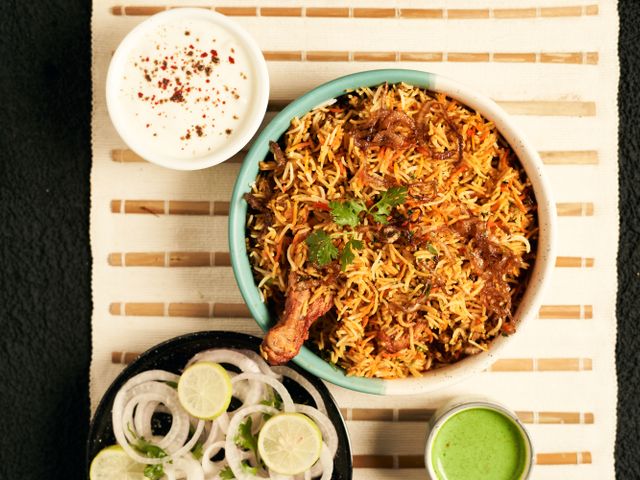
- Transfer to a serving platter or bowl, garnishing with the reserved caramelized onions, extra fresh mint, cilantro, and a few slices of fresh green chili if desired.
- Serve hot alongside raita (yogurt sauce) and a simple salad.
+ Show details− Hide details
Ready when: Rice is fluffy, fully cooked, and fragrant with cardamom and saffron; chicken is tender and smoky
Tip: Fluff gently with a fork rather than stirring vigorously to keep the grains intact. Serve immediately while the biryani is still steaming
Good to know
Tips
- The tandoor oven is traditional and imparts irreplaceable smokiness and char. If you don't have access to one, a very hot broiler is a decent substitute—the key is high, direct heat and a short cooking time.
- Saffron is expensive but non-negotiable for authentic biryani. Buy whole threads (not powder) from a reputable spice merchant. Store in an airtight jar away from light and heat; it lasts for years.
- The dum pukht (sealed-pot) method is the soul of biryani. Lifting the lid releases steam and disrupts cooking. Trust the process—do not peek.
- Caramelizing onions requires patience. Low-to-medium heat and frequent stirring are essential. Don't increase the heat; burnt onions ruin the biryani's subtle sweetness.
Make ahead
Marinate the chicken 4–8 hours ahead or the night before. Caramelize the onions up to 4 hours ahead and store at room temperature. Soak the saffron in warm milk up to 2 hours ahead. Cook the entire biryani no more than 2 hours before serving for best flavor and texture.
Storage & reheating
Store leftover biryani in an airtight container in the refrigerator for up to 3 days. Reheat gently in a covered pot over low heat on the stovetop for 10–15 minutes, stirring occasionally and adding a splash of water if it seems dry. Do not microwave, as this dries out the rice. Biryani can be frozen in an airtight container for up to 2 months; thaw overnight in the refrigerator and reheat as above.
Substitutions
- tandoori masala spice blend → use 1 tablespoon (10 g) garam masala plus 1 teaspoon (3 g) smoked paprika. This creates a similar warm spice profile, though without the exact tandoori blend. The smoked paprika mimics the tandoor's smokiness.
- basmati rice, long-grain → jasmine rice (same quantity). Jasmine rice is fragrant and will absorb spices well, though it is slightly less aromatic than basmati. Do not use short-grain rice.
- saffron threads → ½ teaspoon (1 g) turmeric plus a pinch of kashmiri red chili for color. This is a budget alternative and won't replicate saffron's delicate floral note, but it adds color and warmth to the rice.
- ghee (clarified butter) → unsalted butter or vegetable oil (same quantities). Ghee provides a rich nutty flavor authentic to biryani. Butter or oil will work but lack ghee's depth. Avoid using salted butter.
More biryani
See all →



Find more like this
- Meal
- Dinner
- Cuisine
- Indian
- Main ingredient
- Chicken ThighsBasmati Rice