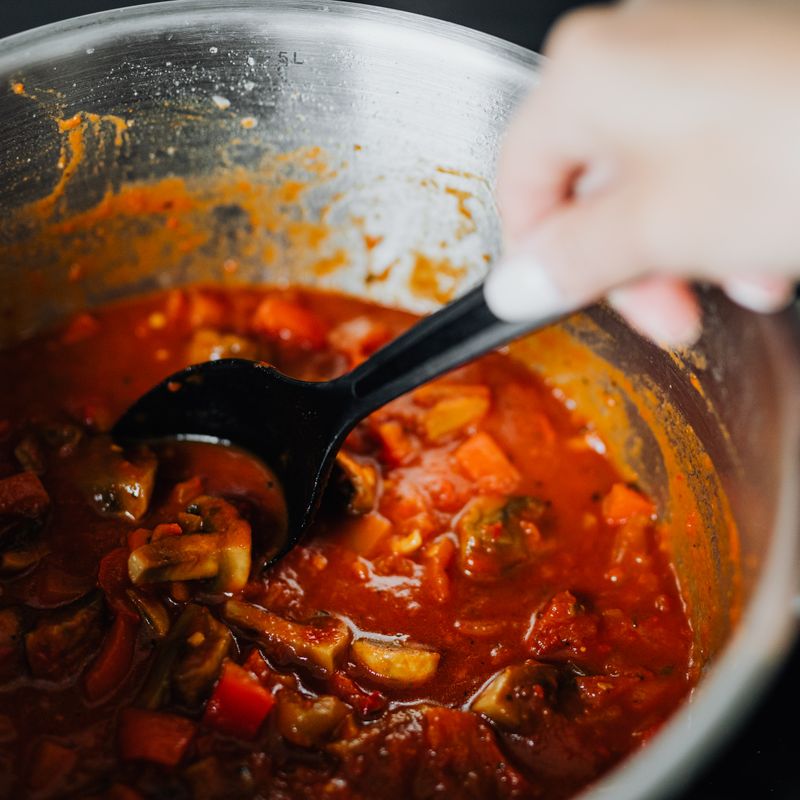
Slow-Simmered Bolognese Sauce
A rich, velvety ragù built the traditional way: finely diced soffritto, beef and pork browned well, then reduced in turn with tomato paste, white wine and whole milk before a long, gentle simmer. Toss it with tagliatelle for a deeply savory, spoon-coating sauce.
- Prep
- 20 min
- Cook
- 1 hr 28 min
- Wait
- 2 hr 20 min
- Total
- 4 hr 8 min
- Makes
- About 5 cups (1.2 L) sauce, enough for 1 lb (450 g) pasta; 6 servings at about ¾ cup (180 ml) sauce each
Steps
Before you start
- Plan on about 4 hours 10 minutes start to finish: roughly 1 hour 50 minutes hands-on (20 minutes chopping, about 88 minutes of active cooking at the stove) plus 140 minutes of the 2½-hour simmer that runs mostly unattended.
- Chop the soffritto (onion, carrot, celery) very finely, about ¼ inch (6 mm). A food processor works: pulse each vegetable separately in short bursts so it doesn't turn to mush.
- Use a wide, heavy 5½–6 qt (5–5.5 L) lidded pot. The wide surface helps the sauce brown and reduce evenly. This recipe is made entirely on the stovetop; no oven is needed.
- Take the milk out of the fridge while you chop, so it doesn't drop the pot's temperature sharply when added.
Chop the soffritto
- Finely chop the onion, carrot and celery into pieces about ¼ inch (6 mm).
- Mince the garlic and keep it separate.
- Chop the pancetta to similar-sized pieces.
- Set the meats out on a plate, breaking them into chunks so they lose their chill.
+ Show details− Hide details
Ready when: Vegetable pieces are small and uniform, roughly the size of a lentil or small pea.
Tip: Uniform small pieces melt into the sauce during the long simmer instead of leaving chunky vegetables.
Render the pancetta
- Set the heavy pot over medium heat.
- Add the olive oil, butter and pancetta.
- Cook, stirring occasionally, for about 8 minutes, until the fat has rendered and the pancetta is lightly golden at the edges.
+ Show details− Hide details
Ready when: Pancetta is pale gold and the fat in the pot looks clear and glossy.
Tip: If the butter starts to brown darkly, lower the heat slightly.
Sweat the soffritto
- Add the onion, carrot and celery with the sauce salt.
- Reduce the heat to medium-low and cook, stirring every minute or two, for about 12 minutes.
- Stir in the garlic for the last 30 seconds.
+ Show details− Hide details
Ready when: Vegetables are very soft and translucent, the onion has no raw smell, and nothing has browned.
Tip: Keep the heat gentle. You want sweet, softened vegetables rather than browned, bitter ones.
Brown the meat
- Raise the heat to medium-high.
- Add the beef and pork and break them into small crumbles with the spoon.
- Cook for about 15 minutes, stirring only every 2 minutes so the meat can brown on the pot bottom.
- Continue until all the liquid released by the meat has evaporated and the meat is deeply browned, with a fond (brown film) on the bottom of the pot.
+ Show details− Hide details
Ready when: Meat is browned and sizzling in fat rather than steaming in liquid, with no pink remaining (160°F / 71°C).
Tip: Don't rush this step. Browning gives the sauce much of its depth. If the soffritto starts to scorch, lower the heat slightly.
Toast the tomato paste
- Push the meat to the sides and add the tomato paste to the center.
- Cook, stirring and smearing it against the pot, for about 3 minutes.
+ Show details− Hide details
Ready when: Paste darkens from bright red to brick red and smells sweet and concentrated.
Reduce the wine
- Pour in the white wine and scrape up all the browned bits from the bottom of the pot with the wooden spoon.
- Simmer briskly for about 8 minutes.
+ Show details− Hide details
Ready when: The sharp alcohol smell has faded and the liquid has reduced to a few syrupy tablespoons.
Simmer in the milk
- Reduce the heat to medium.
- Add the milk and the nutmeg, if using.
- Simmer, stirring occasionally, for about 12 minutes.
- The milk will foam slightly and then slowly be absorbed.
+ Show details− Hide details
Ready when: Most of the milk has been absorbed or evaporated and the meat looks creamy, with a little fat separating at the edges.
Tip: Milk tenderizes the meat and softens the tomato's acidity. Reduce it before adding the tomatoes, since acid will curdle it.
Add tomatoes and simmer
- Stir in the crushed tomatoes, broth and bay leaf.
- Bring to a bubble, then reduce the heat to low so the surface shows only a few lazy bubbles at a time.
- Partially cover the pot with the lid slightly ajar.
- Simmer for 2½ hours (150 minutes) in total: about 10 minutes of that is stirring and scraping the bottom every 30 minutes, and the remaining 140 minutes is unattended.
- If the sauce looks dry or starts to stick, add ¼ cup (60 ml) hot water.
+ Show details− Hide details
Ready when: Sauce is thick and glossy, a spoon dragged across the bottom leaves a clear trail, and orange-tinted fat pools on the surface.
Tip: A heat diffuser or a very low flame prevents scorching. If the sauce spits, the heat is too high.
Season and finish
- Remove the bay leaf.
- Skim off some of the pooled fat if you prefer a leaner sauce.
- Taste, then add salt and black pepper as needed (start with ¼ tsp more salt).
- Keep the sauce warm over low heat while you cook the pasta.
- You should have about 5 cups (1.2 L).
+ Show details− Hide details
Ready when: Sauce tastes rounded, savory and slightly sweet, with no raw tomato edge.
Tip: Season at the end. The sauce reduces and concentrates, so earlier seasoning can end up too salty.
Cook and toss the pasta
- Bring 5 quarts (5 L) of water to a boil in the large pot and add the pasta salt (1 tbsp is plenty, since the sauce is seasoned too).
- Cook the tagliatelle 1 minute short of the package time, usually 7–9 minutes for dried egg pasta.
- Scoop out 1 cup (240 ml) of pasta water, then drain.
- Add the pasta to the sauce pot with ¼ cup (60 ml) pasta water and about 2 cups (480 ml) of the sauce.
- Toss over medium heat for 1 minute, adding more pasta water by the tablespoon if tight.
- Divide among 6 bowls and spoon about ½ cup (120 ml) of the remaining sauce over each; this gives roughly ¾ cup (180 ml) sauce per serving in total.
- Top with the Parmigiano and pass extra at the table.
+ Show details− Hide details
Ready when: Pasta is al dente (tender with a slight bite) and the sauce clings to each strand without pooling.
Tip: Finishing the pasta in the sauce helps the sauce cling to it. Serve right away. This is a rich, meaty sauce, so a lighter ½ cup per bowl is fine if you prefer.
Good to know
Tips
- Stir the sauce along the bottom every 30 minutes. A sticking sauce can scorch and taste bitter.
- Don't skip browning the meat. Pale, gray meat makes a flat-tasting sauce.
- Add a Parmigiano rind to the sauce during the simmer for extra savory depth. Remove it before serving.
- If the finished sauce tastes sharp, simmer it uncovered for 10 more minutes, or stir in ½ tsp sugar.
Make ahead
The sauce tastes even better made 1–2 days ahead. Cool it completely, cover and refrigerate, then reheat gently over low heat with a splash of water or broth, stirring often.
Storage & reheating
Room temperature: no more than 2 hours. Fridge: up to 4 days in an airtight container. Freezer: up to 3 months in portions, with the sauce cooled first. Thaw overnight in the fridge. Reheat in a saucepan over low heat, stirring and adding a splash of water or broth, until steaming hot (165°F / 74°C).
Substitutions
- pancetta → Unsmoked bacon or an extra 1 tbsp olive oil. Blanch bacon in boiling water for 2 minutes first to remove the smoke. Without pancetta, the sauce is milder but still good.
- dry white wine, such as Pinot Grigio → Dry red wine or dry vermouth. Red gives a darker, more robust sauce. Use the same amount.
- ground pork → Ground veal or more ground beef. Veal gives a more tender texture. Using all beef is fine, just use 8 oz (225 g) more beef in place of the pork.
- dried tagliatelle or fettuccine → Pappardelle, rigatoni or fresh egg pasta. Wide ribbons or tubes hold thick sauce well. Fresh pasta cooks in 2–3 minutes.
More pasta sauces
See all →


Find more like this
- Meal
- Dinner
- Cuisine
- Italian
- Main ingredient
- Ground BeefGround PorkPasta
- Diet
- Sugar-Free
- Method
- Stovetop