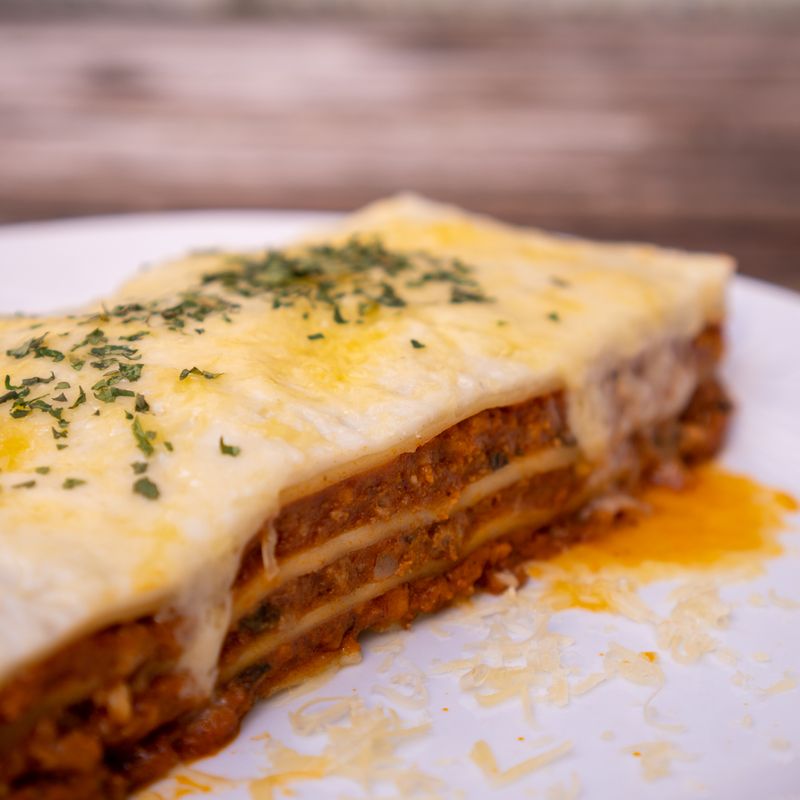
Lasagna Bolognese with Béchamel
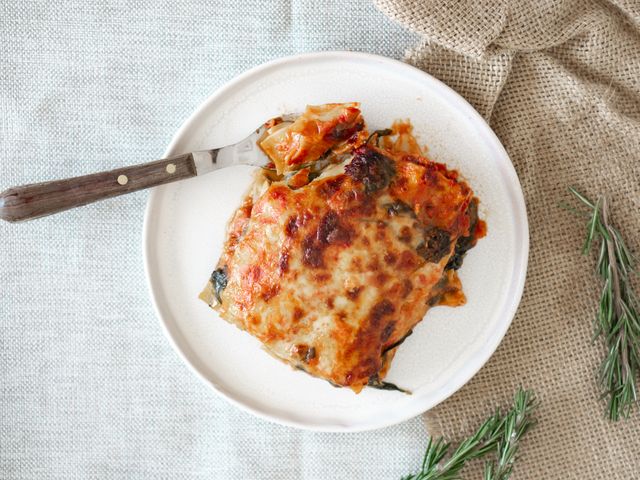
Tender fresh egg pasta layered with a slow-simmered, milk-enriched ragù alla Bolognese, silky nutmeg-scented béchamel and plenty of Parmigiano Reggiano. It bakes into a golden, bubbling, sliceable classic that is well worth the long simmer.
- Prep
- 45 min
- Cook
- 3 hr 55 min
- Wait
- 25 min
- Total
- 5 hr 5 min
- Makes
- 1 lasagna (9×13-inch dish, 8 generous portions)
Steps
Before you start
- Plan on about 5 hours start to finish, most of it hands-off ragù simmering. The ragù can be made up to 3 days ahead.
- Take the fresh pasta sheets out of the fridge 20 minutes before assembling so they unfold without cracking.
- Have the milk for the béchamel at room temperature or slightly warmed; this helps prevent lumps.
- Finely grate the Parmigiano Reggiano yourself from a wedge. Pre-grated cheese melts less smoothly.
- Place the oven rack in the center position, and set a baking sheet on the rack below to catch drips.
- Keep an instant-read thermometer handy: the ground beef and ground pork must reach at least 160°F (71°C).
Prep the ingredients
- Finely dice the pancetta, onion, carrot and celery into pieces about ¼ inch (6 mm) or smaller; a fine, even chop lets the vegetables melt into the sauce.
- Finely grate the Parmigiano Reggiano and set aside.
- Measure the milk, broth, wine and passata so everything is ready at the stove.
+ Show details− Hide details
Ready when: All vegetables and pancetta are uniformly small and the cheese is fluffy.
Tip: A food processor can chop the vegetables, but pulse in short bursts so they don't turn to paste.
Soften the soffritto
- Melt 2 tbsp (28 g) butter with the olive oil in a Dutch oven over medium heat.
- Add the pancetta and cook, stirring, for 3 minutes until the fat begins to render.
- Add the onion, carrot and celery with ½ tsp of the ragù salt.
- Cook, stirring often, for 8–10 minutes until the vegetables are soft, translucent and lightly golden at the edges.
+ Show details− Hide details
Ready when: Onion is translucent, vegetables are soft and the pancetta is lightly golden.
Tip: Don't rush with high heat; burnt browned bits will make the ragù bitter.
Brown the meat
- Raise the heat to medium-high.
- Add the beef and pork in a few clumps, breaking them up with a wooden spoon.
- Cook, stirring occasionally, for 12–15 minutes until all the liquid released by the meat has evaporated and the meat is browned in spots and sizzling in its own fat.
- Ground pork and beef must reach at least 160°F (71°C); check by inserting an instant-read thermometer into the meat.
- Season with the remaining 1 tsp ragù salt and the pepper.
+ Show details− Hide details
Ready when: No pink remains, the meat reads at least 160°F (71°C), the pot sounds like sizzling rather than bubbling, and the meat has golden-brown bits.
Tip: Let the meat sit undisturbed for a minute between stirs to encourage browning rather than steaming.
Add paste and wine
- Stir in the tomato paste and cook for 1–2 minutes until it darkens to a brick red and smells sweet.
- Pour in the white wine, scraping up the browned bits from the bottom of the pot.
- Simmer for 3–4 minutes until the wine has almost completely evaporated and the sharp alcohol smell is gone.
+ Show details− Hide details
Ready when: The pan looks nearly dry with only a thin glaze of liquid.
Simmer the ragù
- Reduce the heat to low.
- Stir in the 1 cup (240 ml) milk, passata and broth.
- Bring to a bare simmer (just a few lazy bubbles), then partially cover with the lid slightly ajar.
- Cook for 2½ hours, stirring every 20–30 minutes and scraping the bottom.
- If it looks dry before the end, add ¼ cup (60 ml) water.
- For the final 15 minutes, uncover and let it thicken.
- Check that it reads at least 160°F (71°C).
+ Show details− Hide details
Ready when: The ragù is thick and glossy, a spoon dragged across the bottom leaves a clear trail, and the fat pools at the edges. It should be thick, not soupy (about 4 cups / 950 ml), and read at least 160°F (71°C).
Tip: Taste and adjust salt at the end. A too-wet ragù will make the lasagna weep and slide when cut.
Make the béchamel
- Melt 4 tbsp (57 g) butter in a medium saucepan over medium heat.
- Whisk in the flour and cook, whisking constantly, for 2 minutes without letting it brown.
- Add the room-temperature milk in 4 additions, whisking until completely smooth after each.
- Bring to a gentle simmer, then cook 6–8 minutes, whisking often and scraping the corners, until thick enough to coat the back of a spoon.
- Off the heat, whisk in the salt and nutmeg.
+ Show details− Hide details
Ready when: The sauce coats a spoon and a finger drawn through it leaves a clean line; it should pour like thick cream (about 4 cups / 950 ml).
Tip: If lumps form, whisk vigorously or pass through a fine strainer. Press plastic wrap onto the surface if not using right away to prevent a skin.
Preheat and assembleOven 375°F / 190°C
- Heat the oven to 375°F (190°C) and set the rack in the center.
- Grease a 9×13-inch (23×33 cm) dish with the softened butter.
- Spread ¾ cup (180 ml) béchamel over the bottom.
- Then build 3 layers, each made of: a single layer of pasta sheets (slightly overlapping, trimmed to fit), one-third of the ragù (about 1⅓ cups / 315 ml), ¾ cup (180 ml) béchamel drizzled over, and 4 tbsp (about 25 g) grated Parmigiano.
- Finish with a fourth layer of pasta, the remaining béchamel (about ¾ cup / 180 ml) spread to the edges, and the remaining cheese.
+ Show details− Hide details
Ready when: Four pasta layers with the top completely covered in béchamel and cheese.
Tip: Spread the ragù thinly and evenly so every sheet is covered; uncovered pasta dries out in the oven.
Bake the lasagnaOven 375°F / 190°C
- Cover the dish loosely with foil (tent it so it doesn't touch the cheese).
- Bake for 25 minutes at 375°F (190°C), then remove the foil and bake 15 minutes more, until the top is golden brown with browned spots and the edges bubble.
+ Show details− Hide details
Ready when: Edges bubble vigorously, the top is golden, and an instant-read thermometer in the center reads 165°F (74°C).
Tip: If the top isn't browned, broil 1–2 minutes on high, watching closely.
Rest before slicing
- Let the lasagna rest on a wire rack, uncovered, for 25 minutes.
- Cut into 8 portions with a sharp knife and serve with a little extra grated Parmigiano if you like.
+ Show details− Hide details
Ready when: The bubbling has stopped and the surface is no longer liquid; a knife cuts through leaving clean layers.
Tip: Skipping the rest is the most common cause of a sloppy slice.
Good to know
Tips
- Keep the ragù thick; sauce that's too loose is the main reason lasagna turns watery.
- Use a thin, even layer of sauce between sheets. Lasagna Bolognese is about balance, not heaping layers.
- Add the nutmeg sparingly; it should be a background note you notice only when missing.
- For extra-crisp edges and top, finish under the broiler for 1–2 minutes, watching closely.
Make ahead
Make the ragù up to 3 days ahead and refrigerate (or freeze up to 3 months). The béchamel can be made 1 day ahead; press plastic wrap on the surface and gently rewarm to loosen. The lasagna can be assembled, covered and refrigerated up to 24 hours before baking; add 10–15 minutes to the covered baking time and check that the center reaches 165°F (74°C).
Storage & reheating
Room temperature: up to 2 hours after baking. Fridge: cover tightly and keep up to 4 days. Freezer: wrap portions well and freeze up to 3 months; thaw overnight in the fridge. Reheat portions covered with foil at 325°F (160°C) for 20–30 minutes (or microwave covered until steaming), until 165°F (74°C) in the center.
Substitutions
- fresh egg pasta lasagna sheets → no-boil dried lasagna sheets (about 12 oz / 340 g). Use 3 layers instead of 4 and make sure each sheet is covered by sauce; add 5–10 minutes to the covered baking time.
- dry white wine → dry red wine or an extra ½ cup (120 ml) beef broth. Red gives a slightly deeper flavor; broth makes it alcohol-free.
- pancetta → unsmoked bacon or prosciutto ends. Blanch smoked bacon 1 minute in boiling water first so it doesn't dominate.
- Parmigiano Reggiano → Grana Padano. Milder and slightly less expensive, with similar melting behavior.
More lasagna
See all →

Find more like this
- Meal
- Dinner
- Cuisine
- Italian
- Main ingredient
- Ground BeefGround Pork
- Diet
- Sugar-Free
- Quick & Easy
- Freezer Friendly
- Season
- Winter Comfort Food