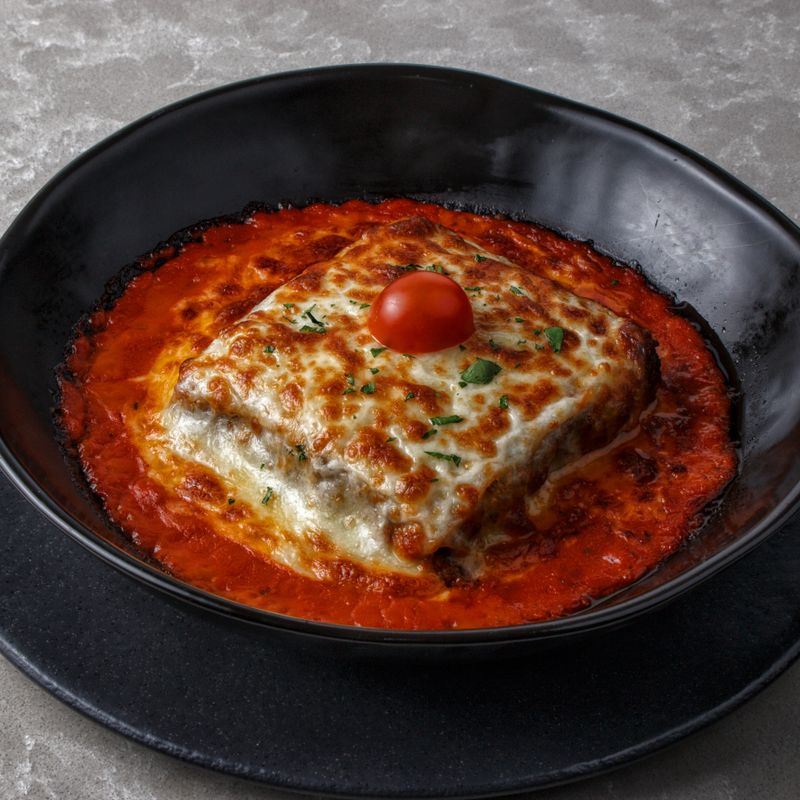
Classic Meat Lasagna
A big, bubbling Italian-American lasagna with a slow-simmered beef and sausage ragù, creamy herbed ricotta, and plenty of melted mozzarella. It's generous, sliceable, and a dependable crowd feeder that actually gets better when made ahead.
- Prep
- 42 min
- Cook
- 1 hr 57 min
- Wait
- 20 min
- Total
- 2 hr 59 min
- Makes
- 1 (9×13-inch) lasagna, 12 generous squares
Steps
Before you start
- Shred your own low-moisture mozzarella from a block if you can; it melts more smoothly than pre-shredded. Do not use fresh (water-packed) mozzarella, which makes the lasagna watery.
- Use whole-milk ricotta. If it looks wet or has liquid pooled on top, drain it in a fine-mesh sieve for 15 minutes before using.
- Plan for about 3 hours total, including a mandatory 20-minute rest after baking so the layers set and slice cleanly.
- Arrange an oven rack in the center position and set a rimmed baking sheet nearby to catch drips.
Prep the vegetables
- Finely chop the onion into ¼-inch (6 mm) pieces, grate the carrot on the small holes of a box grater, and mince the garlic.
- Keep the garlic separate from the onion and carrot because it goes in later.
- Remove the sausage from its casings.
+ Show details− Hide details
Ready when: Onion and carrot are in small, even pieces that will melt into the sauce.
Tip: Fine, even pieces disappear into the sauce so every bite is meaty rather than chunky.
Brown the meats
- Heat the olive oil in a 5-quart (4.7 L) Dutch oven or large deep skillet over medium-high heat until shimmering.
- Add the ground beef and sausage.
- Break them into small crumbles with a wooden spoon and cook, stirring occasionally, for 10–12 minutes.
- Spoon off all but about 2 tablespoons of the rendered fat.
+ Show details− Hide details
Ready when: No pink remains and the meat is lightly browned with browned bits on the bottom of the pot; the meat reaches 160°F (71°C).
Tip: Don't crowd or stir constantly. Letting the meat sit for a minute between stirs gives it better browning and more flavor.
Build the flavor base
- Reduce the heat to medium.
- Add the onion and carrot and cook, stirring, for 6 minutes until the onion is soft and translucent.
- Stir in the garlic and tomato paste and cook for 2 minutes, until the paste darkens to a brick red.
- Pour in the red wine, if using, and scrape up the browned bits from the bottom of the pot.
- Simmer for 2 minutes until the wine has mostly evaporated.
+ Show details− Hide details
Ready when: The tomato paste has darkened and smells sweet and toasty, and the pot smells of wine only faintly.
Tip: If the garlic starts to brown, lower the heat. Burnt garlic turns the sauce bitter.
Simmer the sauce
- Stir in the crushed tomatoes, tomato sauce, oregano, basil, sugar, 1 teaspoon salt, and the black pepper.
- Bring to a gentle bubble, then reduce the heat to low.
- Cover partly with the lid ajar and simmer for 30 minutes, stirring every 10 minutes.
- Taste and add more salt if needed.
- Remove from the heat.
+ Show details− Hide details
Ready when: The sauce is thick enough that a spoon dragged across the bottom leaves a trail that closes slowly. You should have about 6 cups (1.4 L).
Tip: A thick sauce is essential. A thin sauce will leak into the pan and make the layers slide apart.
Boil the noodlesOven 375°F / 190°C
- Position a rack in the center of the oven and heat it to 375°F (190°C).
- Bring 4 quarts (3.8 L) of water and the 1 tablespoon salt to a rolling boil in a large pot.
- Cook the noodles, stirring gently the first minute, for 1 minute less than the package directs (usually 8–9 minutes) until flexible but still firm.
- Drain, rinse briefly with cool water, and lay the noodles in a single layer on a lightly oiled baking sheet or parchment so they don't stick.
+ Show details− Hide details
Ready when: Noodles bend without breaking but are still slightly firm in the center (they finish cooking in the oven).
Tip: Cook all 12 noodles even though you need only about 9. A few usually tear, and spares are handy for patching.
Mix the cheese filling
- In a large bowl, stir together the ricotta, beaten eggs, ½ cup (40 g) Parmesan, parsley, ½ teaspoon salt, and nutmeg, if using, until evenly combined and spreadable.
- Divide the mozzarella into three portions: 4 ounces (113 g) for layer one, 4 ounces (113 g) for layer two, and the remaining 8 ounces (227 g) for the top.
+ Show details− Hide details
Ready when: The filling is uniformly pale with flecks of green and holds its shape on a spoon.
Assemble the layers
- Spray the 9×13-inch (23×33 cm) dish with cooking spray.
- Spread 1 cup of the meat sauce over the bottom.
- Lay 3 noodles lengthwise, overlapping slightly, and fill any gap with a torn piece.
- Dollop half the ricotta mixture over the noodles and spread it gently to the edges, then sprinkle with 4 ounces of mozzarella and spoon over about 1½ cups sauce.
- Repeat with another layer of noodles, the remaining ricotta, 4 ounces of mozzarella, and another 1½ cups sauce.
- Finish with a third layer of noodles, the remaining sauce (about 2 cups), the remaining 8 ounces of mozzarella, and ½ cup (40 g) Parmesan.
- Spray a sheet of foil with cooking spray and cover the dish loosely, sprayed side down.
+ Show details− Hide details
Ready when: The dish is full to within ½ inch (1 cm) of the rim, with noodles covered by sauce so no edge is exposed.
Tip: Make sure every noodle is covered with sauce or cheese. Exposed edges dry out and turn hard in the oven.
Bake coveredOven 375°F / 190°C
- Set the dish on the rimmed baking sheet and slide it onto the center rack of the 375°F (190°C) oven.
- Bake covered for 45 minutes.
+ Show details− Hide details
Ready when: Sauce is bubbling at the edges of the dish and the center is hot.
Tip: The foil prevents the cheese from browning before the center is hot.
Uncover and brownOven 375°F / 190°C
- Remove the foil carefully, away from your face, since steam will escape.
- Return the lasagna to the 375°F (190°C) oven and bake uncovered for 15 minutes more.
+ Show details− Hide details
Ready when: The cheese is melted with golden-brown spots, the edges bubble, and an instant-read thermometer in the center reads 165°F (74°C).
Tip: If the top isn't browned at the end, broil for 1–2 minutes, watching constantly.
Rest and slice
- Transfer the dish to a wire rack and let the lasagna rest for 20 minutes, uncovered.
- Cut into 12 squares with a sharp knife (3 across and 4 down) and lift out with a wide spatula.
+ Show details− Hide details
Ready when: The bubbling has stopped and the sauce no longer runs when you cut a corner square.
Tip: Skipping the rest produces soupy slices. The first piece is always the messiest, so cut it as a test.
Good to know
Tips
- Don't skip the sauce simmer. Reducing it for 30 minutes is what keeps the lasagna from being watery.
- Grate your own mozzarella; bagged shreds contain anti-caking starches that keep them from melting smoothly.
- Place the dish on a baking sheet because sauce can bubble over the rim and burn on the oven floor.
- Use a thermometer rather than guessing: 165°F (74°C) in the center means the egg-based filling is safely cooked and the layers are hot.
Make ahead
"Assemble the lasagna through step 7, cover tightly with foil, and refrigerate up to 24 hours. Bake straight from the fridge, adding 15 minutes to the covered bake time. The meat sauce can be made up to 3 days ahead and refrigerated."
Storage & reheating
"Room temperature: no more than 2 hours. Refrigerator: cover tightly, up to 4 days. Freezer: wrap individual squares or the whole pan well in plastic and foil, up to 3 months; thaw overnight in the fridge. Reheat squares covered at 350°F (175°C) for 20–25 minutes, or microwave a single portion for 2–3 minutes, until steaming hot and 165°F (74°C) in the center."
Substitutions
- mild or hot Italian sausage → additional ground beef or ground pork. Use 1 lb (454 g) and add ½ tsp fennel seeds and ¼ tsp red pepper flakes to replace the sausage seasoning.
- whole-milk ricotta → small-curd cottage cheese. Drain well and blend briefly for a smoother texture; the flavor is slightly tangier.
- dry red wine → beef broth. Use ½ cup (120 ml) and simmer until reduced for the same amount of time.
- dry lasagna noodles (standard, not no-boil) → no-boil lasagna noodles. Skip the boiling step, use about 9 sheets, and add ½ cup (120 ml) water to the sauce because the noodles absorb liquid as they bake.
More lasagna
See all →



Find more like this
- Meal
- Dinner
- Cuisine
- Italian
- Main ingredient
- Ground BeefMozzarellaSausage
- Quick & Easy
- Make Ahead
- Occasion
- Family Gatherings