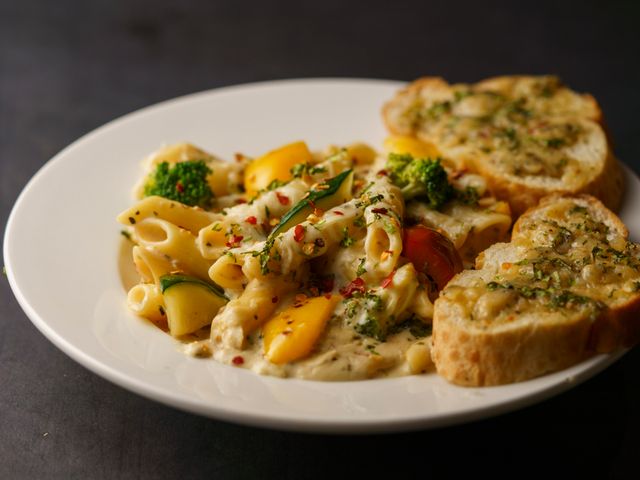
Classic Amatriciana Sauce with Guanciale and Pecorino
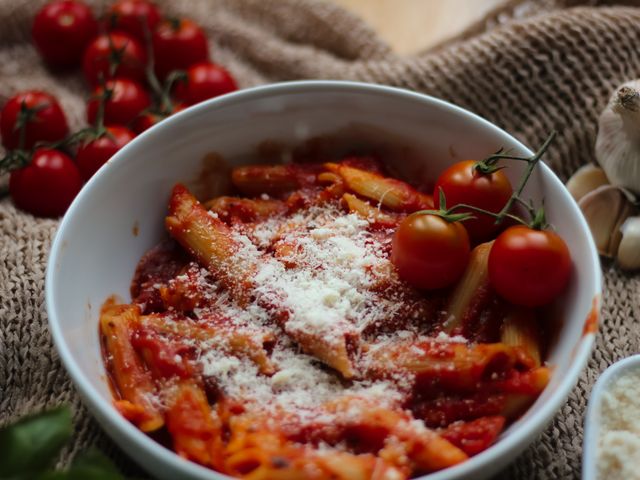
A Roman classic: crisp, rendered guanciale, a splash of white wine, sweet San Marzano tomatoes and a pinch of chili, finished with sharp Pecorino Romano. It takes under an hour and uses only a few ingredients. This makes enough sauce for 1 pound of pasta.
- Prep
- 15 min
- Cook
- 40 min
- Total
- 55 min
- Makes
- About 3 cups sauce, enough for 1 lb (450 g) pasta (4 servings)
Steps
Before you start
- Guanciale is easiest to slice when it is very cold. Keep it in the fridge until the moment you cut it.
- Grate the Pecorino Romano on the finest holes of a box grater or a rasp. Coarse shreds clump instead of melting into the sauce.
- Pecorino and guanciale are both salty. Salt the pasta water lightly as written, and do not salt the sauce until you taste it at the end.
- The timing is planned so the pasta finishes just as the sauce does: the pasta water goes on the heat when the guanciale goes in, and the pasta goes into the pot 8 minutes before the sauce is done. Read steps 2 to 5 before you begin.
Prep the ingredients
- Cut the guanciale into ¼-inch (6 mm) thick strips about 1 inch (2.5 cm) long.
- Pour the tomatoes and their juice into a bowl and crush each tomato by hand into rough ½-inch (1 cm) pieces.
- Finely grate both portions of Pecorino Romano and keep them in separate bowls.
- Fill the large pot with 4 quarts (3.8 L) of cold water and cover it with the lid.
- Do not add the salt yet.
+ Show details− Hide details
Ready when: Tomatoes are in rough pieces with no whole tomatoes left.
Tip: Crush the tomatoes by hand rather than blending them. Blending turns the sauce pale and thin.
Render the guanciale
- Set the covered large pot of water on the stove over high heat so it heats while you cook the sauce.
- Put the guanciale in the cold 12-inch (30 cm) skillet and set it over medium-low heat.
- Cook for 10–12 minutes, stirring every minute or two.
- The fat will slowly melt out and the meat will shrink.
- Expect about ¼ cup (60 ml) of fat in the pan.
- Tilt the pan and spoon off the excess into a small heatproof bowl, leaving about 3 tablespoons (45 ml) in the skillet.
- Discard the extra fat once it cools.
+ Show details− Hide details
Ready when: The pieces are golden at the edges and chewy-crisp, and about 3 tablespoons of clear fat remain in the pan after you spoon off the excess.
Tip: Start in a cold pan. A hot pan browns the outside before the fat has melted out.
Bloom chili and add wine
- Sprinkle the chili flakes into the skillet and stir for 20–30 seconds, until fragrant.
- Pour in the wine, raise the heat to medium-high, and scrape up the browned bits on the bottom of the pan.
- Simmer for 2–3 minutes.
+ Show details− Hide details
Ready when: The wine has reduced by about two-thirds and no longer smells sharply of alcohol.
Tip: Do not let the chili flakes sit in the dry fat for more than 30 seconds. They will burn and turn bitter.
Simmer the tomatoes
- Add the crushed tomatoes and all their juice to the skillet.
- Stir, then bring to a gentle bubble.
- Reduce the heat to medium-low and simmer uncovered, stirring every 5 minutes.
- This simmer lasts 20 minutes in total.
- Keep the pasta water covered on high heat; it should be at a full boil by the time you finish this step (about 12 minutes into the sauce simmer).
- If it boils earlier, reduce its heat to medium to hold it.
+ Show details− Hide details
Ready when: After the first 12 minutes the sauce is bubbling gently and the pasta water is at a full rolling boil.
Tip: Keep the simmer gentle, with small bubbles. A hard boil makes the sauce spatter and taste harsh.
Cook the pasta
- Uncover the large pot of boiling water, stir in the Diamond Crystal salt, then add the pasta.
- Stir for the first minute so it doesn't stick.
- Cook for 2 minutes less than the package time (usually 7–9 minutes).
- Meanwhile the sauce in the skillet keeps simmering gently for its last 8 minutes, stirring once or twice.
- By the end the sauce should have reduced to about 3 cups (700 ml).
- The pasta will finish cooking in the sauce.
+ Show details− Hide details
Ready when: The pasta bends easily but still has a firm white core when you bite a piece. The sauce is thick enough that a spoon dragged through the pan leaves a trail that closes slowly, and the oil has turned deep orange.
Tip: Bucatini often needs a minute or two longer than spaghetti. Bite a strand to check before draining.
Reserve water and drain
- Scoop out 1 cup (240 ml) of the starchy pasta water into a heatproof measuring cup.
- Drain the pasta in the colander without rinsing it.
- Taste the sauce and add a little salt only if it needs it.
+ Show details− Hide details
Ready when: The sauce tastes balanced, with sweetness from the tomatoes, salt from the guanciale and a light chili warmth.
Tip: Reserve the water before you drain. It is easy to forget, and the starch is what makes the sauce cling.
Toss pasta with sauce
- Turn the skillet to medium heat.
- Add the drained pasta and ¼ cup (60 ml) of the pasta water.
- Toss with tongs for 1–2 minutes, until the sauce coats every strand.
- Add more pasta water 2 tablespoons at a time if the sauce looks tight.
+ Show details− Hide details
Ready when: The sauce is glossy and clings to the pasta, with only a little loose sauce pooling in the pan.
Tip: If the sauce looks dry, add water a little at a time. It is easier to loosen than to thicken.
Add the Pecorino
- Remove the skillet from the heat and let it sit for 30 seconds.
- Sprinkle in the ½ cup (50 g) Pecorino from the sauce portion and toss vigorously for 30 seconds.
- Loosen with a splash of pasta water if the cheese clumps.
+ Show details− Hide details
Ready when: The cheese has melted into a creamy, orange-pink sauce with no visible clumps.
Tip: Adding cheese off the heat keeps it from turning stringy or clumpy.
Plate and serve
- Divide the pasta among 4 warmed bowls, spooning the guanciale and sauce from the bottom of the pan over the top.
- Sprinkle each bowl with the remaining Pecorino and add black pepper if you like.
- Serve immediately.
+ Show details− Hide details
Tip: Serve right away. The sauce keeps absorbing into the pasta as it sits.
Good to know
Tips
- Authentic Amatriciana does not use garlic or onion. If you want them anyway, cook 1 finely chopped small onion in the guanciale fat for 5 minutes before adding the chili.
- Adjust the heat to taste. 1 teaspoon of chili flakes gives gentle warmth, and 1½ teaspoons makes it noticeably spicy.
- Bucatini and spaghetti are the classic shapes, and rigatoni also works well because the sauce gets inside the tubes.
- Do not add oil to the pasta water. It keeps the sauce from clinging.
Make ahead
The sauce can be made up to 3 days ahead through step 4, simmering the full 20 minutes and leaving out the pasta and cheese. Cool it, then refrigerate in an airtight container. To finish, reheat the sauce in the skillet over medium-low heat until bubbling. At the same time, bring the pot of water to a boil, then cook the pasta as in step 5 and continue with steps 6 through 9.
Storage & reheating
Room temperature: no more than 2 hours. Fridge: sauce keeps up to 3 days, and dressed pasta keeps up to 2 days in an airtight container. Freezer: sauce made without the cheese freezes up to 3 months. Thaw it overnight in the fridge. Reheat sauce in a skillet over medium-low heat until bubbling. Reheat dressed pasta in a skillet over medium-low heat with a splash of water, stirring until hot throughout.
Substitutions
- guanciale → pancetta. Pancetta is leaner and less rich, with a milder flavor. Add 1 tablespoon of olive oil to the pan with it. Do not use smoked bacon, because the smoke will take over the sauce.
- Pecorino Romano → Parmigiano-Reggiano. The sauce will be milder and slightly sweeter. Use the same amount.
- whole peeled San Marzano tomatoes with their juice → good-quality canned whole peeled plum tomatoes. Use the same weight. If they taste acidic, simmer 5 minutes longer.
- dry white wine → water with 1 teaspoon white wine vinegar. Use ½ cup (120 ml) water. The sauce will be a little less complex.