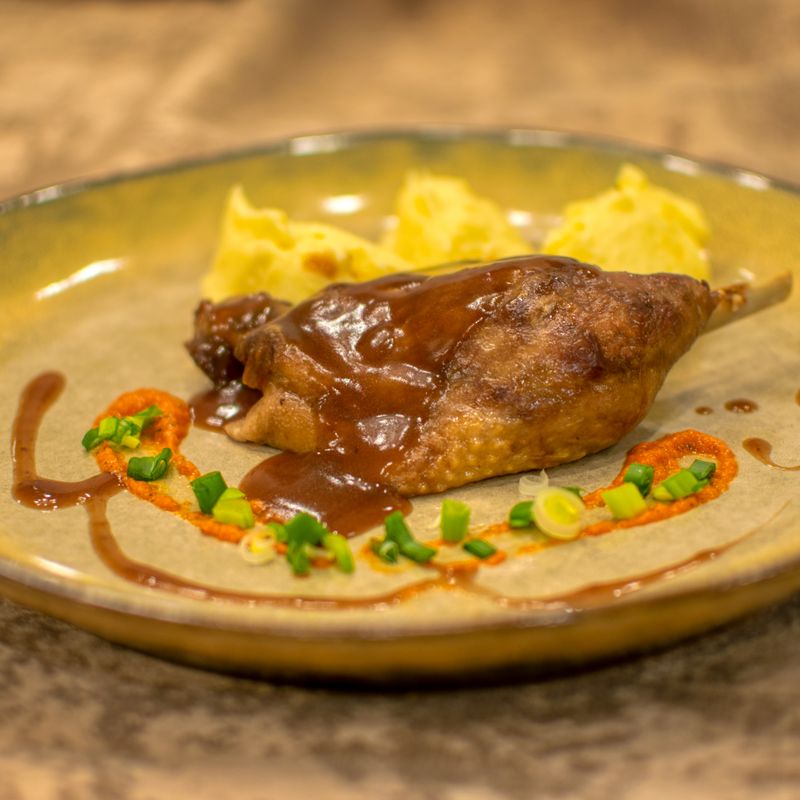
Slow Cooker Duck Confit and Cherry Sauce
Succulent slow-cooked duck legs infused with aromatic herbs, then shredded and combined with a glossy cherry and red wine sauce. This French-style ragù develops deep, complex flavors over hours of gentle cooking and is ideal spooned over fresh pasta, creamy polenta, or crusty bread. The sweet-tart cherries balance the rich duck fat for an elegant yet comforting dish.
- Prep
- 20 min
- Cook
- 8 hr
- Wait
- 30 min
- Total
- 8 hr 50 min
- Makes
- 4 servings (about 1¼ cups sauce with shredded duck per serving)
Steps
Before you start
- Pat duck legs dry with paper towels to help them brown
- Measure out all ingredients and have them ready before starting
- Read through the full recipe; the slow cooker cooking time is 8 hours
- Ensure your slow cooker is clean and ready to use
Brown the duck legs
- Heat a large skillet or Dutch oven over medium-high heat (about 6–7 on a standard dial).
- Once hot, place the patted-dry duck legs skin-side down in the skillet.
- Sear for 4–5 minutes until the skin is golden and crispy; most of the duck fat will render out.
- Flip the legs and sear the underside for 2–3 minutes.
- Transfer the duck legs to a plate.
- Reserve 2 tablespoons of the rendered duck fat in the skillet and carefully pour off any excess into a container (save it for other cooking).
+ Show details− Hide details
Ready when: Skin is golden brown and most fat has rendered
Tip: Don't skip browning; it builds deep flavor and renders much of the fat. Pat the duck completely dry before searing or it will steam instead of brown.
Sauté aromatics
- In the same skillet with the reserved duck fat over medium heat, add the sliced shallots and cook for 3–4 minutes, stirring occasionally, until they soften and turn translucent.
- Add the minced garlic and cook for another 1 minute until fragrant.
- Stir in the tomato paste and cook for 1 minute to deepen the flavor.
+ Show details− Hide details
Ready when: Shallots are soft and pale gold, garlic is fragrant
Tip: Cooking the tomato paste in fat for a minute intensifies its umami flavor—don't skip this step.
Deglaze with wine
- Pour the red wine into the skillet, scraping up all the browned bits from the bottom with a wooden spoon (this is fond, pure flavor).
- Simmer for 2–3 minutes to reduce the wine slightly and cook off some of the harsh alcohol.
+ Show details− Hide details
Ready when: Wine is slightly reduced and no raw alcohol smell remains
Tip: Scraping the fond is essential—that's where the best flavor lives.
Transfer to slow cooker
- Pour the wine mixture into a 4-quart slow cooker.
- Add the stock, thyme sprigs, and bay leaf.
- Return the browned duck legs to the slow cooker, nesting them in the liquid.
- Season with the kosher salt and black pepper.
- Stir gently to combine.
+ Show details− Hide details
Ready when: All ingredients are in the slow cooker and liquid partially submerges the duck
Tip: Nestle the duck legs so they are mostly submerged but not fully buried; this helps them cook evenly.
Slow cook the duck
- Cover the slow cooker and cook on the low setting for 8 hours.
- The duck legs should be very tender, almost falling off the bone, and the braising liquid should have turned rich and gelatinous.
- If cooking on high, reduce the time to 5–6 hours (though low and slow yields better results).
+ Show details− Hide details
Ready when: Duck legs shred easily with a fork; meat is very tender
Tip: Resist opening the lid during cooking; each time you open it, you add 15–20 minutes to the cooking time.
Shred and strain
- Using tongs, transfer the cooked duck legs to a cutting board and let cool for 5 minutes.
- Meanwhile, pour the braising liquid through a fine-mesh strainer into a large bowl, discarding the thyme sprigs and bay leaf.
- Once the duck is cool enough to handle, pull the meat from the bones, shredding it into bite-sized pieces; discard the bones and skin (or reserve the skin for crackling, if desired).
- You should have about 2 cups of shredded duck meat.
+ Show details− Hide details
Ready when: Meat pulls cleanly from the bones; strain is complete
Tip: Save the braising liquid; it's the base for your sauce and contains all the collagen and gelatin that makes it silky.
Skim fat and measure
- Let the strained braising liquid rest for 5 minutes so the fat rises to the surface.
- Using a skimmer or shallow spoon, remove most of the surface fat, leaving a thin sheen (about 1 tablespoon of fat in the liquid for richness).
- You should have about 1½ cups of braising liquid.
- If you have less, add stock or cherry juice to reach 1½ cups.
+ Show details− Hide details
Ready when: Liquid is relatively clear with only a thin layer of fat on top
Tip: Skimming most of the fat gives you a more refined sauce, but a thin sheen adds silkiness without greasiness.
Build the cherry sauce
- In a small saucepan over medium heat, combine the measured braising liquid with the pitted cherries, red wine vinegar, sugar, and salt and pepper to taste.
- Bring to a gentle simmer and cook uncovered for 8–10 minutes.
- The cherries will begin to soften and release their juice, and the liquid will reduce slightly and take on a garnet color.
+ Show details− Hide details
Ready when: Cherries are tender and liquid is noticeably reduced and darker in color
Tip: The vinegar and sugar balance each other—start with equal amounts and adjust to your taste. Taste the sauce before thickening.
Thicken the sauce
- In a small bowl, whisk together the cornstarch and water until smooth (this is a slurry).
- Increase the heat to medium-high and slowly drizzle the cornstarch slurry into the simmering sauce while stirring constantly.
- Simmer for another 1–2 minutes, stirring, until the sauce thickens and becomes glossy.
- It should coat the back of a spoon lightly.
+ Show details− Hide details
Ready when: Sauce coats a spoon and falls back smoothly; no starchy taste remains
Tip: Whisk the cornstarch into cold water first, or it will lump in the hot sauce. Add it slowly and stir constantly.
Combine duck and sauce
- Remove the saucepan from the heat and gently fold the shredded duck meat into the cherry sauce.
- Stir until the duck is evenly coated.
- Taste and adjust seasoning with salt, pepper, and a pinch more vinegar if needed.
- The sauce should be rich, slightly sweet, and gently tart.
+ Show details− Hide details
Ready when: Duck is evenly coated and heated through; flavors are balanced
Tip: Fold gently to keep the meat tender; rough stirring can shred it into stringy pieces.
Rest and finish
- Let the finished ragù rest off the heat for 5 minutes.
- This allows the flavors to meld and the sauce to become silkier.
- Just before serving, stir in the chopped fresh parsley.
- Ladle over warm pasta, creamy polenta, or crusty bread.
+ Show details− Hide details
Ready when: Sauce is smooth and glossy, parsley is stirred in
Tip: Add the parsley just before serving so it retains its bright color and fresh flavor.
Good to know
Tips
- Duck legs benefit from long, gentle cooking; don't rush by using the high setting on the slow cooker. Low and slow (8 hours) produces meat so tender it falls from the bone.
- Make sure your slow cooker is large enough (4-quart minimum) so the duck legs fit comfortably and are mostly submerged. Overcrowding leads to uneven cooking.
- The flavor improves dramatically if made 1–2 days ahead. The sauce becomes deeper and the duck absorbs the cherry-wine flavors. Reheat gently on the stovetop.
- Pair this ragù with egg tagliatelle, hand-torn pappardelle, creamy polenta, or mashed potatoes. A few crispy duck skin cracklings scattered on top add textural contrast.
Make ahead
This ragù improves when made 1–2 days ahead. Prepare through step 9 (combining duck and sauce), cool completely, then refrigerate in an airtight container. Gently reheat over low heat on the stovetop (do not boil), add a splash of stock if it thickens too much, and stir in fresh parsley just before serving.
Storage & reheating
Refrigerate in an airtight container for up to 4 days. Freeze for up to 3 months. To reheat from refrigerated: warm gently over medium-low heat, stirring occasionally, until heated through (about 10–15 minutes). To reheat from frozen: thaw in the refrigerator overnight, then reheat as above. Do not microwave, as the sauce can break. Add a splash of stock if the sauce has reduced too much after storage.
Substitutions
- fresh or frozen pitted red cherries → Dried cherries (use ¾ cup / 100 g, soaked in warm water for 30 minutes before adding) or canned pitted sour cherries (1½ cups / 350 g, drained and rinsed). Dried cherries give a more concentrated flavor and chewier texture; canned are convenient and yield a slightly softer result. Adjust sugar and vinegar to taste.
- dry red wine (Burgundy or Pinot Noir preferred) → Beef or duck stock with 1 tablespoon red wine vinegar added for acidity. You'll lose some depth and tannin structure, but the braise will still be rich. This is useful if avoiding alcohol.
- fresh thyme sprigs → 1½ teaspoons dried thyme or ½ teaspoon herbes de Provence. Dried herbs are less fragrant; use about one-third the amount of fresh. Add them in step 4.
- cornstarch → 1 tablespoon slurry made from potato starch or arrowroot (mixed with 1 tablespoon cold water). These thicken more smoothly and give a glossier sauce than cornstarch, though they break down if reheated repeatedly.
More sauces
See all →




Find more like this
- Meal
- Dinner
- Cuisine
- French
- Method
- Slow Cooker
- Quick & Easy
- Make Ahead