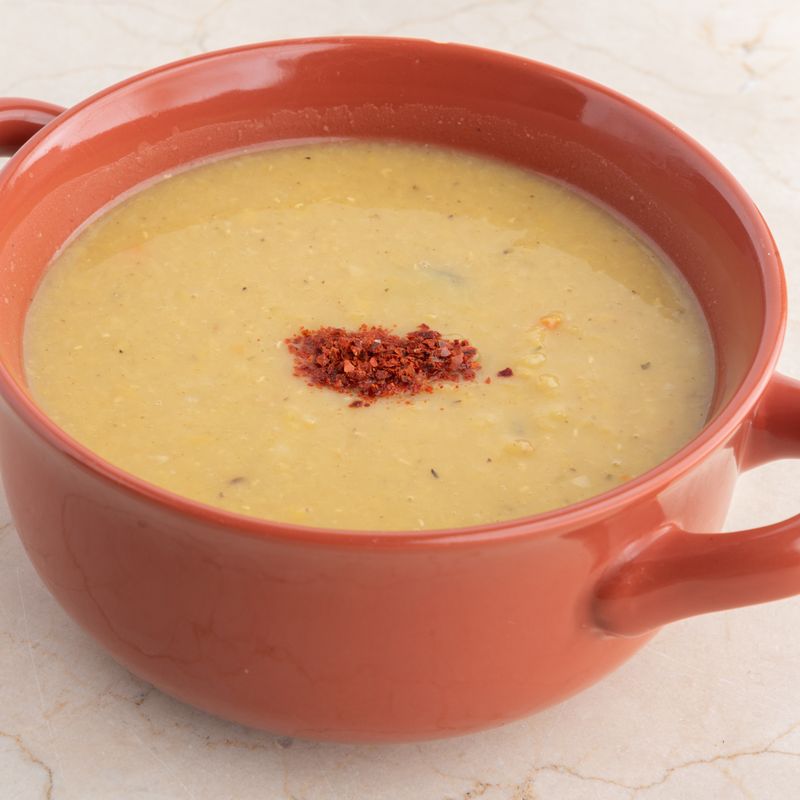
Scotch Broth Base
A rich, mellow Scottish lamb broth built on bone-in lamb neck, pearl barley, onion, carrot and leek. It's hearty enough to serve as a meal and works as the foundation for any Scotch broth variation.
- Prep
- 20 min
- Cook
- 2 hr 10 min
- Wait
- 25 min
- Total
- 2 hr 55 min
- Makes
- About 2 liters (8 cups) broth with barley, vegetables and shredded lamb (6 bowls)
Steps
Before you start
- Ask your butcher for bone-in lamb neck cut into 1½- to 2-inch (4–5 cm) slices, or cut them yourself with a heavy cleaver.
- Read the timing: the lamb simmers 1 hour on its own before the barley and vegetables go in, so don't add them early or they will turn to mush.
- Leeks hold grit between their layers, so plan to wash them thoroughly after slicing.
- Use a pot of at least 5 quarts (4.7 L) so the broth can simmer gently without boiling over.
Prep barley and vegetables
- Rinse the pearl barley in a fine-mesh strainer under cold running water for about 1 minute, shaking, until the water runs mostly clear.
- Drain and set aside.
- Dice the onion and carrots into ½-inch (1.3 cm) pieces.
- Slice the leek, wash the slices in a bowl of cold water, swishing to release grit, then lift out and drain.
- Keep the pale parts and the dark green tops in two separate piles.
+ Show details− Hide details
Ready when: Vegetables are in even ½-inch pieces and the leeks are grit-free.
Tip: Lift the leeks out of the water rather than pouring it off, so the grit stays in the bowl.
Start and skim lamb
- Put the lamb neck slices in the pot and add the 2.5 L (10½ cups) cold water.
- Set over medium-high heat and bring slowly to a bare boil, about 10 minutes.
- As grey-white foam rises, skim it off with a spoon.
- Keep skimming for about 10 minutes, until little new foam appears.
+ Show details− Hide details
Ready when: The surface is mostly clear with only a few small bubbles of foam left.
Tip: Starting with cold water draws impurities out of the meat, giving a clearer broth.
Simmer the lamb
- Add the bay leaf, thyme sprigs and peppercorns.
- Reduce the heat to low so the surface only trembles with a few lazy bubbles.
- Cover with the lid slightly ajar and simmer for 1 hour.
+ Show details− Hide details
Ready when: The meat is starting to loosen from the bones and the broth smells savory and rich.
Tip: A hard boil makes the broth cloudy and the lamb tough, so keep it at a gentle simmer.
Add barley and vegetables
- Stir in the rinsed barley, onion, carrots, the pale leek slices, and 2 tsp (10 g) kosher salt.
- Return to a gentle simmer, cover with the lid ajar, and cook for 30 minutes, stirring once or twice to keep the barley from sticking to the bottom.
+ Show details− Hide details
Ready when: Carrots are nearly tender when pierced with a knife and the barley is swollen but still slightly chewy.
Tip: Barley absorbs liquid as it cooks; if the pot looks dry, add up to 1 cup (240 ml) hot water.
Lift out the lamb
- With tongs, transfer the lamb pieces to a cutting board.
- Add the dark green leek tops to the pot and keep simmering on low for 10 more minutes.
- Let the lamb cool for 10 minutes while the barley finishes.
+ Show details− Hide details
Ready when: Barley is tender with a slight chew in the center and the lamb meat pulls easily from the bone.
Tip: Fish out the bay leaf and thyme stems now if you can see them.
Shred the meat
- Pull the meat from the bones, discarding bones, gristle and large pieces of fat.
- Shred or chop the meat into bite-size pieces, about ½ inch (1.3 cm).
- You should have roughly 2 cups (about 280 g) of meat.
+ Show details− Hide details
Ready when: Meat shreds easily with no resistance; internal temperature was about 190–200°F (88–93°C) before cooling.
Tip: Don't discard the marrow or small bits clinging to the bones; they add flavor if stirred into the broth.
Return meat and season
- Return the shredded lamb to the pot and bring back to a gentle simmer over low heat for 5 minutes to warm through.
- Taste the broth and add more salt, ¼ teaspoon at a time, until it tastes savory and well rounded.
+ Show details− Hide details
Ready when: Broth tastes savory and balanced, and meat is hot throughout.
Tip: Season at the end: the broth reduces slightly and barley absorbs salt, so early seasoning can mislead.
Rest, skim and finish
- Turn off the heat and let the pot stand for 10 minutes so the fat rises.
- Skim excess fat from the surface with a ladle or spoon.
- Stir in the chopped parsley and serve hot in wide bowls, or cool and store as a base.
+ Show details− Hide details
Ready when: Broth has only a thin film of fat on top and is rich, golden and full of tender barley and vegetables.
Tip: For easiest fat removal, chill the broth overnight and lift off the solid fat layer.
Good to know
Tips
- Keep the simmer gentle throughout; a rolling boil emulsifies fat into the broth and makes it cloudy and greasy.
- Dice the vegetables evenly so they finish cooking at the same time as the barley.
- Chilling the broth overnight makes defatting effortless and deepens the flavor.
- To use as a base for other Scotch broth variations, add diced turnip or swede and split peas along with the barley in step 4.
Make ahead
"Make the whole broth up to 2 days ahead. Cool quickly, refrigerate, and lift off the solidified fat before reheating. The barley will thicken the broth as it stands; thin with a splash of hot water when reheating."
Storage & reheating
"Room temperature: no more than 2 hours. Refrigerator: up to 4 days in an airtight container. Freezer: up to 3 months in freezer-safe containers, leaving 1 inch (2.5 cm) headspace (barley softens slightly after freezing). Reheat gently in a pot over medium-low heat until steaming hot (165°F/74°C), adding water to loosen; thaw frozen broth overnight in the fridge first."
Substitutions
- bone-in lamb neck → Bone-in lamb shoulder chops or lamb shanks. Shanks may need an extra 20–30 minutes in the first simmer; shoulder chops are about the same time.
- pearl barley → Pot barley. Pot barley retains more bran and needs 15–20 minutes longer, plus about ½ cup (120 ml) more water.
- leek → Extra onion (½ large) plus 1 celery rib. Flavor is slightly less sweet and delicate but still good.
- fresh thyme sprigs → ½ tsp dried thyme. Add with the bay leaf in step 3.
More broths
See all →


Find more like this
- Meal
- Dinner
- Main ingredient
- Lamb
- Method
- Stovetop
- Season
- Winter Comfort Food