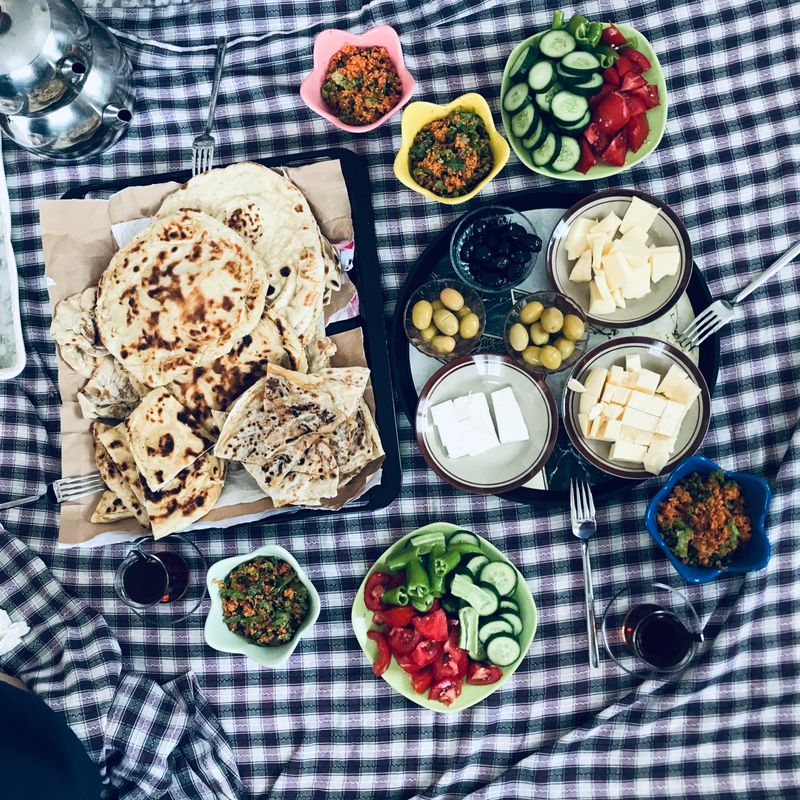
Ramadan Savory Beet and Feta Cheese Flatbread Triangles
Crispy, golden flatbread triangles filled with roasted beets, creamy feta cheese, fresh dill, and toasted caraway seeds. Built on sourdough discard, these are ideal for breaking the fast—earthy, bright, and rich. Serve warm with a dollop of yogurt or sour cream.
- Prep
- 25 min
- Cook
- 35 min
- Wait
- 1 hr
- Total
- 2 hr
- Makes
- 12 flatbread triangles (serves 4–6 as an appetizer or light main)
Steps
Before you start
- Bring sourdough discard to room temperature if it has been refrigerated (30 minutes)
- Roast beets ahead (up to 2 days prior) and store in an airtight container in the fridge
- Measure all dry ingredients and have feta crumbled before starting
Mix the dough
- In a large bowl, combine the sourdough discard, all-purpose flour, olive oil, kosher salt, and warm water.
- Stir with a fork until the mixture is shaggy and all flour is hydrated.
- The dough should be slightly sticky but hold together.
+ Show details− Hide details
Ready when: all flour is incorporated and dough is cohesive
Tip: Don't overwork the dough; a loose, slightly sticky texture is ideal for a tender flatbread.
Knead and rest
- Knead the dough on an unfloured surface for 2–3 minutes until it becomes smooth and elastic.
- Shape into a ball, place it in the bowl, cover with a damp kitchen towel, and let it rest at room temperature for 45–60 minutes.
- The dough should increase by about 30% in volume.
+ Show details− Hide details
Ready when: dough is noticeably puffier and jiggles when the bowl is tapped
Tip: This bulk fermentation step is short because sourdough discard provides ready-to-use yeasts and bacteria; don't skip it or the flatbread will be dense.
Prepare the filling
- While the dough rests, make the filling.
- In a small bowl, gently fold together the cubed roasted beets, crumbled feta cheese, fresh dill, and toasted caraway seeds.
- Season with freshly ground black pepper to taste.
- Let the mixture sit uncovered so excess moisture can evaporate slightly (5–10 minutes).
+ Show details− Hide details
Ready when: filling is well combined and no liquid pools at the bottom of the bowl
Tip: Don't add salt to the filling; feta is already quite salty, and excess salt will draw more moisture from the beets.
Shape the flatbread baseOven 400°F / 205°C
- Preheat your oven to 400°F (204°C).
- Line a 9×13-inch (23×33 cm) baking sheet with parchment paper.
- Transfer the rested dough onto the parchment and gently stretch it into a thin rectangle approximately 8×12 inches (20×30 cm), leaving a ½-inch (1.25 cm) border all around.
- Use your fingertips to avoid tearing; if dough resists, let it rest for 2 minutes before stretching further.
+ Show details− Hide details
Ready when: dough is stretched to an even, thin rectangle without visible thick spots
Tip: If the dough tears slightly, just pinch it closed; these imperfections disappear during baking.
Fill the flatbread
- Spread the beet-and-feta filling evenly over the dough base, leaving the ½-inch (1.25 cm) border clear.
- Distribute the filling in an even layer so each triangle will have balanced filling.
+ Show details− Hide details
Ready when: filling is spread in a thin, even layer across the entire dough rectangle
Tip: Don't overfill; too much filling will cause the flatbread to tear or bake unevenly.
Fold and cut into triangles
- Starting at a short end, fold the dough in half over the filling, creating a rectangle approximately 4×12 inches (10×30 cm).
- Lightly press to seal.
- Using a sharp knife, cut the rectangle diagonally from corner to corner, then make parallel diagonal cuts to create 12 triangular pieces.
+ Show details− Hide details
Ready when: dough is folded cleanly and cut into 12 roughly equal triangular pieces
Tip: Clean the knife between cuts with a damp cloth to prevent sticking and ensure clean edges.
Arrange on the baking sheet
- Carefully transfer the triangles to the lined baking sheet, spacing them about 1 inch (2.5 cm) apart.
- They will expand slightly during baking, so don't crowd them.
+ Show details− Hide details
Ready when: triangles are evenly spaced and stable on the parchment
Tip: If the filling seeps out slightly during handling, that's normal; use a small spoon to return it to the triangle.
Apply egg wash and garnish
- Beat the large egg with 1 tablespoon of water in a small bowl.
- Using a pastry brush, lightly coat the top and sides of each triangle.
- Brush the entire baking sheet lightly with extra-virgin olive oil.
- If desired, sprinkle a tiny pinch of fleur de sel on top of each triangle.
+ Show details− Hide details
Ready when: all triangles are evenly brushed with egg wash and oil
Tip: Don't oversaturate with egg wash; a thin, even coat is all that's needed for a golden crust.
Bake until goldenOven 400°F / 205°C
- Transfer the baking sheet to the preheated 400°F (204°C) oven and bake for 18–22 minutes, until the triangles are deep golden brown on top and the edges are crispy and caramelized.
- Rotate the baking sheet halfway through baking (around 10 minutes) to ensure even browning.
+ Show details− Hide details
Ready when: triangles are deep golden brown, edges are caramelized and crispy, and a skewer inserted into a triangle comes out clean
Tip: Every oven bakes differently; if your triangles are browning too fast, lower the temperature to 375°F (190°C) and add 2–3 minutes to the baking time.
Cool and serve
- Remove the baking sheet from the oven and let the triangles cool on the pan for 3–5 minutes.
- This allows them to set slightly and become even crispier.
- Transfer to a serving platter.
- Serve warm or at room temperature with a dollop of plain Greek yogurt or sour cream on the side, if desired.
+ Show details− Hide details
Ready when: triangles are firm to the touch and no longer steaming
Tip: Serve within 30 minutes of baking for the best texture; leftover triangles can be gently reheated in a 300°F (150°C) oven for 5 minutes.
Good to know
Tips
- To roast beets from scratch: wash 4–5 medium beets, wrap individually in foil, and roast at 375°F (190°C) for 45–60 minutes until fork-tender. Cool, peel under cool running water, and cut or grate as needed.
- For a more pronounced sourdough flavor, let the dough rise for up to 90 minutes after the initial knead; the longer fermentation deepens the tang without overproofing.
- These flatbreads are excellent served alongside a simple tomato salad dressed with olive oil and sumac, or with a creamy labneh for a rich contrast.
- If you prefer less earthy flavor, reduce the roasted beets to 1 cup (220 g) and add ½ cup (85 g) crumbled feta mixed with 2 tablespoons grated sharp white cheddar for brightness.
Make ahead
Roast beets up to 2 days ahead and refrigerate in an airtight container. The dough can be made up to 4 hours ahead and refrigerated after the first rise; bring it to room temperature for 20 minutes before stretching and filling. Assemble the flatbread triangles on the parchment-lined baking sheet up to 2 hours ahead, cover loosely with plastic wrap, and refrigerate; add 2–3 minutes to the baking time if baking from cold.
Storage & reheating
Room temperature: Store in an airtight container for up to 2 days (flavor and crispness decline after 1 day). Refrigerator: Store in an airtight container for up to 4 days; reheat gently in a 300°F (150°C) oven for 5 minutes. Freezer: Wrap cooled triangles individually in parchment paper, then place in a freezer bag; freeze for up to 1 month. Reheat from frozen in a 350°F (175°C) oven for 10–12 minutes. Do not microwave, as the flatbread will become tough and rubbery.
Substitutions
- sourdough discard (unfed) → ½ cup (120 ml) whole-wheat flour mixed with ½ cup (120 ml) water and 1 teaspoon active dry yeast. If you don't have sourdough discard, this mixture will provide similar tang and leavening; let the dough rest for 30 minutes before proceeding.
- fresh dill, finely chopped → 2 tablespoons fresh parsley plus 1 tablespoon fresh tarragon, finely chopped. Maintains the herbal brightness; adjust quantities to taste.
- crumbled feta cheese → ricotta salata or crumbled goat cheese, mixed with 2 tablespoons grated Pecorino Romano. Ricotta salata provides a creamier texture; the Pecorino adds the salty, savory depth that feta provides.
- caraway seeds → 1 tablespoon fresh thyme leaves or 1 teaspoon dried thyme, plus ½ teaspoon fennel seeds. Caraway's distinctive earthiness is hard to replicate, but this combination offers similar warm, aromatic notes.