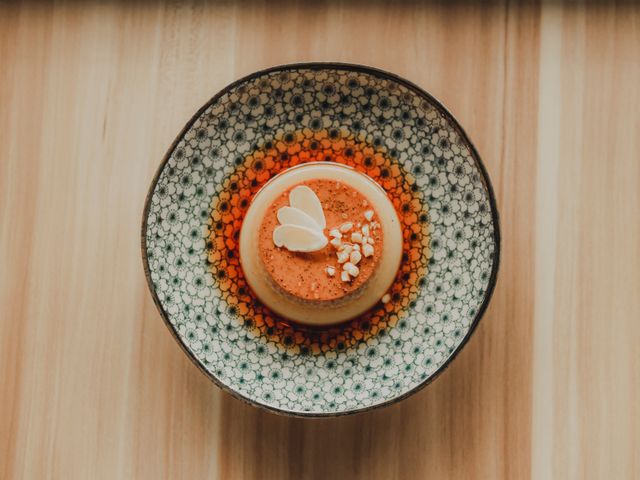
Ramadan Mahalabia Breakfast Custard Cake with Pistachios and Rose Petals
A silky, aromatic Levantine custard cake infused with rose water and topped with crushed pistachios and edible rose petals. Mahalabia is a traditional milk-based custard pudding that's baked into a tender cake and served chilled—perfect for breaking the fast or enjoying during suhoor (pre-dawn meal) in Ramadan. The delicate floral notes and nutty pistachio finish make it feel both celebratory and comforting.
- Prep
- 20 min
- Cook
- 35 min
- Wait
- 3 hr
- Total
- 3 hr 55 min
- Makes
- 1 cake (8 slices, 8×8-inch)
Steps
Before you start
- Preheat oven to 350°F (175°C)
- Use whole milk at room temperature for smoothest custard
- Have all ingredients measured and ready
- Ensure your 8×8-inch baking pan is level
Prepare baking pan
- Lightly brush the 8×8-inch baking pan with a little melted butter (use a small amount from the 2 tablespoons).
- Line the bottom with parchment paper, then brush the parchment lightly as well.
- Set aside.
+ Show details− Hide details
Tip: Parchment paper makes it easy to lift the finished custard cake from the pan without sticking.
Combine cornstarch and milk
- In a medium heavy-bottomed saucepan, whisk together the cornstarch and 1/2 cup (120 ml) of the milk until smooth with no lumps.
- Add the remaining 3 cups (720 ml) milk gradually while whisking to create a smooth, lump-free custard base.
+ Show details− Hide details
Ready when: No visible lumps; mixture is smooth and uniform
Tip: Whisking the cornstarch with a small amount of milk first prevents lumps from forming when you add the rest.
Heat custard base
- Place the saucepan over medium heat and add the sugar and salt.
- Stir frequently with a whisk, scraping the bottom and sides of the pan, until the mixture reaches a gentle simmer.
- The custard will thicken as it cooks—continue stirring for about 6–8 minutes after the first bubbles appear, until it coats the back of a spoon and a line drawn through it stays clear.
+ Show details− Hide details
Ready when: Custard coats the back of a spoon; a finger drawn across it leaves a clear trail
Tip: Do not walk away—frequent stirring prevents lumps and ensures even cooking. Stop cooking as soon as it reaches the right consistency; overcooking can break down the cornstarch.
Add rose water and butter
- Remove the saucepan from heat and immediately stir in the 2 tablespoons melted butter and rose water until fully combined.
- Smell to confirm the floral aroma is pleasant—if you prefer stronger or lighter rose flavor, adjust slightly (the flavor will intensify as the custard cools).
+ Show details− Hide details
Ready when: Butter and rose water are fully incorporated; mixture is smooth and fragrant
Tip: Add these off heat to preserve the delicate rose flavor—high heat can diminish its aroma.
Pour into baking pan
- Slowly pour the warm custard mixture into the prepared baking pan, using a fine-mesh sieve to strain out any thin skin that may have formed on top.
- Tap the pan gently on the counter a few times to settle the mixture and remove air bubbles.
+ Show details− Hide details
Ready when: Custard is level in the pan with no large bubbles on the surface
Tip: Straining ensures the texture is silky smooth without any cooked milk skin.
Bake the custard cakeOven 350°F / 175°C
- Place the pan in a preheated 350°F (175°C) oven and bake for 30–35 minutes.
- The custard will puff slightly and the top will be very pale golden or cream-colored.
- The center should still jiggle slightly (about 1/2 inch in the middle) when you gently shake the pan—it will continue to set as it cools.
+ Show details− Hide details
Ready when: Top is pale golden; center jiggles very slightly; toothpick inserted 1 inch from edge comes out clean
Tip: Do not overbake—the custard continues to firm up during cooling. Slight jiggle is normal and desired.
Cool and chill
- Remove the pan from the oven and place it on a cooling rack.
- Let the mahalabia cool to room temperature (about 30–40 minutes), then refrigerate uncovered for at least 3 hours, preferably 4–6 hours or overnight, until fully chilled and set.
+ Show details− Hide details
Ready when: Mahalabia is firm and cold to the touch; no jiggle in the center when pan is shaken
Tip: Chilling is essential—the custard firms up significantly and develops better texture and flavor. Cover loosely with plastic wrap if chilling longer than 3 hours to prevent odor absorption.
Cut and serve
- Run a thin knife around the edges of the pan, then invert onto a cutting board.
- Peel away the parchment paper.
- Using a sharp, wet knife (wipe between cuts), slice the mahalabia into 8 equal pieces, wiping the blade after each cut for clean edges.
+ Show details− Hide details
Ready when: Pieces are neat with sharp, clean edges
Tip: A hot, wet knife produces cleaner slices. Have a damp kitchen towel nearby for frequent wiping.
Garnish and serve
- Arrange the mahalabia slices on a serving platter or individual plates.
- Generously scatter the crushed pistachios over each piece, then sprinkle with edible rose petals if using.
- Serve chilled, ideally within a few hours of plating.
+ Show details− Hide details
Ready when: Each slice is topped with pistachios and rose petals; presentation is elegant
Tip: Add pistachio and rose petal garnish just before serving so the nuts stay crisp and the petals don't soften.
Good to know
Tips
- For extra elegance, dust the entire platter lightly with edible gold leaf or a pinch of ground pistachios before arranging slices.
- If the mahalabia cracks when cutting, it was slightly overbaked. This is purely aesthetic—it will taste just as delicious. Try dipping the knife briefly in warm water between cuts.
- Make this without the oven step for a stovetop custard pudding (mousse-like): Pour the warm custard into serving glasses, chill, and top with nuts just before serving.
- Ramadan timing: Prepare this the night before suhoor (pre-dawn meal) so it's perfectly chilled and ready to serve early in the morning.
Make ahead
Bake the mahalabia up to 1 day ahead. Cool, chill uncovered for the first 3 hours to firm up, then cover loosely with plastic wrap and refrigerate. Garnish with pistachios and rose petals just before serving.
Storage & reheating
Room temperature: Do not leave unrefrigerated for more than 2 hours. Refrigerator: Cover loosely with plastic wrap; keep for up to 4 days. The custard will become denser and slightly firmer. Freezer: Not recommended—the custard texture will become grainy and separate upon thawing. To serve chilled: Remove from fridge 15 minutes before serving if you prefer a slightly softer texture.
Substitutions
- rose water, food-grade → 1 tablespoon orange blossom water. Creates a more citrus-floral flavor instead of pure rose. Reduce to 1 tablespoon since orange blossom water is more potent.
- shelled roasted unsalted pistachios → Sliced raw almonds or shelled pine nuts. Toast lightly before crushing to bring out flavor. Almonds will be slightly more bitter; pine nuts will be richer and buttery.
- cornstarch → 2 tablespoons tapioca starch + 6 tablespoons all-purpose flour (total 1/2 cup), sifted together. This creates a slightly less silky custard with a more cake-like crumb, but still delicious. Sift to remove lumps.
- whole milk, at room temperature → Combination of 1.75 cups (420 ml) whole milk + 1.75 cups (420 ml) heavy cream. Creates a much richer, more luxurious custard. Keep all other ingredients the same; baking time may increase by 3–5 minutes.