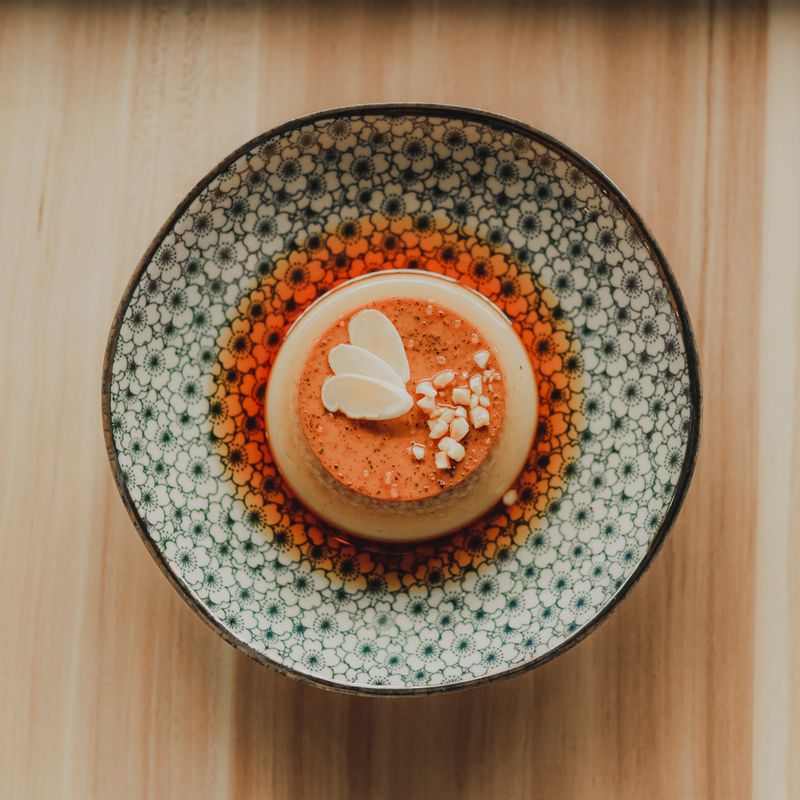
Pomegranate Molasses Flan
A silky baked custard infused with cream and topped with a glossy pomegranate molasses caramel. This Middle Eastern–inspired flan has a tender crumb and bright, slightly tart finish from pomegranate molasses, garnished with toasted walnuts for crunch and depth. Serve chilled or at room temperature as an elegant spoon dessert.
- Prep
- 20 min
- Cook
- 35 min
- Wait
- 1 hr 30 min
- Total
- 2 hr 25 min
- Makes
- 6 flans (one 6-ounce/180 ml flan per serving)
Steps
Before you start
- Preheat oven to 325°F (160°C) and position a rack in the center
- Bring a kettle of water to a boil for the water bath
- Bring eggs and milk to room temperature (30 minutes)
- Have a fine-mesh sieve and roasting pan ready for water bath
Toast walnuts
- Heat a small skillet over medium heat.
- Add the 0.5 cup (55 g) chopped walnuts and toast, stirring frequently, for 3–4 minutes until fragrant and lightly golden.
- Transfer to a plate to cool.
- Do this first so the walnuts are ready for garnish.
+ Show details− Hide details
Ready when: Walnuts are fragrant and light golden brown
Tip: Watch constantly so they don't burn; they toast quickly once hot.
Make pomegranate caramelOven 350°F / 175°C
- In a medium saucepan, combine 0.5 cup (100 g) sugar and 3 tablespoons (45 ml) water.
- Set over medium heat and do not stir; just let it bubble.
- After 4–5 minutes, the mixture will begin to turn amber at the edges.
- Swirl the pan gently to even the color.
- Cook another 1–2 minutes until the entire mixture is a deep amber (around 350°F/175°C).
- Remove from heat immediately and carefully pour in 6 tablespoons (90 ml) pomegranate molasses—it will bubble vigorously.
- Stir with a wooden spoon until smooth and combined, then divide evenly among the 6 custard cups, tilting each to coat the bottom and sides.
- Work quickly as the caramel sets rapidly.
+ Show details− Hide details
Ready when: Caramel is deep amber and pomegranate molasses is fully incorporated and smooth
Tip: Have all cups ready before you start; do not stir the sugar syrup while it cooks or it will crystallize. Let it cool slightly if needed for handling, but work while still pourable.
Prepare custard base
- In a medium heatproof bowl, whisk together 4 large eggs (room temperature), 0.25 cup (50 g) sugar, 1 teaspoon (5 ml) vanilla extract, and 0.25 teaspoon (1.5 g) fine sea salt until well combined and pale, about 1 minute.
- Add 1.5 cups (360 ml) whole milk and 0.5 cup (120 ml) heavy cream, both at room temperature.
- Whisk until smooth and homogeneous—do not over-whisk or you'll incorporate air bubbles.
+ Show details− Hide details
Ready when: Mixture is pale, smooth, and completely combined
Tip: Avoid vigorous whisking or aerial bubbles will create holes in the flan; whisk gently but thoroughly.
Strain and fill
- Pour the custard mixture through a fine-mesh sieve into a measuring cup or large spouted bowl, pressing gently on any foam or bits.
- Slowly pour the strained custard evenly into the 6 caramel-lined custard cups, filling each to just below the rim.
- Avoid splashing.
+ Show details− Hide details
Ready when: All cups are filled evenly and custard is smooth on top
Tip: Straining removes any broken egg white bits and excess foam, ensuring a silky texture.
Set up water bath
- Place the 6 filled custard cups in a 9×13-inch (23×33 cm) roasting pan.
- Pour boiling water into the pan around the cups until it reaches halfway up the sides (about 3 cups/720 ml).
- The water bath ensures even, gentle heat so the custard cooks slowly without curdling.
+ Show details− Hide details
Ready when: Water level is halfway up the sides of the cups
Tip: Use boiling water so the temperature of the bath is correct from the start; this reduces baking time and prevents overcooking.
Bake flansOven 325°F / 165°C
- Carefully transfer the roasting pan to the preheated 325°F (160°C) oven.
- Bake for 25–35 minutes.
- The flans are done when the edges are set and jiggle slightly when gently shaken, but the center still has a slight wobble the size of a quarter.
- The internal temperature should read 175–180°F (79–82°C) on an instant-read thermometer inserted 1 inch (2.5 cm) from the edge, not the center.
+ Show details− Hide details
Ready when: Edges are set, center has a slight quarter-sized jiggle, and thermometer reads 175–180°F (79–82°C) at the edge
Tip: Overbaking will create a dense, grainy, curdled flan. Slight underbaking is better—the residual heat will continue cooking as it cools.
Cool and chill
- Carefully remove the roasting pan from the oven and let it sit in the water bath for 10 minutes so the flans cool gradually and do not crack.
- Lift the cups out of the water and place them on a wire rack to cool to room temperature, about 30 minutes.
- Then cover them loosely with plastic wrap and refrigerate for at least 2 hours, or up to 24 hours.
+ Show details− Hide details
Ready when: Flans are cold and set but still tender
Tip: Do not remove flans from the water bath immediately; gradual cooling prevents the delicate custard from cracking.
Unmold and serve
- To unmold, run a thin, flexible knife around the inside edge of each cup to loosen the flan.
- Place a dessert plate upside down over each cup and, holding the cup and plate together firmly, flip with a quick, confident motion.
- The flan should release and the caramel should run down the sides.
- If it sticks, place the cup in a bowl of hot water for 10–15 seconds and try again.
- If serving chilled, let the flans sit at room temperature for 5 minutes for the best flavor.
- Sprinkle the toasted walnuts over each flan just before serving.
+ Show details− Hide details
Ready when: Flan is released cleanly onto the plate with caramel flowing around it
Tip: A confident flip is key; hesitation can cause the flan to break. If unmolding is difficult, dipping the cup in hot water loosens the caramel and allows easy release.
Good to know
Tips
- Room-temperature ingredients are crucial: cold eggs and milk will not emulsify smoothly and will cook unevenly, leading to a grainy texture. Set them out 30 minutes before starting.
- Do not skip the water bath: it distributes heat slowly and evenly, ensuring a tender, custard-like texture. Baking without one will result in a dense, curdled flan.
- The flan is done when the center still jiggles slightly—a quarter-sized wobble is ideal. Overbaking by even a minute or two will make it grainy and overcooked.
- Pomegranate molasses darkens as it cooks; choose a brand with no added sugar for the best tangy flavor, and taste yours before using so you can adjust the caramel sweetness if needed.
Make ahead
Unmolded flans can be made up to 2 days ahead. After cooling completely, cover with plastic wrap and refrigerate. Let sit at room temperature for 5 minutes before serving. Alternatively, keep flans in their cups, covered, for up to 3 days, and unmold just before serving.
Storage & reheating
Room temperature: not recommended (dairy and eggs). Refrigerator: cover loosely with plastic wrap and store for up to 3 days. Freezer: flans can be frozen in their cups (covered) for up to 1 month; thaw in the refrigerator overnight, then unmold and serve. The texture will be slightly less silky after freezing. Do not reheat.
Substitutions
- pomegranate molasses → pomegranate juice concentrate or 2 tablespoons pomegranate juice mixed with 1 tablespoon honey. Pomegranate molasses provides the signature tang and caramel color. Juice concentrate will be less intense; use less sugar in the caramel (3 tablespoons/60 g) and reduce the liquid slightly.
- walnuts, coarsely chopped → toasted pistachios, almonds, or hazelnuts, coarsely chopped. Any toasted nut provides crunch and complements the pomegranate. Pistachios add color and traditional Middle Eastern flair.
- vanilla extract → 1/4 teaspoon ground cardamom or 1/8 teaspoon rose water. Cardamom or rose water are traditional Middle Eastern flavors that enhance the pomegranate profile.
- heavy cream → whole milk (use 1 cup/240 ml total milk instead of 1.5 cups/360 ml milk plus cream). The flan will be slightly lighter and less rich, but still delicious.
More puddings & custards
See all →



Find more like this
- Meal
- Dessert
- Cuisine
- Middle Eastern
- Method
- Oven