Quick Asparagus and Leek Broth
A delicate, French-inspired vegetable broth made with fresh asparagus and leeks simmered in white wine and aromatic stock. Ready in 30 minutes, this light broth serves as a refined base for soups or a simple consommé on its own. The asparagus and leeks are lightly cooked to preserve their subtle flavor while infusing the broth with their natural sweetness.
Steps
Before you start
- Trim the asparagus and leeks fresh, as they cook very quickly
- Have your vegetable stock at hand—cold stock is fine; it will heat through
- Rinse leeks thoroughly between layers to remove any sand
Sauté the leeks
- Pour the white wine into a medium 3-quart saucepan and bring to a gentle simmer over medium-high heat.
- Once steaming, add the sliced leeks and stir occasionally for 3 minutes.
- The leeks will begin to soften and release their flavor into the wine.
- They should be translucent but still hold their shape.
+ Show details− Hide details
Ready when: Leeks are translucent and fragrant
Tip: Stir gently to avoid breaking the leek pieces; they cook very quickly
Add stock and aromatics
- Pour in the vegetable stock, then add the thyme sprigs, bay leaf, and peppercorns.
- Stir gently to combine.
- Increase the heat to high and bring the broth to a rolling simmer, about 2 minutes.
+ Show details− Hide details
Ready when: Broth is at a rolling simmer with small bubbles breaking the surface
Tip: A rolling simmer will infuse the aromatics faster than a gentle simmer
Add asparagus and simmer
- Add the asparagus pieces and stir gently.
- Reduce the heat to medium-low and maintain a steady, gentle simmer for 10 to 12 minutes.
- The asparagus should be tender but still bright green and not mushy.
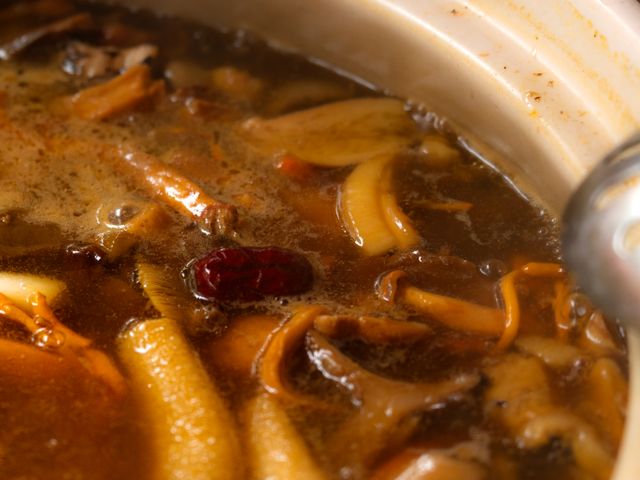
- The broth will take on a pale golden hue with flecks of green from the vegetables.
+ Show details− Hide details
Ready when: Asparagus is fork-tender but still holds its color; broth is fragrant and pale golden
Tip: Keep the heat gentle to prevent the asparagus from breaking apart and clouding the broth
Taste and season
- Remove from heat.
- Taste the broth and add sea salt to your preference—start with a small pinch and taste again.
- The broth should taste bright and slightly herbal, with the sweetness of leek and asparagus coming through.
- If the flavor is too delicate, return to a simmer for 1 minute and taste again.
+ Show details− Hide details
Ready when: Broth is well-seasoned and balanced
Tip: Season conservatively at first; you can always add more salt, but you cannot remove it
Strain and serve (optional)
- For a refined presentation, pour the broth through a fine-mesh strainer into serving bowls, leaving the vegetables behind.
- Alternatively, serve the broth with the vegetables included for a heartier dish.
- Ladle into warm bowls and serve immediately.
+ Show details− Hide details
Tip: If serving with vegetables, ladle carefully so the tender asparagus pieces don't break
Good to know
Tips
- Trim asparagus at the natural breaking point (bend each spear gently until it snaps) to avoid woody, fibrous bottoms
- For a more robust broth, add a small splash of lemon juice at the end—it brightens the flavor without overwhelming the delicate vegetables
- This broth is an ideal base for spring vegetable soups; simply add fresh herbs, cream, or additional vegetables and simmer for 5 more minutes
- If your vegetable stock is very flavorful or salty, reduce it by ½ cup (120 ml) and increase the white wine or water slightly to avoid an overly strong broth
Storage & reheating
Store in an airtight container in the refrigerator for up to 3 days. Reheat gently on the stovetop over medium-low heat, stirring occasionally, until warmed through (about 5 minutes). The broth can be frozen in ice cube trays for up to 2 months; thaw overnight in the refrigerator and reheat as above.
Substitutions
- dry white wine → dry vermouth or additional vegetable stock. If avoiding wine, use the same amount of stock instead; the broth will be slightly less complex but still delicate and fresh
- fresh thyme sprigs → ¾ teaspoon dried thyme or 1 teaspoon fresh tarragon. Tarragon brings a subtle anise note that pairs beautifully with asparagus and leek
- fresh asparagus → spring peas or finely cut zucchini. Peas are sweeter and cook slightly faster (reduce simmering time to 8 minutes). Zucchini has a more neutral flavor; use the same cooking time
- leeks → 1½ pounds (680 g) fennel or 4 shallots, halved and thinly sliced. Fennel will add a delicate licorice note; shallots will provide a milder allium flavor