
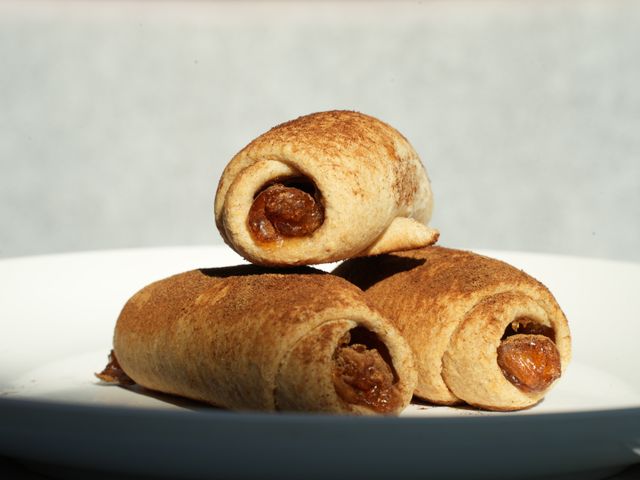
Platano Maduros Croissant with Caramel Swirl
A laminated pastry croissant filled with caramelized ripe plantain, swirled with dark caramel sauce, and finished with a dusting of cinnamon sugar. The crispy, buttery layers contrast beautifully with the soft, sweet plantain filling. This recipe uses a simplified lamination method ideal for home bakers.
- Prep
- 1 hr 30 min
- Cook
- 25 min
- Wait
- 12 hr
- Total
- 13 hr 55 min
- Makes
- 8 large croissants
Steps
Before you start
- Use European-style butter (86% fat) for best lamination; keep all dough and butter very cold throughout
- Chill dough between folds and always work on a cool surface
- Prepare plantain filling and caramel ahead, then chill before assembly
- Read the lamination steps carefully—they take patience but are essential for flaky layers
Mix the dough base
- In a stand mixer bowl, whisk together bread flour, salt, instant yeast, and sugar.
- Add very cold water and mix on low speed with the dough hook for 3–4 minutes until a shaggy dough forms.
- The dough should be around 60°F (15°C).
- Do not knead; it should be rough and slightly sticky.
- Cover and refrigerate for at least 30 minutes while you prepare the lamination butter.
+ Show details− Hide details
Ready when: Shaggy, slightly sticky dough that pulls away from sides; temperature around 60°F (15°C)
Tip: Cold dough is essential—if it warms above 70°F (21°C), refrigerate longer before proceeding
Prepare lamination butter
- While the dough chills, cut the European-style butter into thin pats (about ¼ inch / 6 mm thick) and layer them between parchment paper on a work surface.
- Using a rolling pin, gently pound and flatten the butter into a rough 8×8-inch (20×20 cm) slab, keeping it very cold but pliable—it should bend without cracking.
- The goal is a consistent thickness so it spreads evenly during lamination.
- Refrigerate on the parchment until the dough is ready.
+ Show details− Hide details
Ready when: Butter is a uniform slab, cold but flexible, not cracking or separating
Tip: If butter becomes too soft (above 65°F / 18°C), chill it longer; too-warm butter will ooze out during lamination
First lamination fold
- On a lightly floured, very cool work surface (chill the counter with an ice pack beforehand if your kitchen is warm), roll the chilled dough into a rough 12×10-inch (30×25 cm) rectangle, keeping it slightly thicker than the butter slab.
- Place the cold butter slab in the center, then fold the dough edges over it like an envelope, sealing the edges with the heel of your hand.
- Roll gently to an even 12×8-inch (30×20 cm) rectangle.
- Fold into thirds (letter fold): fold the bottom third up, then the top third down over it.
- Wrap in plastic and refrigerate for 15 minutes.
+ Show details− Hide details
Ready when: Dough is folded into thirds with sealed edges and is cold to the touch
Tip: Work quickly—if dough begins to feel warm or sticky, chill it for 5 minutes before continuing
Second and third lamination folds
- Remove dough from the fridge and rotate it 90 degrees (this prevents uneven lamination).
- Roll to a 12×8-inch (30×20 cm) rectangle again, then fold into thirds as before.
- Wrap and chill for 15 minutes.
- Repeat this step one more time: rotate, roll, and fold into thirds.
- After the third fold, refrigerate for at least 1 hour (or overnight, wrapped in plastic).
- The dough should show faint butter stripes when you look at the edge.
+ Show details− Hide details
Ready when: Dough is cold and slightly elastic; visible thin butter stripes appear at the edge
Tip: If butter ever breaks through the dough, dust with flour and chill immediately; multiple short rests beat fewer long ones for lamination success
Prepare plantain filling
- Peel the ripe plantains and slice into ½-inch (1.3 cm) thick rounds.
- Heat the butter in a large skillet over medium heat until foaming.
- Add the plantain slices in a single layer and sauté for 3–4 minutes per side until golden and slightly caramelized.
- Sprinkle with brown sugar, cinnamon, salt, and vanilla extract.
- Cook for another 1–2 minutes, tossing gently, until the sugar melts and coats the plantains.
- Transfer to a plate, spread to cool, then coarsely mash into chunky pieces (not smooth).
- Chill until needed.
+ Show details− Hide details
Ready when: Plantain slices are tender, golden-brown, and the sugar has melted into a glaze
Tip: Don't over-mash the plantains—chunky texture adds interest; if filling is too wet, drain excess liquid before chilling
Make caramel swirlOven 350°F / 175°C
- In a small saucepan, melt the butter over medium heat.
- Add the brown sugar and stir constantly for 2–3 minutes until the mixture turns a deep amber color (around 350°F / 175°C on an instant thermometer if you have one).
- Remove from heat and carefully pour in the heavy cream—it will bubble vigorously.
- Stir in the salt.
- Let cool to room temperature until it reaches a thick, spreadable consistency (like peanut butter), about 10–15 minutes.
- If it hardens too much, warm gently over low heat.
+ Show details− Hide details
Ready when: Caramel is deep amber, bubbles have subsided, and it's thick enough to coat a spoon
Tip: Watch carefully—caramel burns quickly; if it darkens past deep amber, start over. Never taste hot caramel; it will cause severe burns
Shape the croissants
- Remove the laminated dough from the fridge and place on a floured work surface.
- Roll to a ¼-inch (6 mm) thick rectangle approximately 16×12 inches (40×30 cm).
- Using a ruler and bench scraper, cut into 8 equal rectangles (about 4×6 inches / 10×15 cm each).
- Spread about 1 tbsp (15 ml) of the cooled caramel sauce down the center of each rectangle, then top with 1.5–2 tbsp (22–30 ml) of the plantain filling.
- Fold each rectangle in half lengthwise to enclose the filling, then twist gently 2–3 times to create a spiral effect.
- Place seam-side down on parchment-lined baking sheets, spacing them 3 inches (7.5 cm) apart.
+ Show details− Hide details
Ready when: Eight shaped pastries with visible caramel and plantain filling, arranged on baking sheets
Tip: Keep the dough very cold during shaping—if it warms and becomes sticky, chill for 5–10 minutes; twisted pastries should feel firm, not soft
Final proof
- Cover the shaped croissants loosely with plastic wrap or a damp towel and let them proof at room temperature (68–72°F / 20–22°C) for 2–3 hours until they've puffed up noticeably and feel light and airy when gently pressed (they should spring back slowly, not immediately).
- They should increase in volume by about 50–75%, and you may see a slight seep of filling at the edges—this is normal.
+ Show details− Hide details
Ready when: Croissants have visibly puffed and feel light; a gentle poke leaves a slow indent
Tip: If your kitchen is cold, place croissants in a warm, draft-free spot (like a 100°F / 38°C oven with the light on); avoid direct sunlight, which can dry the surface
Apply egg wash and cinnamon sugarOven 400°F / 205°C
- About 20 minutes before baking, preheat the oven to 400°F (200°C).
- Beat together the egg and 1 tbsp (15 ml) water until smooth.
- Brush the egg wash over the top of each proofed croissant, being careful not to deflate them.
- Mix the cinnamon and granulated sugar together, then sprinkle evenly over the egg-washed croissants.
- Let the egg wash set for 5 minutes at room temperature while the oven finishes preheating.
+ Show details− Hide details
Ready when: Croissants are evenly coated with egg wash and cinnamon-sugar mixture
Tip: Avoid brushing egg wash on the sides of the croissants or any parchment contact points; it can cause sticking
Bake until goldenOven 400°F / 205°C
- Place both baking sheets in the preheated 400°F (200°C) oven.
- Bake for 22–25 minutes, rotating the sheets halfway through (top shelf to bottom and vice versa) at the 12-minute mark to ensure even browning.
- The croissants are done when they're deeply golden-brown on top and the bottoms are crisp and golden.
- The internal temperature should reach 190–195°F (88–90°C) in the thickest part of a croissant.
+ Show details− Hide details
Ready when: Croissants are deep golden-brown; bottoms are crisp; internal temperature 190–195°F (88–90°C)
Tip: If the tops brown too quickly, loosely tent with foil; rotate sheets to promote even baking on both shelves
Cool and serve
- Remove croissants from the oven and let them cool on the baking sheet for 5 minutes.
- Transfer to a wire cooling rack and let rest for at least 15 minutes before serving.
- The croissants are best enjoyed warm or at room temperature within a few hours of baking, when the layers are at their crispiest.
- The plantain and caramel filling will soften slightly as the pastry cools.
+ Show details− Hide details
Ready when: Croissants are cool enough to handle; pastry is crisp on the outside, tender inside
Tip: Don't wrap warm croissants tightly—trapped steam will soften the crispy layers. Cool uncovered or in a loose paper bag
Good to know
Tips
- Lamination success hinges on temperature control: invest in an instant-read thermometer and keep your dough and butter cold. If your kitchen is warm, work at night or use ice packs under your cutting board and between folding rests.
- The caramel can seep slightly from the pastries during baking—this is normal and adds flavor, but place a baking sheet underneath to catch any drips and prevent burning on the oven floor.
- For a professional finish, sprinkle the cinnamon sugar just before baking when the egg wash is still tacky; if applied too early, it may fall off during proofing.
- If you don't have a stand mixer, knead the dough by hand for 5–6 minutes until a shaggy dough forms, keeping it cool throughout.
Make ahead
The laminated dough can be frozen after the final fold for up to 2 weeks, wrapped tightly in plastic. Thaw overnight in the fridge before shaping. The plantain filling and caramel can each be made up to 2 days ahead and stored in the fridge; bring both to cool room temperature before assembly. Shaped, unbaked croissants can be frozen for up to 1 week on a baking sheet, then transferred to a freezer bag; bake directly from frozen, adding 2–3 minutes to the bake time.
Storage & reheating
At room temperature: store in an airtight container for up to 2 days (layers will soften gradually). In the fridge: up to 4 days in an airtight container; reheat gently in a 300°F (150°C) oven for 5–7 minutes to crisp the exterior. In the freezer: unbaked shaped croissants for up to 1 week; baked croissants for up to 3 weeks, wrapped individually. To reheat frozen baked croissants, bake at 350°F (175°C) for 10–12 minutes until warmed through and crisp.
Substitutions
- cold unsalted European-style butter, cut into thin pats → High-quality unsalted butter (at least 82% fat) or clarified butter (ghee). European-style butter yields the most authentic flaky layers due to its higher fat content, but standard unsalted butter works acceptably if kept very cold; ghee lamination will produce a slightly different (and richer) texture
- ripe plantains (deep yellow with black spots) → Very ripe bananas or sweet potatoes (about 1.25 lb / 570 g), peeled, sliced, and sautéed the same way. Bananas cook faster (2–3 minutes per side); sweet potatoes stay chunkier and less sweet. Both will change the flavor profile but maintain the overall concept
- instant yeast → Active dry yeast (use 2 tsp / 6 g, then bloom in 2 tbsp / 30 ml of the cold water for 5 minutes before adding to dough). Active dry yeast requires blooming and may result in a slightly denser crumb than instant yeast
- heavy cream → Evaporated milk or dulce de leche (add 1–2 tbsp / 15–30 ml instead of cream). Evaporated milk creates a thinner caramel; dulce de leche adds a deeper, more condensed sweetness
More pastries
See all →


Find more like this
- Meal
- Breakfast
- Diet
- VegetarianHalal
- Method
- Oven