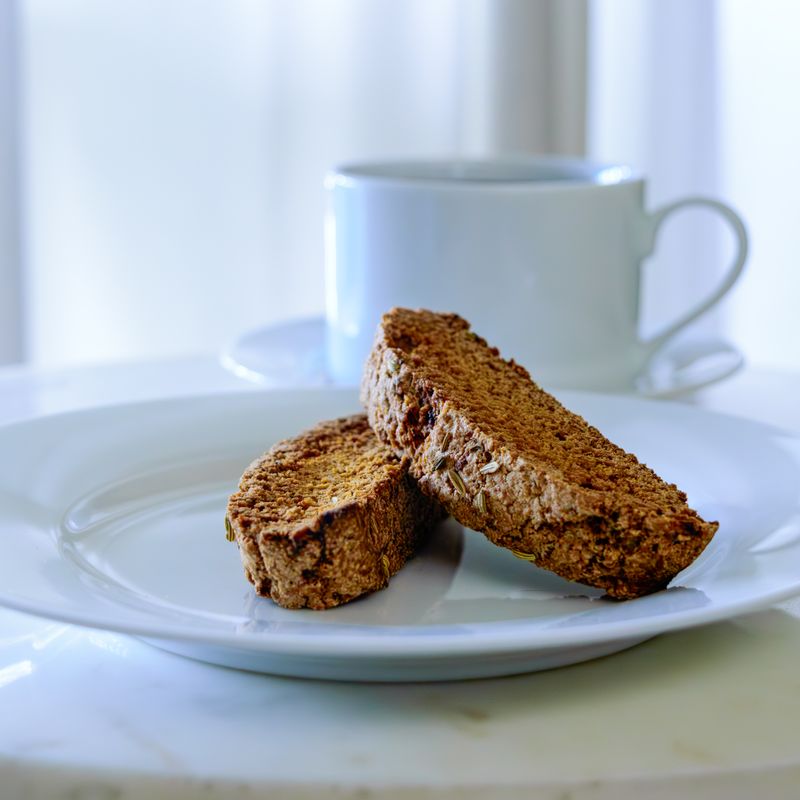
Pistachio and Rose Water Breakfast Biscotti
Twice-baked Italian biscotti infused with Persian flavors: roasted pistachios and fragrant rose water. Crisp and crunchy, perfect for dunking in coffee, tea, or milk. The delicate floral note balances the rich, buttery crumb and nutty pistachios for an elegant breakfast or light dessert.
- Prep
- 20 min
- Cook
- 50 min
- Wait
- 30 min
- Total
- 1 hr 40 min
- Makes
- 18 biscotti
Steps
Before you start
- Preheat oven to 350°F (175°C) for the first bake
- Bring eggs to room temperature (about 30 minutes)
- Line two baking sheets with parchment paper
- Chop pistachios into ¼-inch pieces (not too fine)
Mix dry ingredients
- In a small bowl, whisk together flour, baking powder, and salt.
- Set aside.
+ Show details− Hide details
Tip: Whisking the baking powder prevents lumps and ensures even rise.
Cream butter and sugar
- In a stand mixer (or large bowl with hand mixer), beat softened butter and sugar on medium speed for 2–3 minutes until pale and fluffy.
- Scrape the bowl halfway through.
+ Show details− Hide details
Ready when: Mixture is light in color and increased in volume by about one-third.
Tip: Do not skip this step; it incorporates air and creates a tender crumb.
Add eggs and flavorings
- Add eggs one at a time, beating well after each addition for about 30 seconds.
- Pour in rose water and vanilla extract, and beat until combined, about 1 minute.
+ Show details− Hide details
Ready when: Mixture is smooth and slightly thickened, with no streaks of egg white visible.
Tip: Adding eggs slowly prevents the batter from curdling. If it looks slightly separated, a few more seconds of beating will bring it together.
Fold in dry ingredients and nuts
- Reduce mixer to low speed and add the flour mixture in two additions, mixing until just combined.
- Remove the bowl from the mixer and fold in the chopped pistachios with a wooden spoon or spatula, stirring just until distributed evenly.
- Do not overmix.
+ Show details− Hide details
Ready when: Batter is just combined with no visible dry flour; pistachios are evenly scattered.
Tip: Overmixing can develop gluten and result in dense biscotti. A few streaks of flour are okay.
Shape the first log
- Turn dough onto a parchment-lined baking sheet.
- With wet hands or a wet spatula, gently shape the dough into a log approximately 11 inches (28 cm) long, 3 inches (8 cm) wide, and 1 inch (2.5 cm) tall.
- Smooth the top and sides.
+ Show details− Hide details
Ready when: Log is evenly shaped with flat top and sides.
Tip: Wet hands prevent sticking. The log will spread slightly during baking, so keep it compact.
First bakeOven 350°F / 175°C
- Bake at 350°F (175°C) for 25–28 minutes until the top is lightly golden and the log is firm to the touch but still slightly springy in the center.
- The internal temperature should reach 200°F (93°C) at the center.
- Remove from the oven and let cool for 10 minutes on the baking sheet.
+ Show details− Hide details
Ready when: Top is light golden; a toothpick inserted in the center comes out clean or with just a crumb or two clinging.
Tip: Baking to an internal temperature of 200°F ensures the center is set and the slices won't crumble when cut.
Cool and slice
- After 10 minutes of cooling, transfer the log to a cutting board.
- Using a serrated bread knife, gently cut the log on a slight diagonal into ½-inch (1.3 cm) thick slices.
- Work slowly to avoid crumbling; a gentle sawing motion works better than pressing down hard.
- You should get about 18 slices.
+ Show details− Hide details
Ready when: Slices are clean and ½-inch thick with minimal crumbs.
Tip: Let the log cool just enough to handle but not completely cool; warm logs cut cleanly without shattering. A serrated knife is essential.
Arrange for second bake
- Place slices cut-side down on two prepared baking sheets, spacing them about ½ inch (1.3 cm) apart.
- You may need to arrange them in two rows or use both sheets.
+ Show details− Hide details
Ready when: All slices are flat on the baking sheets, evenly spaced.
Tip: Cut-side down ensures the flat surfaces toast to a crispy finish for dunking.
Second bake (first side)Oven 325°F / 165°C
- Bake at 325°F (163°C) for 12–14 minutes until the cut sides are lightly golden and beginning to firm up.
- The biscotti should not be fully crisp yet.
+ Show details− Hide details
Ready when: Cut sides are light golden and feel slightly firmer; sides still bend gently.
Tip: Lower temperature prevents overbrowning the delicate rose-pistachio crumb.
Flip and second bake (second side)Oven 325°F / 165°C
- Remove baking sheets from the oven and flip each biscotto onto its other side.
- Return to the oven and bake for another 12–14 minutes until both sides are golden and the biscotti are completely crisp throughout.
- They should snap cleanly when bent.
+ Show details− Hide details
Ready when: Both flat sides are golden brown; biscotti snap cleanly in half with no soft center and sound hollow when tapped.
Tip: Bake until fully crisp; any soft center will soften further as they cool and sit in the pantry.
Cool completely
- Transfer biscotti to a wire cooling rack and let cool completely, about 15–20 minutes.
- They will crisp further as they cool.
+ Show details− Hide details
Ready when: Biscotti are room temperature and sound hollow when tapped; they snap cleanly with no give.
Optional dusting
- Once completely cool, lightly dust the top of each biscotto with powdered sugar if desired.
- This adds an elegant touch and subtle sweetness.
+ Show details− Hide details
Ready when: Light dusting of powdered sugar is visible on top; not clumpy.
Tip: Use a fine-mesh sieve or sifter to dust evenly. This step is purely optional.
Good to know
Tips
- Use roasted, unsalted pistachios for the best flavor. Raw pistachios lack the depth; salted ones will oversalt the dough.
- Rose water intensity varies by brand; start with 1 tablespoon and taste the batter. You can add another ½ teaspoon if you want more floral intensity, but it's easy to overdo. Start conservative.
- The serrated knife is essential for clean slices. A dull or straight knife will crumble the log. A bread knife works perfectly.
- Biscotti stay crisp far longer than most cookies because they're baked twice. They're ideal for making ahead and gifting or enjoying throughout the week.
Make ahead
You can prepare the dough and refrigerate it in an airtight container for up to 2 days before shaping and baking. Bring to room temperature (about 30 minutes) before shaping. Alternatively, bake fully and store (see storage below) for weeks.
Storage & reheating
Room temperature: Store in an airtight container for up to 2 weeks; they will remain crisp. Refrigerator: Not recommended; cold and humidity will soften them. Freezer: Place cooled biscotti in a freezer-safe bag or container (separated by parchment) for up to 3 months. Thaw at room temperature for 20–30 minutes before serving. Refresh softened biscotti by placing them on a baking sheet and warming in a 275°F (135°C) oven for 5–10 minutes until crispy again.
Substitutions
- roasted unsalted pistachios → roasted unsalted almonds or hazelnuts. Use the same weight. Almonds will be slightly milder; hazelnuts add deeper nuttiness. The character will shift but biscotti will remain excellent.
- rose water (food-grade) → orange zest (finely grated) or almond extract. Use 1 tablespoon finely grated orange zest or ½ teaspoon almond extract. Rose water adds floral elegance; these alternatives offer brightness or warmth instead.
- granulated sugar → light brown sugar or coconut sugar. Use the same amount by weight. Brown sugar adds molasses depth; coconut sugar brings caramel notes. Flavor will be richer but structure remains the same.
- unsalted butter → neutral oil (canola, light olive, or vegetable). Use 5 tablespoons (75 ml). Oil biscotti will be slightly crispier and less rich; the texture remains excellent.
More pastries
See all →



Find more like this
- Meal
- Breakfast
- Cuisine
- Italian
- Diet
- VegetarianHalal
- Method
- Oven