
Spanish Hornazo: Sweet Meat Pastry
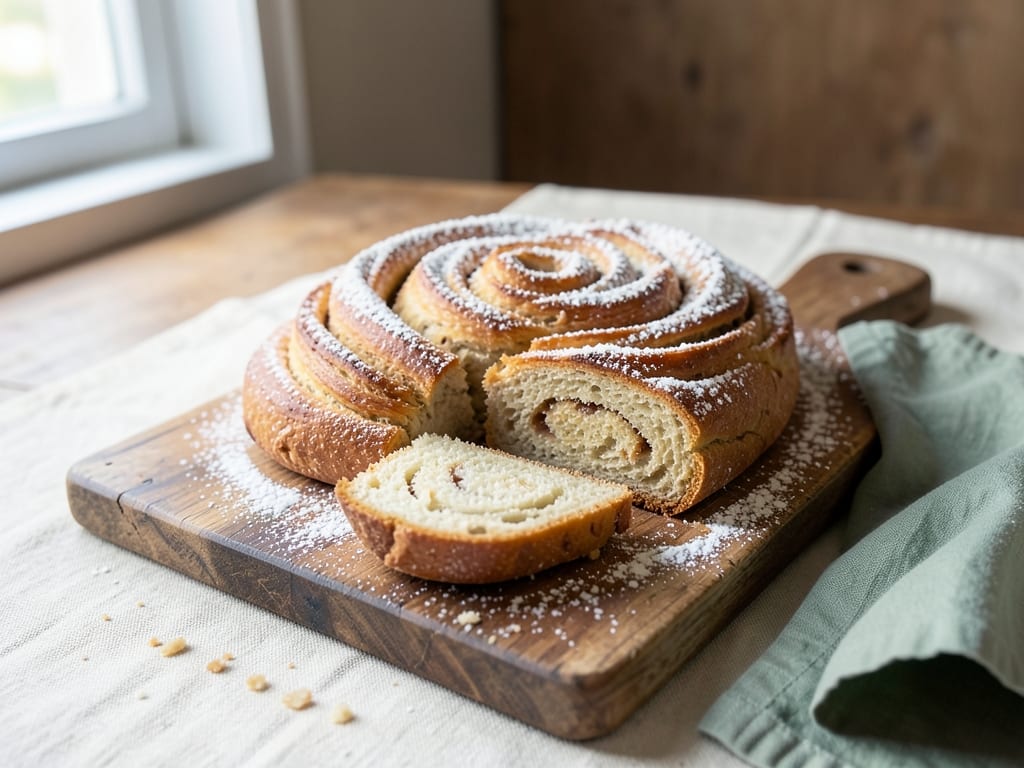
Hornazo is a traditional Spanish pastry, especially popular during Easter, that combines a tender, slightly sweetened bread dough with savory fillings of chorizo and hard-boiled eggs. This handheld pastry is brushed with an egg wash and finished with anise seeds for a subtle licorice note. Golden and flaky on the outside, it's satisfying warm or at room temperature.
- Prep
- 30 min
- Cook
- 40 min
- Wait
- 1 hr 30 min
- Total
- 2 hr 40 min
- Makes
- 6 individual pastries
Steps
Before you start
- Bring eggs to a boil and cool before peeling
- Have all filling ingredients measured and ready
- Preheat oven to 400°F (200°C) 15 minutes before baking
- Line two baking sheets with parchment paper
Make the dough
- In a large bowl or stand mixer, combine 3½ cups (420 g) flour, 2¼ teaspoons (7 g) instant yeast, 2 tablespoons (25 g) sugar, and 1 teaspoon (6 g) salt.
- Add 1¼ cups (295 ml) warm water and mix on low speed (or by hand) until a shaggy dough forms.
- Add 3 tablespoons (43 g) softened butter and knead on medium speed for 8–10 minutes until the dough is smooth, elastic, and slightly tacky (or knead by hand for 12–15 minutes).
- The dough should clear the bowl sides but stick slightly to the bottom.
+ Show details− Hide details
Ready when: Dough is smooth, elastic, and slightly tacky
Tip: Water temperature is crucial—use a kitchen thermometer to ensure it's around 110°F (43°C), not hotter, or the yeast will die.
First rise
- Lightly oil the bowl or use a bench scraper to shape the dough into a loose ball.
- Cover with a damp cloth or plastic wrap.
- Let rise at room temperature for 60 minutes until the dough has increased by about 50% (it should not double, as this is a rich, dense dough).
+ Show details− Hide details
Ready when: Dough has visibly increased in volume and looks airy
Tip: A warm, draft-free spot (like a turned-off oven with the light on) speeds rising by 10–15 minutes.
Prepare filling
- While the dough rises, cook the chorizo: slice 6 ounces (170 g) Spanish chorizo into thin coins (about ¼ inch / 6 mm thick).
- Heat a medium skillet over medium heat and cook the chorizo for 3–4 minutes, stirring occasionally, until the edges are lightly crisped and fat renders.
- Transfer to a small plate and let cool.
- In a small bowl, toss the cooled chorizo with ½ teaspoon (1 g) smoked paprika and black pepper to taste.
+ Show details− Hide details
Ready when: Chorizo edges are lightly crisped and oil is released
Tip: Do not overcook the chorizo or it will become tough; you want it just rendered and still moist.
Divide and shape dough
- Gently turn the dough out onto a lightly floured surface.
- Divide it into 6 equal pieces (about 2.5 ounces / 70 g each) by cutting it into 6 wedges or portions.
- Gently shape each piece into a ball by tucking the edges underneath and rolling slightly on the work surface.
- Cover loosely with plastic wrap while you work.
+ Show details− Hide details
Ready when: Each piece is roughly the same size and rounded
Tip: Don't overwork the dough at this stage—gentle handling keeps it tender and airy.
Flatten and fill
- Working with one dough ball at a time, flatten it into a 5-inch (12 cm) disk on a lightly floured surface using the palm of your hand or a rolling pin.
- In the center of each disk, arrange 2–3 slices of cooked chorizo (about ½ ounce / 15 g) and 2 quartered pieces of hard-boiled egg (about ½ an egg).
- Sprinkle a tiny pinch of paprika over the filling.
+ Show details− Hide details
Ready when: Filling is evenly distributed in the center of each disk
Tip: Don't overfill or the seams will burst during baking; a small handful of filling per pastry is ideal.
Seal pastries
- Fold the edges of each dough disk over the filling, overlapping them slightly like a rough package and pinching the seams closed.
- Gently flip each pastry seam-side down onto a parchment-lined baking sheet, spacing them about 2 inches (5 cm) apart.
- You should fit 3 on each baking sheet.
- Gently press the top of each pastry to flatten it slightly into a disk about ½ inch (1.3 cm) thick.
+ Show details− Hide details
Ready when: Pastries are sealed, seam-side down, and evenly spaced
Tip: Pinch seams firmly so they don't open as the pastry rises and bakes.
Second rise
- Cover the pastries loosely with plastic wrap or a damp cloth.
- Let them rise at room temperature for 25–30 minutes until they are puffy and feel slightly springy when pressed gently with a fingertip.
+ Show details− Hide details
Ready when: Pastries are visibly puffier and feel light to the touch
Tip: They should not double in size—just enough to look plump and inviting.
Apply egg wash and seedsOven 400°F / 205°C
- While pastries finish rising, preheat the oven to 400°F (200°C).
- In a small bowl, beat 1 large egg with 1 tablespoon water until well combined.
- Once pastries have risen, lightly brush the top of each with the egg wash using a pastry brush.
- Sprinkle about ½ teaspoon (4 g) of anise seeds over each pastry, pressing gently so they adhere.
+ Show details− Hide details
Ready when: Pastries are evenly brushed and seeds are visible
Tip: Brush gently to avoid deflating the risen dough.
BakeOven 400°F / 205°C
- Bake at 400°F (200°C) for 20–25 minutes until the pastries are deep golden brown on top and the bottoms are firm.
- Rotate the baking sheets halfway through (at 12–13 minutes) for even browning.
- The pastries should be crispy outside and just cooked through inside.
+ Show details− Hide details
Ready when: Top is deep golden brown and a tap on the bottom sounds hollow
Tip: If the tops brown too quickly, loosely cover with foil for the last 5–8 minutes.
Cool and serve
- Remove the baking sheets from the oven and let the pastries cool on the pan for 5 minutes, then transfer to a cooling rack.
- Hornazo is delicious warm or at room temperature.
- Serve whole or slice in half to reveal the filling.
+ Show details− Hide details
Ready when: Pastries are cool enough to handle and filling is set
Tip: Cooling slightly makes them sturdier to handle, but they're best enjoyed within a few hours while the crust is still crisp.
Good to know
Tips
- Hornazo is traditionally served during Easter week in Spain, particularly in Extremadura and other regions. It's a portable breakfast or snack that makes sense for travel—hence the wrapped, handheld shape.
- The sweet dough is intentional and balances the savory chorizo and eggs. Don't reduce the sugar or skip the butter, as they create a tender, slightly rich crumb.
- For a more luxurious version, add 2 tablespoons (30 ml) whole milk to the dough instead of 2 tablespoons of the water, and use cultured or European butter for deeper flavor.
- Smoked paprika is key for authentic flavor, but if you only have sweet paprika, use the same amount. Avoid hot paprika unless you prefer extra spice.
Make ahead
Dough can be made up to 12 hours ahead: after the first rise, cover and refrigerate. Remove 30 minutes before shaping to allow it to come to room temperature slightly. Unbaked pastries can be frozen on a baking sheet for up to 2 months; bake directly from frozen, adding 5–8 minutes to the baking time.
Storage & reheating
Store cooled hornazo in an airtight container at room temperature for up to 2 days (the crust will soften slightly). Refrigerate for up to 4 days; reheat gently in a 300°F (150°C) oven for 8–10 minutes to re-crisp. Freeze baked pastries for up to 3 months; thaw at room temperature for 30 minutes and reheat as above.
Substitutions
- Spanish chorizo → Spanish salchichón (cured pork sausage) or prosciutto, thinly sliced. These are less spiced but give a similar salty, savory flavor. If using prosciutto, crumble or tear it into small pieces.
- anise seeds → Sesame seeds or coarse sea salt. Sesame adds nuttiness; sea salt emphasizes the savory filling. Both are traditional Spanish variations.
- smoked paprika → Red pepper flakes (use half the amount) or omit entirely. Paprika adds warmth and color to the filling. Red pepper flakes bring heat; omitting keeps the filling mild.
- instant (rapid-rise) yeast → Active dry yeast (use 2¼ teaspoons / 7 g) or fresh yeast (½ ounce / 14 g, crumbled). Active dry yeast requires slightly longer rising times (add 10–15 minutes to each rise). Fresh yeast should be mixed into the water before adding flour.


.jpg)