Spanish Ensaimada with Powdered Sugar and Lard
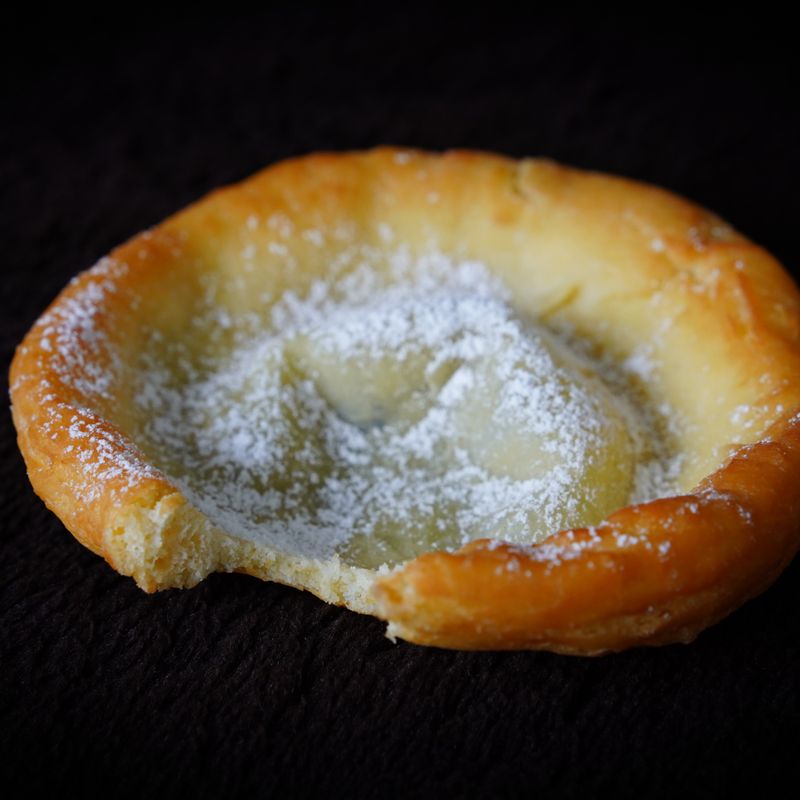
A traditional Spanish spiral pastry from Mallorca, with a tender, buttery crumb enriched with lard and a delicate anise flavor. The dough is rolled into a thin sheet, brushed with lard, and coiled into a spiral before baking until golden. A generous dusting of powdered sugar finishes this beloved breakfast pastry.
- Prep
- 30 min
- Cook
- 25 min
- Wait
- 2 hr
- Total
- 2 hr 55 min
- Makes
- 2 ensaimadas (8 pastries)
Steps
Before you start
- Have lard at room temperature (soft but not melted)
- Preheat oven to 375°F (190°C) about 15 minutes before baking
- Use a kitchen scale for accurate flour measurement
- Ensure all equipment is clean and dry
Make the dough
- In a stand mixer fitted with the dough hook, combine 440 g (3.5 cups) bread flour, 7 g (2.25 teaspoons) instant yeast, 50 g (¼ cup) sugar, and 6 g (1 teaspoon) salt.
- Add the lightly beaten eggs and 120 ml (½ cup) warm milk (110°F/43°C).
- Mix on medium-low speed for 8–10 minutes, until a soft, elastic dough forms.
- Add 5 g (1 teaspoon) crushed anise seeds and 30 g (2 tablespoons) soft lard, mixing for another 2 minutes until fully incorporated.
- The dough should feel slightly sticky but hold together.
+ Show details− Hide details
Ready when: Dough is smooth, elastic, and pulls away from bowl sides
Tip: Use bread flour for better gluten development and a lighter crumb. Avoid overmixing after adding lard, or the dough becomes tough.
First rise
- Transfer the dough to a clean, lightly oiled bowl.
- Cover with a damp kitchen towel or plastic wrap.
- Let rise at room temperature (68–72°F / 20–22°C) for 1 hour, until visibly puffy but not necessarily doubled.
+ Show details− Hide details
Ready when: Dough is visibly expanded, surface shows slight bubbles
Tip: A cool, draft-free spot is ideal. If your kitchen is warm, reduce rising time to 45–50 minutes.
Shape into two pieces
- Turn the dough out onto a lightly floured work surface.
- Divide it in half with a bench scraper or sharp knife, creating two equal portions of about 300 g each.
- Shape each into a rough ball by gently pulling the sides toward the center.
- Cover loosely with a towel.
+ Show details− Hide details
Ready when: Two balls of dough, evenly divided
Tip: Keep one ball covered while working with the other so it doesn't dry out.
Roll out the first spiral
- Working with one dough ball, lightly flour your work surface and a rolling pin.
- Roll the dough into a very thin rectangle about 12 by 8 inches (30 by 20 cm), with uniform thickness.
- The dough should be thin enough that you can almost see through it when held to light.
+ Show details− Hide details
Ready when: Very thin, even rectangle, no thick edges
Tip: If dough springs back, rest it for 2–3 minutes before continuing. This relaxes the gluten and makes rolling easier.
Apply lard and begin spiral
- Spread 3–4 tablespoons (45–60 g) of soft room-temperature lard thinly and evenly over the dough rectangle, leaving a ½-inch (1 cm) border on all sides.
- Starting from the long side closest to you, tightly roll the dough away from you into a thin log.
- As you roll, keep tension so the spiral will be tight.
- Once fully rolled, coil the log into a tight spiral by rolling it inward, with the seam facing down, into a flat coil about 5 inches (12 cm) in diameter.
+ Show details− Hide details
Ready when: A tightly coiled spiral shape, seam tucked underneath
Tip: Keep lard soft (about 65°F / 18°C) so it spreads easily without tearing the dough. If it's too firm, microwave for 10 seconds.
Transfer and rest
- Place the coiled spiral seam-side down on a baking sheet lined with parchment paper.
- Repeat steps 4–5 with the second dough ball.
- Space the two spirals at least 3 inches (7.5 cm) apart on the baking sheet.
- Cover loosely with a damp towel and let rest for 30 minutes at room temperature while you preheat the oven.
+ Show details− Hide details
Ready when: Spirals are slightly puffy, about 25% larger
Tip: Don't over-proof or the spiral may flatten and lose definition during baking.
Preheat and egg washOven 375°F / 190°C
- About 15 minutes before baking, preheat your oven to 375°F (190°C).
- Just before baking, brush each spiral lightly with beaten egg wash (about 1 teaspoon per spiral).
- This gives them a gentle golden sheen.
+ Show details− Hide details
Ready when: Oven reaches 375°F (190°C)
Tip: A light egg wash is traditional for ensaimada—avoid soaking the dough or it becomes too dark.
Bake until goldenOven 375°F / 190°C
- Place the baking sheet in the preheated oven on the middle rack.
- Bake for 20–25 minutes, until the spirals are a light golden brown on top and the edges are slightly darker.
- The pastry should sound hollow when tapped on the bottom.
+ Show details− Hide details
Ready when: Light golden-brown color; hollow sound when tapped on bottom; internal temperature reaches 190°F (88°C)
Tip: If the tops brown too quickly, tent loosely with foil for the last 5 minutes. Ensaimada should be golden, not dark brown.
Cool and dust with powdered sugar
- Transfer the baking sheet to a wire rack and let the ensaimadas cool for 10 minutes.
- They will continue to firm up slightly.
- Generously dust each spiral with 60 g (½ cup) of powdered sugar while still warm (not hot).
- The warmth helps the sugar adhere and creates the signature snowy appearance.
+ Show details− Hide details
Ready when: Pastries are warm, surface is no longer steaming
Tip: Apply powdered sugar while warm for best adhesion. If the ensaimada cools completely, lightly mist the top with water before dusting.
Finish cooling
- Allow the ensaimadas to cool to room temperature on the wire rack, about 30 minutes.
- The powdered sugar will set and create a crisp, sweet coating.
- Serve at room temperature or slightly warm.
+ Show details− Hide details
Ready when: Ensaimadas are cool to the touch, powdered sugar is firm
Good to know
Tips
- Lard is the soul of an authentic ensaimada—it creates the characteristic tender crumb and flaky layers. Resist the urge to substitute with all butter unless necessary. If using lard from a butcher counter, ask for the leaf lard (fatback), which has the mildest flavor.
- The dough should remain soft and slightly tacky throughout. Too much flour on the work surface during rolling makes the dough tough. Dust lightly and brush off excess.
- Ensure your lard and dough are at similar temperatures. Cold lard won't spread evenly; too-warm lard melts into the dough rather than creating distinct layers.
- For a more impressive presentation, dust the ensaimada again with powdered sugar just before serving. The contrast between the crisp, sugar-coated top and the tender spiral interior is quintessentially Spanish.
Make ahead
Prepare through step 3 (dividing dough) up to 4 hours ahead. Cover and refrigerate the dough balls. When ready to proceed, let them warm to room temperature for 20–30 minutes before rolling in step 4.
Storage & reheating
Room temperature (2 days): Store in an airtight container away from heat. The pastry stays tender and the lard keeps it fresh. Refrigerator (4 days): Cover tightly; reheat gently in a 300°F (150°C) oven for 8–10 minutes. Freezer (3 months): Wrap individually in plastic wrap and foil; thaw at room temperature for 1 hour, then warm in a 325°F (163°C) oven for 10–12 minutes. Powdered sugar may dust off during storage; re-dust before serving if desired.
Substitutions
- lard, at room temperature and soft → unsalted butter, at room temperature. Butter creates a slightly crisper, less rich pastry. Use the same weight. The flavor will be lighter and less authentic to traditional Mallorcan ensaimada.
- anise seeds → orange zest (1 teaspoon finely grated). A subtle citrus note replaces the anise. Some versions use both for complexity.
- bread flour or strong white flour → all-purpose flour (sift before measuring). All-purpose flour produces a slightly softer crumb. Sifting helps incorporate air and improves texture.
- powdered sugar → confectioners' sugar (same amount). Identical ingredient; use whichever term your local market uses. Sift before dusting for finer coverage.