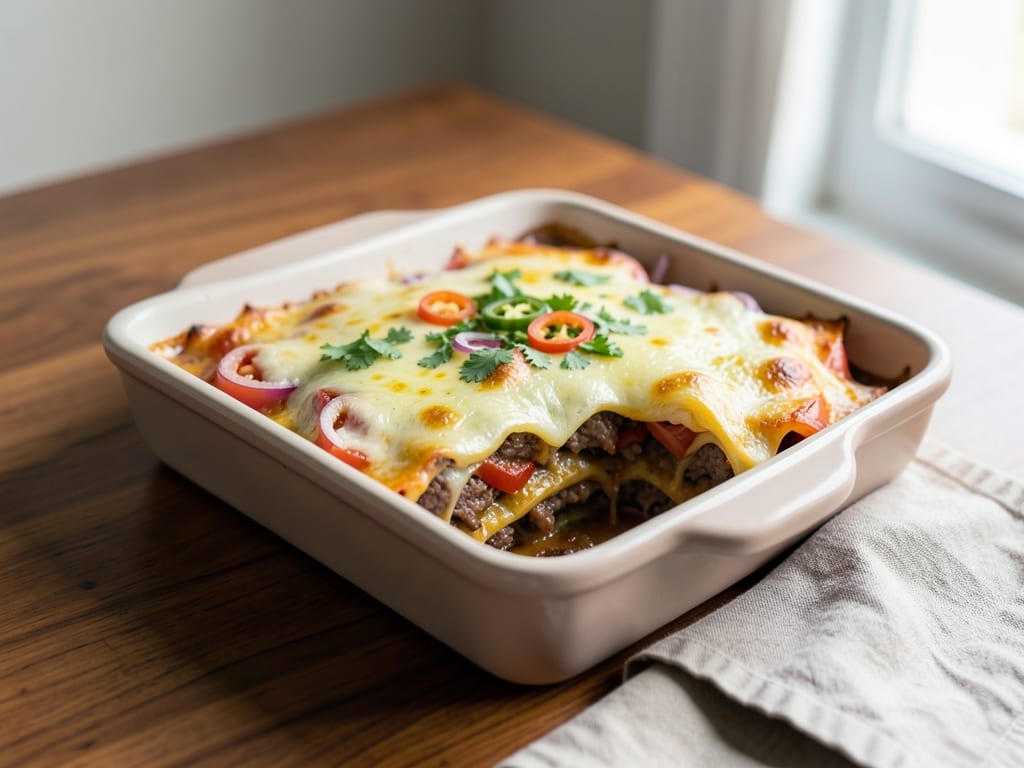
Peruvian Lomo Saltado Lasagna
This fusion dish brings together the bold flavors of Peru's beloved lomo saltado—tender beef sirloin, ají amarillo, soy sauce, and red onions—in a comforting baked lasagna format. Layers of seasoned beef, spiced tomato sauce, melted cheese, and pasta create a dish that honors both the source inspiration and the Italian classic, finished with fresh cilantro.
- Prep
- 20 min
- Cook
- 1 hr 30 min
- Wait
- 10 min
- Total
- 2 hr
- Makes
- 1 lasagna (6 servings)
Steps
Before you start
- Preheat oven to 375°F (190°C) before assembling the lasagna
- Slice red onions and mince garlic during the beef-browning step to save time
- Have ají amarillo paste available—found in Latin or specialty sections; it's essential for authentic flavor
- Cut beef sirloin against the grain into ¼-inch-thick strips so they stay tender
- Read through all instructions to understand the timing and which steps can run in parallel
Cook the lasagna noodles
- Bring a large pot of salted water to a boil over high heat.
- Add lasagna noodles and cook according to package directions, usually 8–12 minutes, until al dente (tender but with a slight firmness).
- Drain in a colander and lay the cooked noodles flat on parchment paper to prevent sticking.
- Set aside.
+ Show details− Hide details
Ready when: Noodles are tender and flexible, not mushy
Tip: Don't fully cook noodles to completely soft—they'll continue cooking in the oven and may become mushy if overcooked now
Brown the beef
- Heat 1 tbsp olive oil in a large skillet over high heat until shimmering.
- Season beef strips generously with salt and black pepper.
- Working in 2–3 batches to avoid crowding, sear the beef for 2–3 minutes per batch, until browned on the outside but still slightly pink in the center.
- Transfer each batch to a plate and set aside.
+ Show details− Hide details
Ready when: Beef is seared on all sides with a golden-brown crust
Tip: Don't overcrowd the pan—searing in batches ensures proper browning instead of steaming. Don't cook through; the beef will finish in the sauce.
Sauté onions and garlic
- Add the remaining 2 tbsp olive oil to the skillet (reduce heat to medium-high).
- Add sliced red onions and cook, stirring occasionally, for 5–6 minutes, until softened and starting to caramelize at the edges.
- Add minced garlic and cook for 1 minute, stirring constantly, until fragrant.
+ Show details− Hide details
Ready when: Onions are soft and lightly browned at edges; garlic is fragrant and not raw
Tip: Caramelizing the onions builds deep, sweet flavor—stir often to prevent burning but don't rush the process
Add ají amarillo paste
- Stir in ají amarillo paste and cook for 2 minutes, stirring constantly.
- This brief cooking toasts out any raw spice notes and integrates the paste evenly with the oil and aromatics.
- The mixture should smell aromatic and warm.
+ Show details− Hide details
Ready when: Paste is fragrant, smooth, and well-distributed throughout the aromatics
Tip: Toasting the paste mellows raw chili flavor and builds complexity—skipping this step leaves a harsh taste
Add tomatoes and seasonings
- Pour in the crushed tomatoes, soy sauce, white vinegar, beef broth, and ground cumin.
- Stir well for about 30 seconds to combine all ingredients thoroughly, scraping the bottom of the pan to incorporate any browned bits.
+ Show details− Hide details
Ready when: All ingredients are combined and the mixture is simmering
Simmer beef and sauce
- Return the browned beef to the skillet along with any accumulated juices.
- Stir to coat the beef in the sauce.
- Reduce heat to medium-low and simmer gently for 10–12 minutes, stirring occasionally, to meld flavors.
- The sauce should thicken slightly and coat the beef.
+ Show details− Hide details
Ready when: Sauce is noticeably thickened and coats the back of a spoon; beef is tender
Tip: Gentle simmering prevents beef from becoming tough and allows the sauce's lomo saltado flavors to deepen and meld
Preheat oven and begin assemblyOven 375°F / 190°C
- Preheat oven to 375°F (190°C) if not already done.
- Spread a thin layer (about ½ cup / 120 ml) of the beef and sauce mixture across the bottom of a 9×13-inch baking dish, covering it completely.
- This prevents sticking and creates a flavor base.
Build lasagna layers
- Break or cut the cooked lasagna noodles to fit the baking dish as needed; layering is more important than keeping noodles whole.
- Arrange a layer of noodles over the sauce on the bottom.
- Spread about 1.5 cups (360 ml) of the remaining beef mixture over the noodles, then sprinkle about ⅓ of the shredded mozzarella and a handful of grated queso fresco.
- Repeat this layering—noodles, beef mixture, mozzarella, queso fresco—until all ingredients are used, ending with a top layer of noodles, remaining beef sauce, and the remaining cheeses.
+ Show details− Hide details
Tip: Breaking noodles to fit prevents overly thick, doughy layers and ensures even cooking. Don't worry about perfect presentation—rustic is fine
Bake coveredOven 375°F / 190°C
- Cover the baking dish tightly with aluminum foil, ensuring the foil doesn't touch the cheese (tent it loosely if needed).
- Bake at 375°F (190°C) for 25 minutes.
- The foil prevents the cheese from browning too quickly while the interior heats through evenly.
+ Show details− Hide details
Tip: Covering the lasagna ensures the inside reaches serving temperature without the top burning
Bake uncoveredOven 375°F / 190°C
- Remove the foil and bake uncovered for 15–20 more minutes, until the cheese is bubbling vigorously at the edges and the top is lightly golden brown.
- Watch carefully in the last 5 minutes to prevent over-browning.
+ Show details− Hide details
Ready when: Cheese is bubbling at the edges and throughout; top is golden brown but not dark
Tip: Watch the oven closely toward the end—every oven runs differently, and the top can brown quickly once it starts
Rest and serve
- Remove the lasagna from the oven and let it rest, uncovered, for 10 minutes at room temperature.
- This allows the structure to set and makes serving much easier.
- Garnish individual portions generously with fresh cilantro and sliced jalapeños if desired.
- Serve hot directly from the dish.
+ Show details− Hide details
Tip: Resting is crucial—cutting too soon causes the lasagna to fall apart and makes plating messy
Good to know
Tips
- Don't skip the searing step—browning the beef on high heat creates depth of flavor and helps strips hold their shape during layering and baking rather than breaking apart.
- Slice red onions as thinly as possible so they cook evenly and caramelize nicely, building the foundation of lomo saltado flavor.
- If you can't find ají amarillo paste, check the international or Latin aisle of your grocery store or order online—it's the key ingredient that makes this dish authentically Peruvian and can't easily be replicated.
- Break lasagna noodles to fit the dish rather than folding them—folded noodles create overly thick, doughy layers and cook unevenly. Rustic is fine.
Make ahead
The lasagna can be assembled up to 24 hours ahead, covered tightly with plastic wrap, and refrigerated. Add 10–15 minutes to the baking time if baking from cold. Alternatively, prepare the beef and sauce up to 2 days ahead and refrigerate separately, then assemble and bake fresh.
Storage & reheating
Room temperature: up to 2 hours (uncovered). Refrigerator: up to 3 days in an airtight container; reheat covered at 350°F (175°C) for 15–20 minutes until heated through. Freezer: up to 2 months (wrap tightly in foil and plastic wrap); thaw overnight in the refrigerator, then reheat covered at 350°F for 25–30 minutes.
Substitutions
- ají amarillo paste → 2–3 tbsp ají amarillo powder mixed with 2 tbsp beef broth or water to form a paste, or another yellow chili paste (like habanero). The flavor profile will shift slightly but remain delicious. Ají amarillo paste is worth seeking out in Latin or specialty markets for authentic flavor.
- queso fresco → crumbled feta cheese, diced Oaxaca cheese, or part-skim ricotta. Queso fresco adds a creamy, slightly tangy layer; these alternatives provide similar texture and flavor balance.
- white vinegar → 2 tbsp fresh lime juice or fresh lemon juice. Lime juice is more authentic to traditional Peruvian lomo saltado and adds bright acidity. Adjust the amount to taste.
- beef sirloin → New York strip steak, flank steak, or skirt steak. Slice against the grain into thin strips for tenderness. These cuts develop similar browning and texture in the sauce.
More lasagna
See all →
Find more like this
- Meal
- Dinner
- Main ingredient
- Mozzarella
- Diet
- HalalSugar-Free