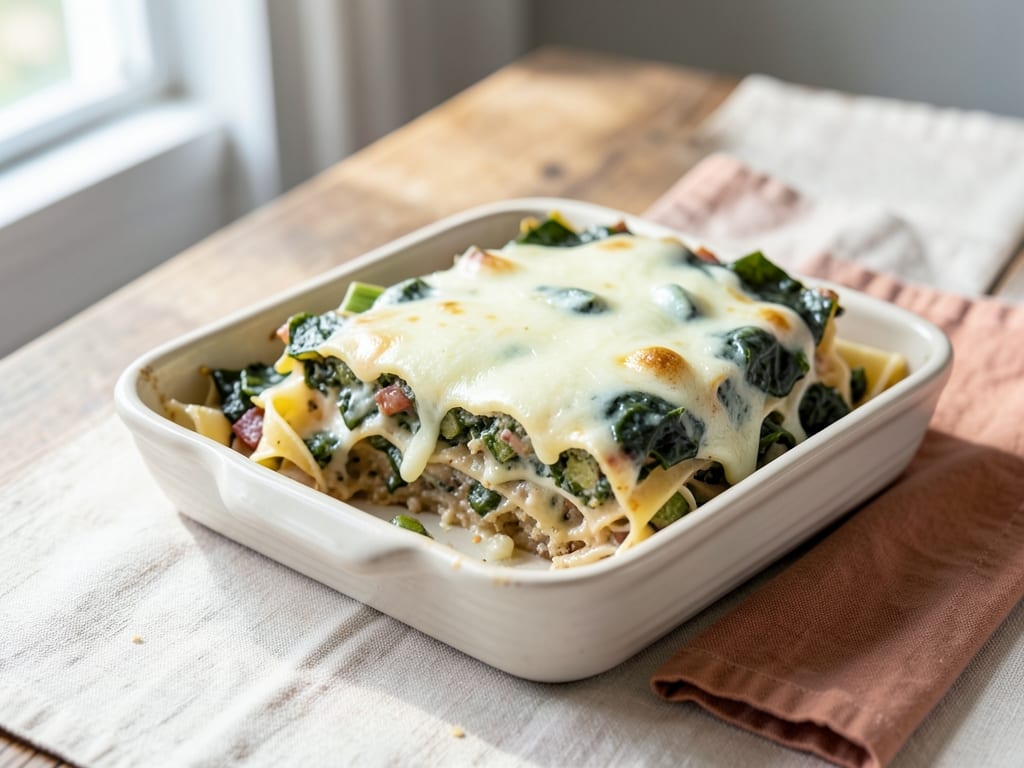
Caribbean Callaloo and Coconut Lasagna
A tropical twist on classic lasagna layering fresh callaloo, tender okra, and a creamy coconut-based sauce beneath melted cheese. This Caribbean-inspired dish marries silky ricotta, full-fat coconut milk, and aromatic thyme with a subtle Caribbean heat from optional Scotch bonnet pepper. The result is a warm, comforting baked pasta that feels both exotic and deeply satisfying. Perfect for showcasing the flavors of Caribbean cuisine.
- Prep
- 25 min
- Cook
- 50 min
- Wait
- 10 min
- Total
- 1 hr 25 min
- Makes
- One 9×13-inch lasagna (6 servings)
Steps
Before you start
- Preheat your oven to 375°F (190°C) and position a rack in the center.
- If using fresh callaloo, wash it thoroughly and remove any tough stems.
- Defrost frozen callaloo if using and squeeze out excess moisture with paper towels to prevent watery lasagna.
- Have all ingredients measured and prepared before you start cooking (mise en place).
Preheat oven and cook noodlesOven 375°F / 190°C
- Set oven to 375°F (190°C).
- Bring a large pot of salted water to a rolling boil.
- Add lasagna noodles and cook following package directions until al dente, usually 8–10 minutes.
- Drain in a colander, rinse briefly with cool water, and lay the noodles flat on parchment paper or clean kitchen towels in a single layer, spacing them slightly apart to prevent sticking.
+ Show details− Hide details
Ready when: Noodles are flexible and tender but still slightly firm to bite; they will soften further during baking
Tip: Avoid overcooking the noodles at this stage; they continue to absorb liquid during baking and can become mushy if overcooked initially
Make the roux base
- In a large skillet over medium heat, melt butter.
- Add diced onion and cook for 3–4 minutes, stirring occasionally, until softened and just beginning to turn golden at the edges.
- Add minced garlic and cook for 1 minute more until fragrant.
- Sprinkle flour evenly over the onion mixture and stir constantly for 2 minutes to form a thick paste (roux).
- The roux should smell toasted and be light golden in color.
+ Show details− Hide details
Ready when: Roux is light golden and smells toasted; no raw flour smell remains
Tip: Stir constantly to prevent the roux from browning too quickly or forming lumps, which would make the final sauce grainy
Simmer the sauce base
- Pour the stock and coconut milk into the roux, whisking continuously to break up any lumps and create a smooth sauce.
- Add thyme, nutmeg, salt, and black pepper.
- If using Scotch bonnet, add it whole without piercing it—this infuses the sauce with gentle heat while the pepper itself remains removable.
- Bring to a simmer over medium heat and cook for 3–4 minutes until the sauce thickens slightly and coats the back of a spoon.
- Remove from heat.
+ Show details− Hide details
Ready when: Sauce is smooth with no visible lumps and coats the back of a spoon; no floury taste remains
Tip: Whisk vigorously if lumps do form; strain through a fine-mesh sieve if necessary. Keep the heat at a gentle simmer to avoid scorching the coconut milk
Wilt the callaloo
- Add the roughly chopped fresh callaloo leaves directly to the hot sauce.
- Stir gently until the greens are completely wilted and no raw green remains, about 2–3 minutes.
- The volume will reduce significantly.
- Taste and adjust seasoning with additional salt, pepper, or a squeeze of lime juice as desired.
- Set the sauce aside and let cool slightly.
+ Show details− Hide details
Ready when: Callaloo is completely wilted with no raw or tough greens visible; sauce is dark green
Tip: If using frozen callaloo, thaw it first and squeeze out excess moisture with paper towels to prevent the lasagna from becoming watery
Sauté the okra
- In a separate small skillet, heat neutral oil over medium-high heat until shimmering.
- Add the sliced okra in a single layer and cook for 4–5 minutes, stirring occasionally, until the okra is tender and no longer slimy in texture.
- It should be bright green and soft.
- Season lightly with salt and pepper.
- Transfer to a plate and let cool slightly.
+ Show details− Hide details
Ready when: Okra is tender, bright green, and no longer gummy; slices soften easily when pressed
Tip: High heat and minimal stirring reduce okra's sliminess. Avoid moving the pieces too much; let them sear slightly on the edges for better texture
Mix the ricotta filling
- In a small bowl, combine ricotta cheese, lime zest, a pinch of salt, and a grind of black pepper.
- Stir until the mixture is smooth and the zest is evenly distributed.
- Set aside.
+ Show details− Hide details
Ready when: Mixture is uniform in color with no lumps and zest is distributed throughout
Start the first layer
- Spread about ¼ cup of the cooled callaloo-coconut sauce over the bottom of a 9×13-inch baking dish to prevent sticking.
- Lay 3–4 lasagna noodles in a single layer, breaking pieces to fit as needed.
- Spread half of the ricotta mixture over the noodles in a thin, even layer.
- Scatter half of the sautéed okra pieces over the ricotta.
- Pour approximately ¾ cup of the remaining callaloo-coconut sauce over the okra.
- Sprinkle ½ cup of shredded mozzarella evenly across the layer.
+ Show details− Hide details
Ready when: First layer is evenly distributed with no large gaps or excessive sauce pooling
Tip: Don't overfill each layer; keep it compact so the lasagna stays stable during baking and cutting
Build the second layer
- Repeat the process: arrange 3–4 lasagna noodles over the cheese.
- Spread the remaining ricotta mixture over the noodles.
- Scatter the remaining sautéed okra.
- Pour approximately ¾ cup of the remaining callaloo-coconut sauce over the layer.
- Sprinkle ½ cup of mozzarella over the sauce.
+ Show details− Hide details
Ready when: Second layer is even and level
Add the top layer and cheese topping
- Arrange the final 3–4 lasagna noodles on top.
- Pour the remaining callaloo-coconut sauce (approximately 1 cup) evenly over the noodles, ensuring all exposed pasta is covered to prevent drying.
- In a small bowl, combine the remaining mozzarella (about 1 cup) and the shredded sharp cheddar.
- Spread this cheese mixture evenly across the top layer in a single, even coating.
+ Show details− Hide details
Ready when: Top cheese is evenly distributed with no bare spots
Bake covered and uncoveredOven 375°F / 190°C
- Cover the baking dish loosely with aluminum foil, tenting it slightly so it doesn't touch the cheese.
- Place in the preheated 375°F (190°C) oven and bake for 25 minutes.
- The foil prevents the top from browning too quickly while the interior heats through.
- After 25 minutes, carefully remove the foil.
- Return to the oven and bake uncovered for an additional 12–15 minutes until the cheese on top is melted, bubbling at the edges, and golden in places.
- The sauce should bubble visibly around the sides of the baking dish.
+ Show details− Hide details
Ready when: Cheese is melted and light golden, sauce bubbles at the edges, and the center feels hot when you insert a knife
Tip: If the top is browning too quickly before 25 minutes, the oven may run hot; reduce temperature to 350°F (175°C). If the top isn't browning after uncovering, increase oven to 400°F (200°C) for the final 5 minutes
Rest and serve
- Remove the lasagna from the oven and let it rest undisturbed for 10 minutes before slicing.
- This allows the layers to set slightly, making it easier to cut clean squares without the filling falling apart.
- Carefully remove any whole Scotch bonnet pepper if you added one (or leave it in if your guests prefer extra spice).
- Cut the lasagna into six equal squares and serve warm.
+ Show details− Hide details
Ready when: Lasagna is set enough to slice without the layers sliding; a knife passes through cleanly
Tip: Resting is critical—cutting too soon will cause the layers to separate and the sauce to run. A bench scraper or a long, thin, sharp knife works best for clean, neat slices
Good to know
Tips
- If fresh callaloo is unavailable at your local market, frozen callaloo is an excellent substitute. Thaw it completely and squeeze out excess moisture using paper towels—this prevents the finished lasagna from becoming watery or soupy.
- The whole Scotch bonnet pepper infuses the sauce with gentle Caribbean heat without overpowering the dish. Do not pierce or break it open. Remove it completely before serving (or leave it in if your guests enjoy bold spice). If you prefer milder heat, omit it entirely.
- For deeper flavor, use full-fat coconut milk; 'lite' coconut milk will result in a thinner, less creamy sauce. Stir the can well before opening to incorporate the cream with the liquid.
- Lasagna is best served and eaten within 1–2 days of baking for the best texture and flavor. After that, the sauce continues to be absorbed by the noodles, and the overall structure becomes softer.
Make ahead
Lasagna can be assembled up to 1 day ahead. Cover the unbaked dish tightly with foil and refrigerate. Bake from cold, adding 10–15 minutes to the baking time. Alternatively, bake the lasagna fully, cool completely, wrap tightly in foil and plastic wrap, and refrigerate for up to 4 days or freeze for up to 3 months.
Storage & reheating
Refrigerate in an airtight container or covered baking dish for up to 4 days. Freeze (wrapped tightly in foil and then plastic wrap, or in labeled freezer bags) for up to 3 months. To reheat refrigerated lasagna, cover with foil and warm at 350°F (175°C) for 20–25 minutes. To reheat from frozen, cover with foil and bake at 350°F for 45–60 minutes, then uncover for the final 10 minutes if you'd like to crisp the top. Thaw overnight in the refrigerator for faster reheating.
Substitutions
- fresh callaloo → Fresh spinach or kale. Use 3 cups (packed) fresh spinach or about 1 lb kale, washed and roughly chopped. Kale may take 1–2 minutes longer to wilt. The flavor will be milder and earthier without the callaloo's characteristic tang.
- full-fat coconut milk → Heavy cream mixed with vegetable broth. Use ¾ cup heavy cream and ¼ cup additional vegetable broth (total 1 cup liquid). This creates a creamy sauce but loses the tropical coconut flavor. For more tropical flavor, use full-fat Greek yogurt instead of cream.
- fresh okra → Green beans or zucchini. Use the same weight of green beans (trimmed and cut into ½-inch pieces) or zucchini (sliced ¼-inch thick rounds). Sauté green beans 1–2 minutes longer until tender. Zucchini will be softer and more delicate. Both lack okra's unique texture but add similar vegetable substance.
- ricotta cheese → Cream cheese or cottage cheese. Use 1 cup cream cheese (at room temperature, stirred until smooth) or drained cottage cheese. Mix with lime zest as directed. Cream cheese will create a denser, richer layer. Cottage cheese will be slightly grainy.
More lasagna
See all →
Find more like this
- Meal
- Dinner
- Cuisine
- Caribbean
- Main ingredient
- MozzarellaOkra
- Diet
- HalalSugar-Free