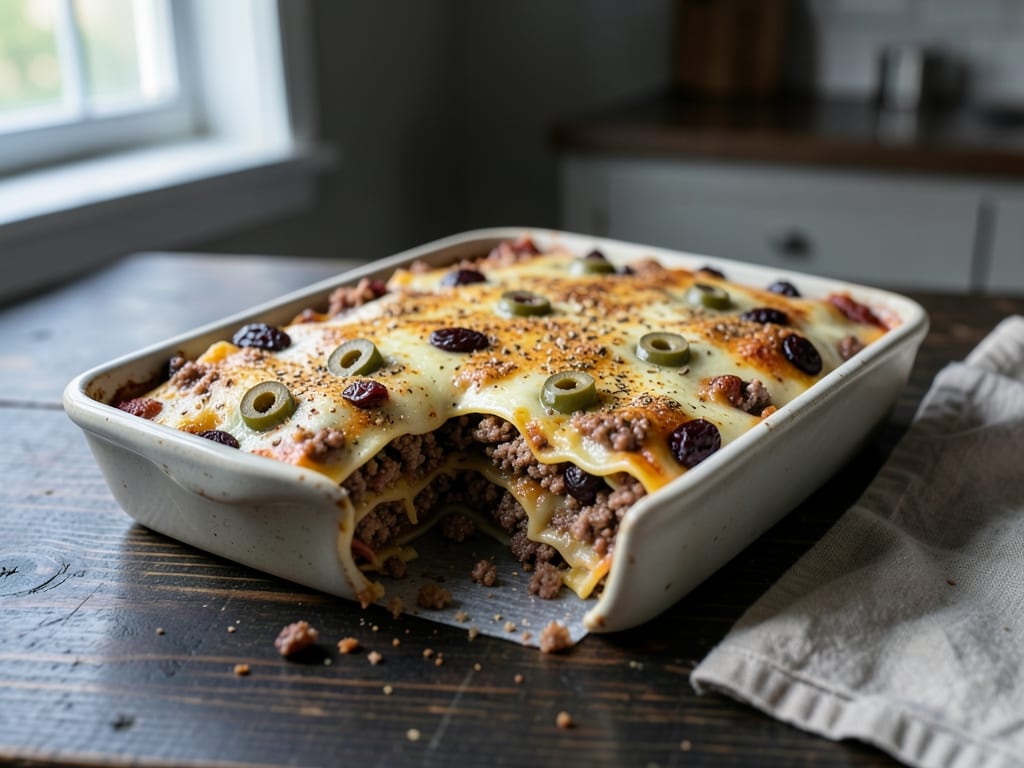
Cuban Picadillo Lasagna
A fusion of Caribbean and Italian flavors: layers of seasoned ground beef filling with green olives, raisins, and warm spices (cumin, oregano, cinnamon) alternating with tender lasagna noodles and a savory cheese custard. The picadillo is classic Cuban—savory, slightly sweet, with briny olives and plump raisins—but baked in a traditional lasagna format. Golden and bubbling when done, it's comfort food with character.
- Prep
- 15 min
- Cook
- 1 hr 10 min
- Wait
- 25 min
- Total
- 1 hr 50 min
- Makes
- 1 lasagna, 8 servings
Steps
Before you start
- Preheat oven to 375°F (190°C) before assembling the lasagna
- Cook lasagna noodles first and let them cool slightly on parchment paper so they're ready to layer
- Measure and chop the onion and garlic before you start cooking—the filling moves quickly once heat is applied
- Have all ingredients (olives, raisins, spices, etc.) measured and within arm's reach of the stove
Cook lasagna noodles
- Bring a large pot (6-quart capacity) of salted water to a rolling boil over high heat.
- Add 1 lb lasagna noodles and stir to separate them.
- Cook according to package directions, usually 8–10 minutes, until al dente but still with a slight firmness when bitten.
- Drain in a colander, reserving about 1/2 cup pasta water for later if needed.
- Lay the cooked noodles flat on parchment paper in a single layer to cool and prevent sticking.
+ Show details− Hide details
Ready when: Noodles are pliable but retain a slight firmness when bitten (al dente)
Tip: Reserve pasta water to loosen the filling if needed during assembly for better moisture distribution
Brown the ground beef
- Heat 1.5 tbsp olive oil in a large (12-inch) skillet over medium-high heat until shimmering.
- Add 2 lbs ground beef and break it up immediately with a wooden spoon or ground meat spatula, crushing it into small, uniform pieces as it cooks.
- Stir frequently for 7–8 minutes, until the meat is completely browned with no pink visible.
- If the beef releases more than 1 tablespoon of fat, carefully pour the excess into a small cup and discard.
- Transfer the cooked beef to a clean bowl using a slotted spoon.
+ Show details− Hide details
Ready when: Beef is completely browned with no pink remaining; meat is broken into small pieces
Tip: Breaking the beef into small pieces while cooking ensures even browning and the right texture in the finished lasagna
Sauté aromatics and bloom spices
- Add the remaining 1.5 tbsp olive oil to the same skillet over medium heat.
- Add 1 large onion, diced into 1/4-inch pieces, and cook for 3–4 minutes, stirring occasionally, until the onion softens and becomes translucent at the edges.
- Add 4 cloves minced garlic and cook for 1 minute more, stirring constantly, until very fragrant.
- Add 1 tsp ground cumin, 1/2 tsp dried oregano, and 1/4 tsp ground cinnamon.
- Stir constantly for about 30 seconds to toast the spices and release their aromatic oils—you should smell the warm, toasted spices.
+ Show details− Hide details
Ready when: Onions are soft and translucent; spices are fragrant and slightly darkened
Tip: Toasting (blooming) the spices in fat unlocks their deeper flavors and prevents them from tasting raw
Simmer the picadillo
- Return the cooked beef to the skillet with the aromatics and spices.
- Stir in 3 tbsp tomato paste and cook, stirring constantly, for 1 minute so the paste coats all the meat.
- Add one 14.5 oz can diced tomatoes (with their juice), 1/4 cup beef broth, 1 cup pitted green olives halved, and 1/2 cup raisins.
- Stir well to combine all ingredients evenly.
- Bring the mixture to a gentle simmer over medium heat and cook uncovered for 8–10 minutes, stirring occasionally.
- The sauce should reduce slightly and thicken; the flavors will meld and deepen.
- The finished filling should be moist but not soupy—like a thick stew that holds together but isn't dry.
- Taste and season with 1 tsp salt and 1/4 tsp black pepper, adjusting to your preference.
- If the filling seems too thick during assembly, add a splash of reserved pasta water.
+ Show details− Hide details
Ready when: Sauce is thickened and concentrated; flavors are well developed; filling is moist but not watery
Tip: Simmering longer than stated will cause the filling to dry out; stir occasionally but don't leave it unattended
Mix the cheese custard
- In a small bowl, beat 2 large eggs at room temperature with a fork until slightly frothy and well combined.
- Stir in 1/2 cup whole milk, 1.5 cups shredded mozzarella cheese, and 1/4 cup grated Parmesan cheese.
- Mix gently until well combined; small clumps of cheese are normal and fine.
- Season with a pinch of salt and black pepper.
- Set the custard aside.
+ Show details− Hide details
Tip: Preparing the custard while the filling simmers on the stove saves time and keeps the workflow smooth
Assemble the lasagnaOven 375°F / 190°C
- Preheat the oven to 375°F (190°C).
- Spread a thin layer of the picadillo filling (about 1 cup) evenly across the bottom of a 9×13-inch baking dish.
- Arrange noodles over the filling in a single layer, overlapping slightly (usually 3–4 noodles).
- Spread half of the remaining picadillo filling (about 3 cups) over the noodles in an even layer.
- Pour half the cheese custard (about 1 cup) over the filling and gently smooth it out with the back of a spoon.
- Repeat with another layer of noodles, the rest of the picadillo filling, and the remaining custard.
- Top with a final layer of noodles.
- Sprinkle the remaining 1/2 cup shredded mozzarella and 1/4 cup grated Parmesan evenly over the top.
- Cover the baking dish tightly with aluminum foil.
+ Show details− Hide details
Tip: Overlapping noodles slightly ensures there are no gaps and helps the lasagna cook evenly
Bake until bubbly and goldenOven 375°F / 190°C
- Place the covered lasagna in the preheated 375°F (190°C) oven.
- Bake covered with foil for 25 minutes.
- Remove the foil and bake for an additional 15–20 minutes until the cheese on top is golden brown and bubbly around the edges, and you can see filling bubbling up the sides of the pan.
- The internal temperature measured with an instant-read thermometer inserted into the center should reach at least 165°F (74°C) for food safety.
- The top should be golden and slightly browned in spots.
+ Show details− Hide details
Ready when: Top cheese is golden brown and bubbling; edges are bubbling; internal temperature reaches 165°F (74°C)
Tip: Covering with foil initially prevents the noodles and top layer from drying out; removing foil in the final phase allows the top to brown
Rest before serving
- Remove the lasagna from the oven and let it rest undisturbed for 10 minutes at room temperature.
- During this time, the layers will set slightly, making the lasagna much easier to cut and serve without the layers sliding apart or falling apart.
- Cut into 8 portions (or as desired) and serve warm.
+ Show details− Hide details
Ready when: Lasagna is still warm but firm enough to cut cleanly
Tip: Do not skip the resting period—it makes a significant difference in how neatly the lasagna cuts and how well the layers stay together on the plate
Good to know
Tips
- Make the picadillo filling a day ahead—it tastes even better once the flavors have melded overnight. Cool completely, cover, and refrigerate; reheat gently on the stovetop before assembling.
- Don't skip the 10-minute rest after baking. It allows the cheese to set and the layers to firm up slightly, making the lasagna much easier to cut and serve without falling apart.
- If you prefer more saucy filling, add a splash of reserved pasta water to the picadillo before assembling. The noodles will absorb liquid as the lasagna bakes.
- Prepare all ingredients and have them within reach before you start cooking (mise en place). This lasagna moves quickly once you begin browning the beef.
Make ahead
Yes. Prepare the picadillo filling up to 1 day ahead, cool completely, and store covered in the refrigerator. Assemble the unbaked lasagna up to 4 hours before baking and refrigerate; if baking straight from the refrigerator, add 10–15 minutes to the baking time. Do not freeze unbaked or baked lasagna for best results.
Storage & reheating
Cover leftovers and refrigerate for up to 3 days. To reheat, cover with foil and warm in a 325°F (163°C) oven for 20–30 minutes until heated through. Do not freeze.
Substitutions
- Green olives → Castelvetrano olives or Kalamata olives. Castelvetrano olives are buttery and mild; Kalamatas are earthier and darker. Either works, though they'll shift the flavor profile slightly.
- Raisins → Golden raisins or dried currants. Golden raisins are slightly milder; currants are smaller and more tart. Use the same amount for equivalent sweetness and texture.
- Ground cumin → Ground coriander. Coriander is milder and slightly citrusy; you'll lose some of the warm, earthy Cuban flavor but gain a different spice note.
- Shredded mozzarella cheese → Mixture of 1 cup ricotta cheese plus 1 cup mozzarella (total 2 cups). Ricotta creates a creamier, more indulgent custard layer and is more traditional in some lasagna recipes.
More lasagna
See all →
Find more like this
- Meal
- Dinner
- Cuisine
- Caribbean
- Main ingredient
- Ground Beef
- Diet
- HalalSugar-Free
- Quick & Easy
- Make AheadFreezer FriendlyBudget