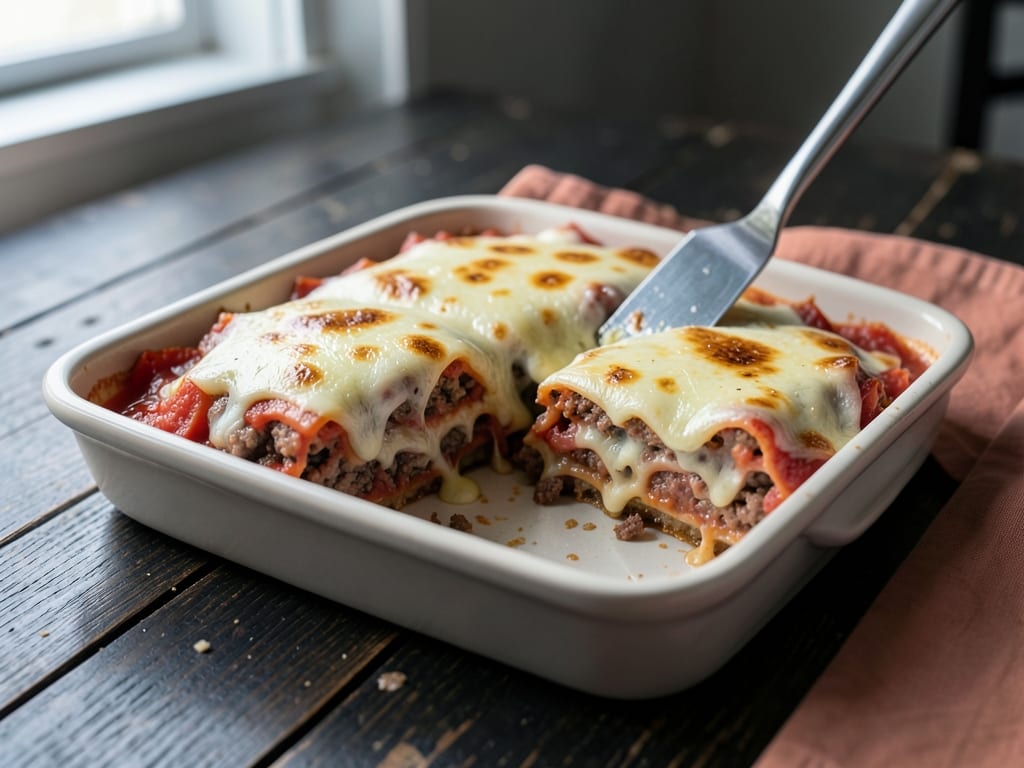
Brazilian Lasagna à Bolonhesa with Ham and Cheese
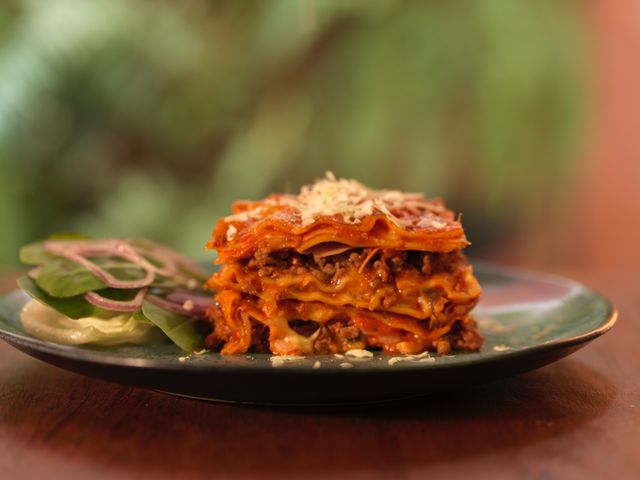
This rich, comforting Brazilian lasagna layers seasoned ground beef and ham in a savory tomato sauce, creamy béchamel, and melted mozzarella and Parmesan. Distinct from Italian lasagna, the béchamel provides a silky texture throughout, while the combination of beef and ham delivers deep, savory flavor. A showstopping dinner that feeds a crowd and improves as it sits.
- Prep
- 25 min
- Cook
- 1 hr 10 min
- Wait
- 15 min
- Total
- 1 hr 50 min
- Makes
- 1 lasagna (8 servings)
Steps
Before you start
- Preheat your oven to 375°F (190°C) while you start the meat sauce—it can preheat in the background.
- Measure and chop all vegetables and ingredients before you begin (mise en place)—the cooking moves quickly once you start.
- Warm the milk gently or leave it at room temperature so it won't shock the roux when you add it.
- Have your 9×13-inch (23×33 cm) baking dish ready and clear space on your counter for assembly.
Prepare all ingredients
- Finely dice the onion into pieces about ¼-inch (6 mm).
- Mince the garlic.
- Cut the pancetta into ¼-inch pieces and the ham into ½-inch pieces.
- Measure out the tomato sauce, tomato paste, and red wine.
- If using dried lasagna sheets, boil them according to the package (usually 8–10 minutes until pliable but still firm), then lay flat on parchment paper to cool.
- If using no-boil sheets, set them aside.
- Have all ingredients ready before you begin cooking.
+ Show details− Hide details
Ready when: All vegetables are chopped and lasagna sheets are cooked and cooled if using dried sheets
Tip: Lay cooked lasagna sheets on parchment paper so they don't stick together—they're easier to separate when cool.
Cook pancetta and aromatics
- Heat the olive oil in a large skillet (12-inch) over medium heat.
- Add the diced pancetta and cook, stirring occasionally, until the fat begins to render and the edges turn golden, about 4–5 minutes.
- Add the diced onion and stir to coat with the fat.
- Cook, stirring occasionally, until the onion is translucent and very soft, about 3–4 minutes.
- Add the minced garlic and stir constantly for about 30 seconds until fragrant.
- Do not let the garlic brown.
+ Show details− Hide details
Ready when: Pancetta is golden and rendered; onion is very soft and translucent; garlic is fragrant
Tip: Don't rush this step—the aromatics provide the foundation of flavor. Low, slow cooking develops sweetness in the onion.
Brown the ground beef and ham
- Increase the heat to medium-high.
- Add the ground beef and ham to the skillet, breaking the beef into small pieces with a wooden spoon as it cooks.
- Stir and break up the meat for 4–5 minutes until the ground beef is fully browned and no pink remains and reaches an internal temperature of 160°F (71°C).
- Pour off excess fat if there is more than ½ inch pooling at the bottom of the pan.
+ Show details− Hide details
Ready when: Ground beef is fully browned with no pink and reads 160°F (71°C) on an instant-read thermometer; ham is heated through and beginning to brown slightly at the edges
Tip: Use a wooden spoon to break the meat into small, uniform pieces—this helps it cook evenly and gives the sauce a better texture.
Build and simmer the meat sauce
- Reduce the heat to medium.
- Stir in the tomato paste and cook for 1 minute to deepen its flavor.
- Pour in the canned tomato sauce (or crushed tomatoes) and the red wine if using.
- Add the bay leaf.
- Stir well to combine.
- Bring the sauce to a gentle simmer, then reduce the heat to medium-low.
- Simmer uncovered for 15 minutes, stirring occasionally.
- The sauce should bubble gently at the edges, not boil vigorously.
- Season with salt and pepper to taste.
- The sauce will reduce slightly and darken.
+ Show details− Hide details
Ready when: Sauce bubbles gently at the edges; has reduced by about ⅓ and is dark and fragrant; bay leaf is visible
Tip: Simmer low and slow—high heat can make the sauce taste sharp and acidic. If your sauce is too thick after simmering, add a splash of water or broth.
Make the béchamel sauce
- While the meat sauce simmers, melt the butter in a medium saucepan over medium heat.
- Once melted and foaming, add the flour all at once and whisk continuously for 1–2 minutes to form a smooth paste (roux).
- The roux should smell slightly nutty and be the color of wet sand.
- Slowly pour the warm milk into the roux while whisking constantly and vigorously.
- Pour in thirds, whisking well between additions, to avoid lumps.
- Once all the milk is incorporated, continue whisking as the sauce heats.
- Bring the sauce to a gentle simmer, then reduce the heat to medium-low and simmer, stirring frequently with a whisk, for 5–7 minutes until the sauce thickens enough to coat the back of a spoon.
- Remove from heat.
- Season with salt, pepper, and nutmeg to taste—start with a pinch of nutmeg; it should be subtle, not pronounced.
+ Show details− Hide details
Ready when: Sauce coats the back of a spoon and leaves a path when you draw a finger across it; no lumps; no raw flour taste
Tip: Whisk constantly to prevent lumps. If lumps form, strain the sauce through a fine-mesh sieve. Warm milk blends more smoothly than cold milk.
Assemble the lasagnaOven 375°F / 190°C
- Remove the bay leaf from the meat sauce.
- Make sure your oven is preheated to 375°F (190°C).
- Spread a thin layer of meat sauce (about ½ cup / 120 ml) on the bottom of a 9×13-inch (23×33 cm) baking dish.
- Lay down a layer of lasagna sheets, overlapping them slightly and breaking sheets if needed to cover gaps.
- Spread about ⅓ of the remaining meat sauce over the pasta.
- Drizzle about ¼ of the béchamel sauce over the meat sauce and sprinkle with ⅕ of the mozzarella cheese and 1 tbsp of Parmesan.
- Repeat this layering two more times: pasta sheets, meat sauce, béchamel drizzle, and cheeses.
- For the top layer, lay down the final pasta sheets, then spread the remaining béchamel (a thin, even coating), and top with the remaining mozzarella and Parmesan.
- The top should be generously covered with cheese.
+ Show details− Hide details
Ready when: Lasagna is evenly layered with all ingredients used; top layer is covered with béchamel and a generous layer of cheese
Tip: Don't skimp on the sauce layers—they keep the pasta moist and the lasagna from drying out. If your béchamel is too thick to drizzle, thin it with a splash of milk.
Bake the lasagnaOven 375°F / 190°C
- Place the assembled lasagna in the preheated 375°F (190°C / gas mark 5) oven.
- Bake uncovered for 40–45 minutes until the top is golden brown and the sauce is bubbling around the edges of the dish.
- The cheese should be melted and beginning to brown slightly.
- You may see a light crust forming on the cheese.
+ Show details− Hide details
Ready when: Cheese on top is golden brown and may have light brown spots; sauce bubbles around the edges; a knife inserted in the center meets no resistance
Tip: If the top is browning too quickly, loosely tent the dish with foil for the last 10 minutes, then remove the foil to let the top finish crisping.
Cool before serving
- Remove the lasagna from the oven and let it rest on the counter for 10 minutes before cutting.
- This resting time allows the layers to set slightly so they hold together better when served.
- The lasagna will be very hot—use caution.
+ Show details− Hide details
Ready when: Lasagna has cooled enough to handle; edges are no longer actively bubbling
Tip: Skipping this rest will result in mushy, hard-to-serve pieces. A sharp knife dipped in hot water makes cutting cleaner.
Good to know
Tips
- Béchamel lumps are fixable: pour the sauce through a fine-mesh sieve into a clean saucepan and gently reheat, stirring, until smooth. Add milk if it thickens too much.
- This lasagna freezes beautifully and actually tastes better after a day or two in the fridge, as the flavors meld. Make it ahead for stress-free entertaining.
- For extra indulgence, reserve some béchamel before seasoning, heat it separately with a splash of heavy cream, and drizzle it over individual plates when serving.
- Freshly grated Parmesan and mozzarella melt more evenly than pre-shredded cheese (which contains anti-caking agents). If using pre-shredded, toss it with a pinch of cornstarch to prevent clumping.
Make ahead
Assemble the lasagna completely (but do not bake) up to 8 hours in advance. Cover tightly with plastic wrap and refrigerate. Bake directly from the fridge, adding 5–10 minutes to the baking time. Alternatively, bake the lasagna, cool completely, wrap well in plastic wrap and foil, and freeze for up to 3 months. Thaw overnight in the refrigerator before reheating.
Storage & reheating
Room temperature: Cover loosely and store for up to 2 hours. Refrigerator: Store in an airtight container or cover tightly with plastic wrap for up to 4 days. Reheat covered at 350°F (175°C) for 20–25 minutes until warmed through. Freezer: Wrap the entire baked lasagna in plastic wrap and then foil, or cut into portions and freeze in an airtight container for up to 3 months. Thaw overnight in the refrigerator and reheat as directed above.
Substitutions
- dry red wine → beef broth or additional tomato sauce. The wine adds depth and acidity. If omitted, increase tomato sauce by ¼ cup (60 ml) and add 1 tbsp red wine vinegar or balsamic vinegar to brighten the flavor.
- pancetta or bacon, diced → bacon or prosciutto, diced. Any cured pork will work. Bacon is more readily available but has a smoky quality; prosciutto is more delicate and Italian-inspired.
- whole milk, warm or room temperature → half-and-half, light cream, or unsweetened plant-based milk. Half-and-half will make a richer béchamel; cream even richer. Plant-based milks work but may separate slightly during heating—add ½ tbsp cornstarch mixed with 1 tbsp milk to the roux if using dairy-free options.
- lasagna pasta sheets (dry or no-boil) → pappardelle or fettuccine (broken into 3-inch / 7.5 cm pieces) layered as you would lasagna sheets. This creates a more rustic, less formal presentation but retains all the flavors. The wider ribbon pasta works well with the creamy sauce.
More lasagna
See all →


Find more like this
- Meal
- Dinner
- Main ingredient
- Ground BeefMozzarella
- Diet
- Sugar-Free
- Method
- Oven
- Quick & Easy
- Make Ahead
- Occasion
- Parties