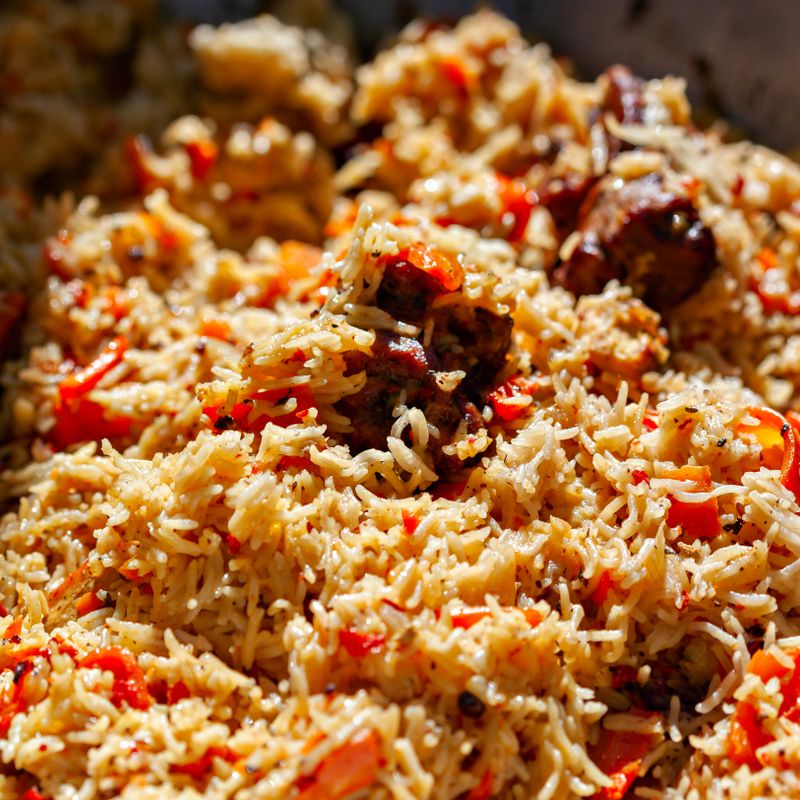
Pakistani Sindhi Biryani
A tangy, fragrant, herb-heavy biryani from Sindh: bone-in chicken simmered in a tomato-yogurt masala with sour dried plums and slit green chilies, tucked with golden fried potatoes, then layered with parboiled basmati and steamed on dum until every grain is perfumed.
- Prep
- 35 min
- Cook
- 1 hr 55 min
- Wait
- 40 min
- Total
- 3 hr 10 min
- Makes
- 1 large pot (6 generous servings)
Steps
Before you start
- Take the yogurt and chicken out of the fridge 30 minutes ahead so the masala doesn't split or cool down when they go in.
- Use a heavy-bottomed 7-quart (6.5 L) pot with a tight lid for the biryani, and a second 6-quart (5.5 L) pot for parboiling the rice.
- Read the timing: the rice must soak 30 minutes, and the finished biryani needs a 10-minute rest, so plan about 3 hours start to finish.
- Sindhi biryani is meant to be tangy and quite spicy. Seed the green chilies if you want less heat, but keep them whole so they flavor the masala without breaking up.
Soak rice and plums
- Rinse the basmati in a large bowl with cold water, swirling and draining 5–6 times until the water runs nearly clear.
- Cover with the soaking water and leave 30 minutes.
- Meanwhile, put the dried plums in a small bowl, cover with hot tap water and soak 15 minutes, then drain.
- If using saffron, crumble it into the warm milk and set aside.
- Slice the onions, chop the herbs and tomatoes, and slit the chilies while you wait.
+ Show details− Hide details
Ready when: Rice grains turn opaque white and snap easily when pressed between your fingers
Tip: Don't soak longer than 45 minutes or the grains become fragile and break during parboiling.
Fry the potatoes
- Heat 4 tablespoons (60 ml) of the oil in the 12-inch skillet or your biryani pot over medium-high heat until shimmering.
- Add the dried potato quarters in a single layer (work in two batches if needed) and fry, turning occasionally, 8–10 minutes until deep golden on the outside with a firm crust.
- They will still be raw-ish inside; they finish cooking in the steam later.
- Lift out with a slotted spoon onto a plate and sprinkle with a pinch of the masala salt.
+ Show details− Hide details
Ready when: Potatoes are deep golden and a knife meets resistance in the center
Tip: Dry the potatoes thoroughly before frying so they brown instead of steaming and sticking.
Brown the onions
- In the same oil, add the sliced onions with a big pinch of salt.
- Fry over medium heat, stirring every minute or two, for 14–16 minutes until evenly golden brown (not dark brown).
- Lift out with a slotted spoon, leaving the oil behind, and spread on a plate so they crisp as they cool.
- Set aside about one-third for garnish.
+ Show details− Hide details
Ready when: Onions are uniformly golden brown and starting to crisp at the edges
Tip: Lower the heat if edges darken before the centers color; burnt onions turn the whole biryani bitter.
Sear chicken with spices
- Add 2 more tablespoons of oil to the pot if little remains (you want about 4 tablespoons / 60 ml total).
- Set the pot over medium-high heat.
- Add the cumin seeds, cardamom pods, cloves and cinnamon and stir 20–30 seconds until fragrant.
- Add the ginger-garlic paste and stir 1 minute.
- Add the chicken and sear, turning, 6–8 minutes until the surface is opaque and lightly browned.
+ Show details− Hide details
Ready when: Spices smell fragrant and the chicken is opaque and lightly browned all over
Tip: Don't let the ginger-garlic paste scorch; if it sticks, splash in 1 tablespoon of water.
Build the masala
- Reduce the heat to medium.
- Add the tomatoes, chili powder, turmeric, coriander, ground cumin and the salt.
- Cook, stirring and mashing the tomatoes, 6 minutes until they collapse.
- Lower the heat to medium-low, then stir in the whisked yogurt a third at a time, stirring constantly.
- Add about two-thirds of the fried onions, crushing them in with your hand.
- Cook 6–8 minutes, stirring, until the oil separates and pools at the edges of the masala.
+ Show details− Hide details
Ready when: Masala is thick and glossy, with oil visibly separating around the edges
Tip: Add the yogurt gradually over medium-low heat and stir nonstop so it doesn't curdle.
Simmer the chicken
- Pour in the hot water and bring to a simmer.
- Cover and cook over low heat for 20 minutes.
- Stir in the drained plums and slit green chilies, cover again and cook 5 more minutes.
- Check a thick piece of chicken with the thermometer: it should read at least 165°F (74°C).
- The gravy should be thick and clingy, not soupy; if it's thin, simmer uncovered 3–5 minutes.
- Stir in the garam masala and taste for salt.
+ Show details− Hide details
Ready when: Chicken reads 165°F (74°C) and the gravy is thick enough to coat the back of a spoon
Tip: Excess liquid makes soggy rice. The masala must be thick, with only a few spoonfuls of sauce pooling.
Parboil the rice
- While the chicken simmers, bring the boiling water to a rolling boil in the 6-quart pot with the kosher salt, black cardamom, bay leaves, peppercorns and lemon juice.
- It should taste like mild seawater.
- Drain the soaked rice and add it.
- Boil, stirring gently once or twice, 4–5 minutes until the grains are about 70% cooked.
- Drain immediately in a colander and spread lightly so steam escapes.
+ Show details− Hide details
Ready when: Grains have lengthened, are soft on the outside but still have a firm white core and snap when bitten
Tip: Undercook rather than overcook; the rice finishes in the steam, and overcooked grains turn mushy.
Layer the biryani
- Leave the masala and chicken in the pot, spread flat, and tuck the fried potatoes in among the chicken.
- Scatter over half the mint, half the cilantro and a handful of fried onions.
- Spoon half the rice over the top in an even layer.
- Add the remaining mint, cilantro and another handful of fried onions, then cover with the remaining rice, mounding it slightly in the center.
- Drizzle the saffron milk in streaks and the melted ghee evenly over the top.
- Scatter on the reserved fried onions.
+ Show details− Hide details
Ready when: Rice sits in two even layers over the masala, with herbs and onions visible between
Tip: Don't press or stir the layers; keep the rice fluffy so steam can circulate.
Steam on dum
- Cover the pot with a sheet of foil pressed around the rim, then set the lid on tightly (wrap the lid in a clean towel if it's loose).
- Place the pot on a hot flat griddle or heat diffuser.
- Cook over medium-high heat for 3 minutes until you hear steady sizzling, then reduce to the lowest heat and steam for 25 minutes without lifting the lid.
- Turn off the heat.
+ Show details− Hide details
Ready when: Steam escapes at the rim of the lid, and a grain from the top layer is fully tender with no white core
Tip: If you smell scorching at the end, the heat was too high; use the diffuser and keep the flame at its lowest next time.
Rest and serve
- Leave the pot covered and undisturbed for 10 minutes.
- Remove the lid and use a wide spoon to gently dig down to the bottom, lifting masala and chicken up through the rice so the layers mix in streaks of white and orange.
- Serve hot with raita, sliced onion and lemon wedges.
+ Show details− Hide details
Ready when: Rice grains are separate, fluffy and evenly colored; potatoes are tender
Tip: Don't skip the rest; serving straight away makes the rice sticky.
Good to know
Tips
- Use aged basmati; fresh rice is stickier and breaks easily.
- The masala should be thick before layering. Wet masala is the most common reason for mushy biryani.
- Keep the plums and chilies mostly whole so diners can find them; the tangy plums are the hallmark of Sindhi biryani.
- Taste a grain of parboiled rice and the cooking water: both should be pleasantly salty, as rice can't be salted later.
Make ahead
"Fry the onions and potatoes up to 1 day ahead and refrigerate separately (re-crisp onions in a dry pan). The chicken masala can be cooked through step 6 up to 2 days ahead and refrigerated; reheat until simmering hot before layering with freshly parboiled rice."
Storage & reheating
"Room temperature: no more than 2 hours. Refrigerator: airtight container up to 3 days. Freezer: up to 2 months in portions. Reheat single portions covered in the microwave with 1–2 tablespoons of water for 2–3 minutes, or in a covered pan over low heat for 10 minutes, until steaming hot (165°F / 74°C)."
Substitutions
- dried sour plums (aloo bukhara) → pitted prunes plus 1 tablespoon lemon juice. Prunes are sweeter, so add the lemon juice to the masala to restore the signature tang.
- ghee → unsalted butter. Use the same amount; the flavor is slightly less nutty.
- ginger-garlic paste → equal parts finely grated fresh ginger and garlic. Use 1 tablespoon each, mashed together.
- green chilies (serrano or Indian green chilies) → jalapeños. Milder; use 4 whole jalapeños, quartered lengthwise.
More biryani
See all →
Find more like this
- Meal
- Dinner
- Cuisine
- Pakistani
- Main ingredient
- Chicken ThighsBasmati RicePotatoes
- Method
- Stovetop
- Occasion
- Family Gatherings