
Kolkata Style Chicken Biryani with Potato
A mellow, fragrant Bengali dum biryani: tender bone-in chicken in a lightly spiced yogurt gravy, golden fried potatoes and eggs, and saffron-scented basmati, all sealed and steamed together in one pot.
- Prep
- 45 min
- Cook
- 45 min
- Wait
- 3 hr
- Total
- 4 hr 30 min
- Makes
- 1 large pot (6 generous servings)
Steps
Before you start
- Plan ahead: the chicken needs at least 2 hours in the marinade (up to 12 hours in the fridge for deeper flavor). The rice soak starts about 40 minutes before the marinade ends, so check the clock.
- Use a heavy-bottomed pot of 5½–6 quart (5–6 L) capacity with a tight lid for the biryani. Thin pots scorch on the bottom during the dum step.
- Take the yogurt out of the fridge 30 minutes before marinating so it blends smoothly with the spices.
- Have foil, a flat griddle (tawa) or heat diffuser, and an instant-read thermometer ready before you start layering.
- Kolkata biryani is mild and fragrant rather than fiery. Adjust the green chilies to your taste.
Marinate the chicken
- In a large bowl, combine the yogurt, ginger-garlic paste, mustard oil, lemon juice, Kashmiri chili powder, garam masala, nutmeg-mace, sugar, the 2 tsp kosher salt for the chicken, and the slit green chilies if using.
- Whisk to a smooth paste.
- Add the chicken and turn and massage until every piece is well coated.
- Cover and refrigerate for at least 2 hours (up to 12 hours).
+ Show details− Hide details
Ready when: Chicken is evenly coated in a thick, pale-orange marinade
Tip: Mustard oil smells sharp when raw. That mellows into a pleasant Bengali nuttiness once cooked.
Soak the rice
- When about 40 minutes of marinating remain (this runs alongside the marinade, so it adds no extra time), rinse the basmati in a bowl of cool water, swirling gently and changing the water 4–5 times until it runs nearly clear.
- Cover with fresh water and soak 30 minutes, then drain well in a sieve for 5 minutes.
- Shortly before you start frying, warm the milk until hot to the touch (not boiling), stir in the crushed saffron, and set aside to bloom.
+ Show details− Hide details
Ready when: Soaked grains look opaque white and the milk turns deep orange-gold
Tip: Handle the rice gently. Soaked grains are fragile and break easily.
Fry the onions
- Heat the neutral oil in a 12-inch (30 cm) deep skillet over medium heat.
- Add the sliced onions and the ¼ tsp salt for the onions and fry, stirring often, for 12–15 minutes until deep golden brown.
- Lift out with a slotted spoon onto a plate lined with paper towels, leaving the oil in the pan.
- They crisp as they cool.
- Crumble about half by hand at layering time; reserve the rest for the top.
+ Show details− Hide details
Ready when: Onions are an even golden brown and sizzle quietly; they crisp further as they cool
Tip: Pull them out a shade lighter than you want. They keep darkening in residual heat and turn bitter if burnt.
Fry potatoes and eggs
- Place the eggs in a small pot, cover with cold water, bring to a boil, then cover, turn off the heat and let stand 10 minutes.
- Cool in cold water, peel, and prick lightly with a fork.
- Meanwhile, toss the potatoes with the turmeric and the ½ tsp salt for the potatoes.
- Reheat the onion oil in the skillet over medium-high heat and fry the potatoes, turning occasionally, for 8–10 minutes until golden outside and just starting to soften (not cooked through).
- Remove.
- Fry the eggs in the same oil for 1–2 minutes until lightly blistered and golden.
- Pour 2 tablespoons of the leftover oil into the 5½–6 quart biryani pot for step 5.
+ Show details− Hide details
Ready when: Potatoes are golden outside and a knife meets resistance in the center; eggs are blistered and golden
Tip: Pricking the eggs lets them absorb flavor and prevents splattering when fried.
Cook the chicken gravy
- Set the 5½–6 quart heavy biryani pot over medium-low heat with the 2 tablespoons of reserved frying oil.
- When the oil shimmers, add the marinated chicken with all its marinade.
- Cook uncovered, stirring and scraping the bottom every 2 minutes, for 8 minutes.
- Then cover and cook 15 minutes more, stirring once or twice, until the chicken is about 80% cooked (about 150°F / 65°C at the thickest part, away from bone) and the gravy is thick and clings to the pieces.
- If the gravy looks loose, simmer uncovered for a few extra minutes.
- Turn off the heat and spread the chicken in an even layer, spooning the gravy over it.
- Taste the gravy; it should taste slightly salty, since it seasons the rice above it.
- Start bringing the rice water to a boil now (step 6).
+ Show details− Hide details
Ready when: Chicken is opaque outside with juices still slightly pink near the bone (150°F / 65°C), and the gravy is thick and reddish-gold
Tip: The chicken finishes cooking in the dum step, so stop here. Frequent stirring early on prevents the yogurt from scorching.
Parboil the rice
- Bring the 2 quarts (1.9 L) of water to a rolling boil in the 6-quart (6 L) pot.
- Add the 1½ tbsp salt, bay leaves, cardamom, cinnamon stick, and cloves.
- The water should taste like mild seawater, because most of the salt drains away and this seasons the rice.
- Add the drained rice and boil over high heat 5–7 minutes.
- Test a grain: it should break easily when pressed but still have a thin, firm white core.
- Drain immediately in a sieve.
- Remove the whole spices if you like, or leave them in for the layers.
+ Show details− Hide details
Ready when: Grains are about 70–80% cooked: elongated, tender outside, with a pin-thin firm core
Tip: Undercook rather than overcook. The rice finishes in the steam, and soft rice now becomes porridge later. Layer it right away; do not let it sit.
Layer the biryani
- Right after draining, build the layers on top of the chicken in its pot.
- Lay the fried potatoes and the eggs over the gravy.
- Spoon half of the parboiled rice on top in an even layer.
- Scatter half of the crumbled fried onions over it, then drizzle with half the saffron milk, half the rose water and half the melted ghee.
- Add the remaining rice, smoothing lightly without pressing down.
- Top with the remaining saffron milk, rose water and ghee, and the rest of the fried onions.
+ Show details− Hide details
Ready when: Rice sits in an even mound with golden saffron streaks and no chicken showing
Tip: Do not stir. Keeping the layers intact gives each spoonful a mix of rice, gravy and chicken.
Seal and dum
- Cover the pot with a sheet of foil pressed around the rim, then set the lid on tightly (weigh it down with a small heavy pot if the lid is loose).
- Place over high heat for 2–3 minutes until you see steam at the edge.
- Slide a flat griddle or heat diffuser under the pot, reduce the heat to low, and cook undisturbed for 35 minutes.
+ Show details− Hide details
Ready when: A steady thin wisp of steam escapes and you smell ghee, saffron and spices
Tip: Don't lift the lid during the 35 minutes. Escaping steam leaves the rice undercooked.
Rest, check, and serve
- Turn off the heat and leave the pot sealed for 10 minutes.
- Remove the foil and lid.
- Push a spoon down to a chicken piece and insert a thermometer into the thickest part, away from bone: it must read at least 165°F (74°C).
- If not, re-cover tightly and return to low heat for 5–10 minutes, then check again.
- Fluff the rice with a wide spoon from the edges toward the center, digging down so each serving gets rice, chicken, potato and egg.
- Serve hot, with the eggs halved.
+ Show details− Hide details
Ready when: Chicken reads at least 165°F (74°C); rice grains are long, separate and fluffy; potatoes are fork-tender
Tip: Serve with raita and a simple cucumber-onion salad.
Good to know
Tips
- Bone-in, skinless thighs and drumsticks stay juicy through the long dum; breast meat dries out.
- Use aged basmati for the longest, fluffiest grains. Fresh-crop basmati turns sticky.
- If your lid is loose, seal the rim with a rope of dough or a tightly crimped foil band to keep the steam in.
- The potatoes are a hallmark of Kolkata biryani. Fry them well so they hold their shape rather than dissolving into the gravy.
Make ahead
Marinate the chicken up to 12 hours ahead. Fry the onions up to 1 day ahead and keep them airtight at room temperature. The chicken gravy can be cooked up to 1 hour before assembly and kept in the pot off the heat. Always parboil the rice last and layer it immediately after draining; held rice clumps and keeps cooking.
Storage & reheating
Cool within 2 hours. Refrigerate in an airtight container up to 3 days; freeze up to 2 months. Reheat single portions covered in the microwave with 1 tablespoon of water per serving until steaming hot (165°F / 74°C), or in a covered pan over low heat for 10 minutes. Do not leave at room temperature more than 2 hours.
Substitutions
- mustard oil → ghee or neutral oil. Gives a milder, less pungent flavor; the biryani will taste less distinctly Bengali.
- rose water → kewra water (1 tsp). Kewra is the more traditional Kolkata floral note; use the same amount.
- plain whole-milk yogurt → Greek yogurt thinned with 1 tbsp water per 3 tbsp. Use the same total weight; avoid low-fat yogurt, which can split.
- bone-in chicken thighs and drumsticks → bone-in goat or lamb pieces. Needs 45–60 minutes of simmering in step 5 before layering; not interchangeable in timing.
More biryani
See all →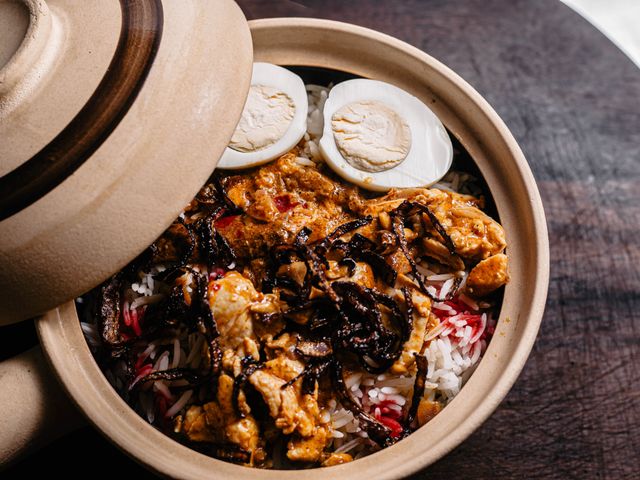

Find more like this
- Meal
- Dinner
- Cuisine
- Indian
- Main ingredient
- Chicken ThighsBasmati RicePotatoes
- Diet
- Gluten-FreeHalal
- Method
- Stovetop
- Occasion
- Family Gatherings