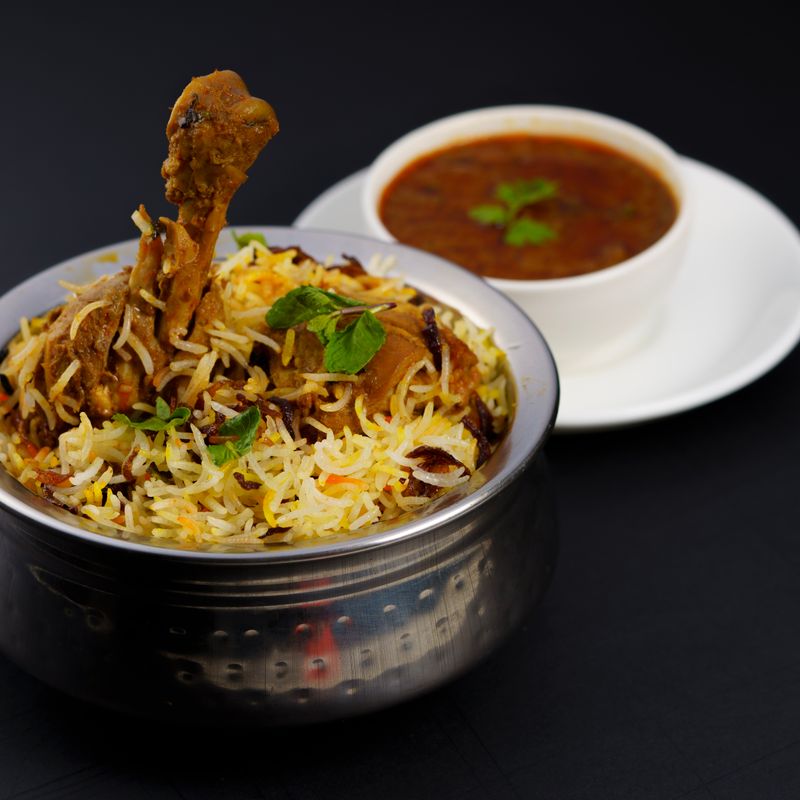
Hyderabadi Chicken Dum Biryani
Bone-in chicken marinated in yogurt, fried onions, mint and spices is layered raw with parboiled basmati, saffron milk and ghee, then sealed and steamed (dum) so the meat cooks in its own juices and perfumes every grain of rice.
- Prep
- 55 min
- Cook
- 1 hr 20 min
- Wait
- 4 hr 40 min
- Total
- 6 hr 55 min
- Makes
- 1 large pot of biryani (6 generous servings)
Steps
Before you start
- Plan ahead: the chicken needs at least 4 hours in the marinade (up to 12 hours in the fridge). Most of the 415 minutes is hands-off.
- Use a heavy, wide 6-quart (5.5 L) pot with a tight-fitting lid, such as a Dutch oven. A thin pot will scorch the bottom layer.
- Keep the marinated chicken in the fridge until the moment you layer the pot. Do not let it sit on the counter to warm up. The raw chicken should be out of the fridge for no more than 30 minutes before the pot goes on the heat.
- Start soaking the rice only once the chicken has marinated at least 4 hours and you are ready to cook. Get your thermometer, a clean spoon and clean bowls out before you start.
- Leave the chicken skin on and the bones in. Bone-in pieces stay juicy during the long steam.
Fry the onions
- Spread the sliced onions on a clean kitchen towel and pat dry.
- Heat the frying oil in a 12-inch (30 cm) skillet over medium-high heat until a slice sizzles steadily on contact, about 3 minutes.
- Add the onions in two batches.
- Fry each batch for 10 to 14 minutes, stirring often at first and constantly near the end, as they turn from translucent to pale gold to deep golden brown.
- Lift out with a slotted spoon onto a wire rack or paper towels in a single layer; they crisp as they cool.
- Pour the oil into a heatproof bowl and keep it.
- You should have about 150 g of fried onions and about ⅔ cup (150 ml) of oil.
+ Show details− Hide details
Ready when: Onions are deep golden brown (not dark brown) and snap when cooled; they keep darkening for a minute after leaving the oil.
Tip: Pull them out when they look one shade lighter than you want. Over-fried onions taste bitter and will spoil the whole pot.
Portion, marinate, chill
- Before touching any raw chicken, set up two clean small bowls.
- In the first, put half of the mint, half of the cilantro, half of the fried onions (about 75 g) and 3 tablespoons (45 ml) of the reserved onion oil; cover and refrigerate this layering bowl.
- Measure out a second 3 tablespoons (45 ml) of onion oil and set it aside covered for the marinade.
- In a large bowl, combine the yogurt, ginger-garlic paste, slit green chiles, chili powder, turmeric, garam masala, lemon juice, marinade salt, the other half of the mint and cilantro, the remaining fried onions (crush them with your fingers as you add them) and the second 3 tablespoons of oil.
- Mix well with a spoon.
- Add the chicken and massage the marinade into every piece, including under the skin.
- Cover and put it in the fridge right away; the yogurt may sit at room temperature only while you mix.
- Wash your hands, the cutting board, knife and any tools that touched raw chicken with hot soapy water.
- Refrigerate at least 4 hours, up to 12 hours.
+ Show details− Hide details
Ready when: Every piece is evenly coated in a thick, orange-red marinade with no dry spots, and the bowl is in the fridge.
Tip: Do not marinate longer than 12 hours; the acid in the yogurt and lemon will make the meat mushy. Never use the marinade bowl or its spoon for serving or for the herbs and onions.
Rinse and soak rice
- When the chicken has marinated at least 4 hours and you are ready to cook, place the basmati in a large bowl and cover with cold water.
- Swirl gently with your fingers, drain, and repeat 4 to 5 times until the water is almost clear.
- Cover with fresh cold water and soak for 30 minutes, then drain well in a colander just before parboiling.
- Leave the chicken in the fridge.
+ Show details− Hide details
Ready when: Soaked grains look opaque white and are slightly longer than dry grains; they snap rather than bend.
Tip: Handle the soaked rice gently. It is fragile and breaks easily, which makes the biryani sticky.
Steep the saffron
- During the soak, warm the milk in a small saucepan over low heat until hot to the touch, about 1 minute.
- Remove from heat, add the crushed saffron, and let it steep while you cook the rice.
+ Show details− Hide details
Ready when: The milk turns a deep golden-orange and smells floral.
Boil the rice water
- About 10 minutes before the soak ends, pour the water into an 8-quart (7.5 L) stockpot.
- Add the rice salt, bay leaves, crushed cardamom, cloves, cinnamon stick and shahi jeera.
- Cover and bring to a full rolling boil over high heat, about 10 minutes.
+ Show details− Hide details
Ready when: Water is at a rolling boil and smells of whole spices and tastes noticeably salty.
Tip: Under-salted rice water gives bland biryani, since the rice is not seasoned again.
Parboil the rice
- Add the drained rice to the boiling water and stir once gently.
- Boil uncovered over high heat for 4 to 5 minutes.
- Test a grain: it should break easily when pressed between two fingers but still have a firm white core (about 70 percent cooked).
- Immediately drain through a colander and spread the rice to let steam escape.
- Do not rinse.
+ Show details− Hide details
Ready when: Grain snaps easily with a small white dot of raw center; it is not soft all the way through.
Tip: Err on the undercooked side. The rice finishes in the steam, and fully cooked rice turns to mush.
Layer the biryani
- Now take the chicken from the fridge; from this point it should be out for no more than 30 minutes before the pot goes on the heat.
- Spread the chicken and all of its marinade in an even layer across the bottom of the 6-quart (5.5 L) pot.
- Wash your hands with soap and water, and use a clean spoon from here on.
- Spoon half of the parboiled rice evenly over the chicken without pressing down.
- Scatter over half of the portioned mint, cilantro and fried onions from the layering bowl.
- Add the rest of the rice in a loose, even layer, then top with the remaining herbs, onions and the oil from the layering bowl.
- Drizzle the saffron milk in streaks over the surface, then drizzle with the melted ghee and the rose water if using.
+ Show details− Hide details
Ready when: The rice forms a level, fluffy mound with golden saffron streaks and no chicken showing.
Tip: Pile the rice loosely. Packing it down stops the steam from circulating and leaves the top layer undercooked.
Seal the pot
- If using the dough, knead the atta with about ¼ cup (60 ml) water until firm and pliable, then roll it into a long rope.
- Press the rope around the rim of the pot, set the lid on top, and press down firmly so there are no gaps.
- If not using dough, cover the pot with a sheet of foil pressed over the rim, then set the lid on top.
+ Show details− Hide details
Ready when: There are no gaps between lid and pot, so steam cannot escape.
Tip: Put a heavy can on the lid if it rattles or lifts when the pot heats.
Start the dum on high
- Place the sealed pot over medium-high heat for 5 minutes.
- You should hear a steady sizzle and see a little steam pushing at the seal.
- This hot start builds steam inside the pot.
- Meanwhile place a flat griddle or heat diffuser on a second burner.
+ Show details− Hide details
Ready when: Pot is sizzling and the seal shows the first wisps of steam.
Tip: If you smell burning before the 5 minutes are up, move to the low step right away.
Cook on dum
- Move the pot onto the griddle or diffuser over the lowest heat.
- Cook undisturbed for 35 minutes without lifting the lid, then turn off the heat.
+ Show details− Hide details
Ready when: Steady thin steam escapes at the seal and you smell ghee, saffron and spices, with no scorched smell.
Tip: Do not open the pot to check; the chicken cannot be tested until after the rest, when you can safely break the seal.
Rest the biryani
- Leave the pot sealed and off the heat for 10 minutes so the steam settles and the layers set and the chicken keeps cooking gently.
- Then break the seal and remove the lid.
+ Show details− Hide details
Ready when: Aroma of saffron, mint and ghee rises when the lid comes off.
Check chicken temperature
- With the lid off, use a clean spoon to dig down through the rice to the chicken.
- Insert an instant-read thermometer into the thickest part of several pieces, including the largest thigh piece and the thickest drumstick, without touching bone.
- Every piece must read at least 165°F (74°C); 175°F (80°C) gives the most tender texture.
- The rice should also be steaming hot throughout.
- If any piece is below 165°F, replace the lid and seal, return the pot to the diffuser over the lowest heat for 10 more minutes, rest 5 minutes, and test again.
- Wipe the thermometer with hot soapy water between checks.
+ Show details− Hide details
Ready when: Every tested piece reads at least 165°F (74°C), the meat is tender and pulls easily from the bone, and the rice is steaming hot and tender.
Tip: Do not rely on clear juices or color to judge doneness; the marinade stains the meat and juices. Use the thermometer.
Fluff and serve
- Using a wide spoon or spatula, dig down to the bottom of the pot and lift the chicken and rice in sections so that white and saffron rice, chicken and fried onions are in each serving.
- Avoid stirring, which breaks the grains.
- Serve hot with raita and mirchi ka salan.
- Do not leave the biryani sitting in the pot: within 2 hours of finishing cooking, put any leftovers into shallow containers and refrigerate.
+ Show details− Hide details
Ready when: Rice grains are separate and fluffy, and the chicken is tender and nearly falling off the bone.
Tip: Scoop from the bottom up so every serving gets both chicken and rice.
Good to know
Tips
- Use aged basmati. Fresh or low-quality rice turns sticky and breaks.
- Do not skip the heat diffuser or griddle. Direct low heat can burn the bottom layer.
- Keep raw chicken away from everything else: portion the herbs, onions and oil before handling it, and wash hands, board and tools with hot soapy water afterward.
- Store-bought crispy fried onions can replace homemade ones if you are short on time; use about 150 g and replace the flavored oil with extra neutral oil.
Make ahead
Fry the onions up to 3 days ahead and store airtight at room temperature. The chicken can marinate in the fridge for up to 12 hours. The rice should be parboiled and layered right before cooking.
Storage & reheating
Room temperature: no more than 2 hours total, counted from when cooking finishes. Do not leave the biryani in the pot to cool; within 2 hours divide leftovers into shallow containers (2 inches / 5 cm deep or less) and refrigerate. Fridge: up to 3 days at most. Freezer: up to 2 months in portions. Reheat only once, covered in a microwave or in a covered pan over low heat with a splash of water, until steaming hot (165°F / 74°C) throughout. Do not reheat the same portion again.
Substitutions
- ghee → unsalted butter plus 1 tbsp oil. Gives a less nutty flavor but works well.
- saffron threads → ¼ tsp ground turmeric in the warm milk. Gives color but lacks saffron's aroma.
- bone-in, skin-on chicken thighs and drumsticks → boneless, skinless chicken thighs cut into 2-inch pieces. Cook on low for 25 minutes instead of 35, rest 10 minutes, and check that pieces reach 165°F (74°C).
- Kashmiri red chili powder → 1 tsp sweet paprika plus ¼ tsp cayenne. Approximates the color and heat of Kashmiri chili.
More biryani
See all →

Find more like this
- Meal
- Dinner
- Cuisine
- Indian
- Main ingredient
- Chicken ThighsBasmati Rice
- Diet
- HalalSugar-Free
- Method
- Stovetop
- Quick & Easy
- Make Ahead
- Occasion
- EidFamily Gatherings