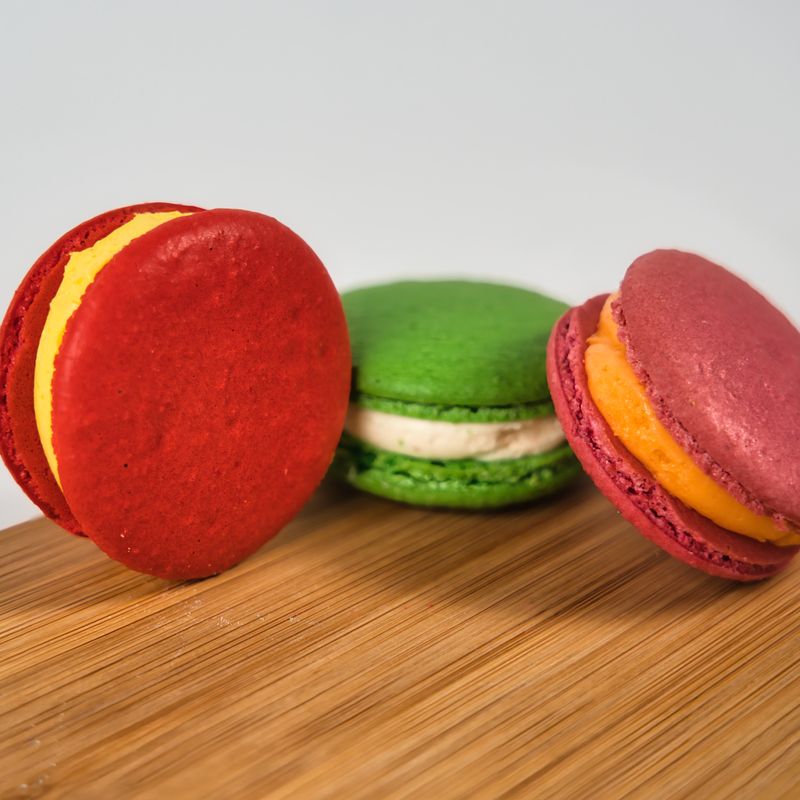
Orange Blossom Macarons
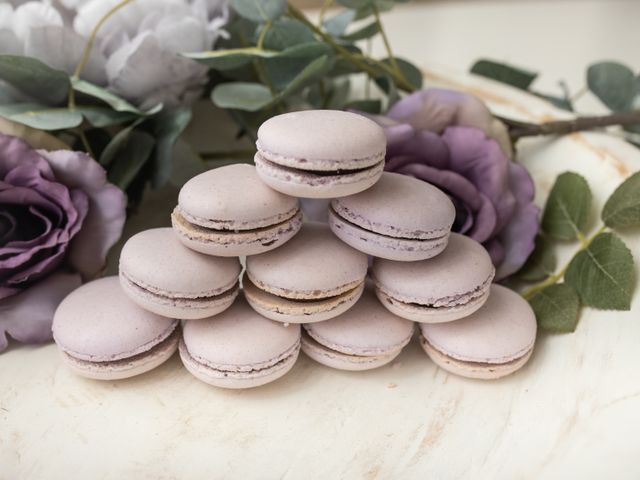
Delicate almond meringue cookies kissed with aromatic orange blossom water and topped with a creamy pistachio filling. These French macarons feature Middle Eastern flavors—the floral sweetness of orange blossom against nutty almond and ground pistachio. They have the signature glossy domed tops and smooth feet, with a tender almond shell and chewy center.
- Prep
- 30 min
- Cook
- 15 min
- Wait
- 1 hr 15 min
- Total
- 2 hr
- Makes
- 24 macarons (12 sandwich pairs)
Steps
Before you start
- Have egg whites at room temperature for at least 1 hour (aged whites from eggs left uncovered overnight are ideal)
- Preheat oven to 300°F (150°C) for 15 minutes before piping
- Sift almond flour and powdered sugar together twice to remove all lumps
- Line 2 baking sheets with parchment paper
Sift dry ingredients
- Sift almond flour and 100 g powdered sugar together twice through a fine-mesh sieve into a medium bowl, pushing through any lumps with the back of a spoon.
- Set aside.
- This removes any grittiness and aerates the mixture.
+ Show details− Hide details
Ready when: mixture is very fine and lump-free
Tip: Do not skip the sifting—it prevents grainy macarons and ensures smooth shells.
Whip egg whites to soft peaks
- Pour 75 g egg whites (reserve 30 g for filling) into a clean, dry bowl of a stand mixer fitted with the whisk attachment.
- Beat on medium speed for about 1 minute until foamy, then gradually increase speed to medium-high.
- When soft peaks form (the meringue falls gently when the whisk is lifted), stop and set aside.
- This takes about 3–4 minutes total.
+ Show details− Hide details
Ready when: meringue holds soft peaks that curl at the tip
Tip: Any grease or yolk in the bowl will prevent the whites from whipping. Use a glass or stainless steel bowl and make sure the whisk is completely clean.
Add sugar gradually
- With the mixer running on medium-high speed, add 100 g granulated sugar 1 tablespoon at a time over about 2 minutes, waiting a few seconds between additions.
- Continue beating until stiff, glossy peaks form and the meringue is thick and smooth, about 2–3 minutes more.
- The meringue should look like thick white clouds.
+ Show details− Hide details
Ready when: meringue holds stiff, glossy peaks and looks very thick and smooth
Tip: Adding sugar slowly stabilizes the meringue. If you dump it all in at once, the mixture may deflate.
Add orange blossom water
- Add 2.5 ml orange blossom water and beat on low speed for 30 seconds until just combined.
- Do not overmix, as this can deflate the meringue.
+ Show details− Hide details
Ready when: orange blossom water is evenly distributed
Tip: Add the flavoring after the meringue reaches stiff peaks so you don't over-whip while incorporating it.
Fold in almond flour mixture
- Scrape the meringue into a large bowl if not already there.
- Using a large rubber spatula, add the sifted almond flour and powdered sugar mixture in two additions.
- For each addition, gently fold by cutting down through the center, scraping along the bottom and folding over itself.
- Rotate the bowl slightly and repeat until no white streaks remain and the mixture is a smooth, glossy, thick batter.
- Be careful not to deflate—this should take about 30 folds total.
- The batter should fall slowly from the spatula in a ribbon.
+ Show details− Hide details
Ready when: no white streaks visible and batter flows slowly and glossily from the spatula
Tip: Macaron success depends on proper macaronage—the folding technique. Too little folding leaves streaks; too much deflates the meringue and creates flat cookies with no feet.
Pipe macaron shellsOven 300°F / 150°C
- Preheat the oven to 300°F (150°C).
- Transfer the batter to a piping bag fitted with a ½-inch (1.3 cm) round tip.
- Hold the bag perpendicular to the parchment paper at a 90-degree angle, about ½ inch above the surface.
- Pipe 48 rounds (for 24 sandwich pairs), spacing them 1 inch apart.
- After piping each batch, gently tap the baking sheet on the counter 3 times to release air bubbles.
- Let the piped shells rest for 15 minutes at room temperature until a thin skin forms on top—when you touch one lightly with a finger, it should not stick.
+ Show details− Hide details
Ready when: tops feel dry to the touch and do not stick to your finger
Tip: The resting step is essential—it allows a skin to form that creates the characteristic macaron feet during baking. If shells are too wet when they go into the oven, they will spread instead of rise.
Bake the shellsOven 300°F / 150°C
- Place one baking sheet in the preheated 300°F (150°C) oven.
- Bake for 14–16 minutes, until the macarons have risen slightly and developed flat tops with ruffled feet around the base.
- The shells should feel firm to the touch on top but still have a slight wobble in the center when the pan is gently shaken.
- Do not open the oven door during baking.
- Remove and let cool on the baking sheet for 2 minutes, then transfer to a wire rack to cool completely before filling, about 15 minutes.
+ Show details− Hide details
Ready when: shells are firm on top, have ruffled feet, and show no browning
Tip: If shells are browning, your oven may run hot. Lower temperature by 10–15°F and bake longer. Perfectly baked macarons are pale and have visible feet.
Make pistachio filling
- While shells cool, beat 45 g room-temperature unsalted butter in a small bowl with an electric mixer on medium speed for 1 minute until pale and creamy.
- Add 80 g pistachio paste and beat for 30 seconds until combined.
- Add 90 g sifted powdered sugar in two additions, beating on low speed after each addition until fully incorporated.
- Add 30 g reserved egg whites a little at a time while beating on low speed, mixing just until the filling is light, fluffy, and spreadable, about 2 minutes total.
- If desired, add 1.2 ml rose water and beat on low for 10 seconds.
+ Show details− Hide details
Ready when: filling is light, fluffy, pale green, and holds soft peaks
Tip: Do not overmix once you add the egg whites, or the filling will become grainy. Add whites gradually to control consistency.
Sandwich and rest
- Once shells are completely cool, pair them by size, placing the flat sides of two shells together.
- Pipe a small dollop of pistachio filling (about ½ teaspoon) onto the flat side of one shell, then gently press the other shell on top, flat side down, until the filling spreads to the edges.
- Arrange filled macarons on a parchment-lined tray and refrigerate for at least 24 hours before serving.
- This resting period allows the flavors to meld and the shells to soften slightly, creating the ideal texture.
+ Show details− Hide details
Ready when: filling is evenly distributed between shells
Tip: Do not skip the resting period. Macarons taste better after 24 hours as the almond shells become slightly chewy and the filling flavor deepens.
Good to know
Tips
- Macarons are humidity-sensitive. Avoid making them on very humid or rainy days—moisture prevents proper skin formation and crispy shells.
- Room temperature egg whites whip to greater volume than cold ones. Use eggs at least 1 hour at room temperature, or use aged whites that sat uncovered for 24 hours in a cool place.
- The oven temperature is critical. Macarons baked at too high a temperature will brown and crack; too low and they won't rise or develop feet. Use an oven thermometer to verify your oven's actual temperature.
- Measure ingredients by weight using a digital kitchen scale for accuracy. Volume measurements of almond flour and powdered sugar vary too much to guarantee consistent results.
Make ahead
Macarons must be made at least 24 hours ahead. Fill and refrigerate. They can be made up to 5 days ahead, stored in an airtight container in the refrigerator. Shells can also be baked and frozen unfilled for up to 2 months; thaw in the refrigerator before filling.
Storage & reheating
Room temperature (sealed container, away from humidity): 2 days. Refrigerator (airtight container): 5 days. Freezer (airtight container, unfilled shells): 2 months. Do not freeze filled macarons as condensation will make them soggy. Thaw frozen shells in the refrigerator for 30 minutes, then fill just before serving.
Substitutions
- natural pistachio paste → ground roasted pistachios made into a paste using a food processor with 1 tablespoon neutral oil. Homemade pistachio paste will be slightly grainier but adds freshness. Process until very smooth, 8–10 minutes.
- orange blossom water → ½ teaspoon finely grated orange zest mixed into the meringue after adding sugar. Orange zest gives a brighter, citrus-forward flavor instead of the floral note of blossom water. Reduce by half if using both together.
- rose water → ¼ teaspoon ground cardamom or ⅛ teaspoon saffron threads (steeped in 1 teaspoon hot water and cooled). Cardamom adds warmth and spice; saffron adds luxury and subtle earthiness. Both pair beautifully with pistachio.
- almond flour, blanched and finely ground → finely ground blanched hazelnuts. Hazelnuts create a slightly deeper, richer flavor. Use the same weight (100 g). Do not use roasted hazelnut flour as it will brown too much.
More cookies
See all →



Find more like this
- Meal
- Dessert
- Cuisine
- Middle EasternFrench
- Method
- Oven