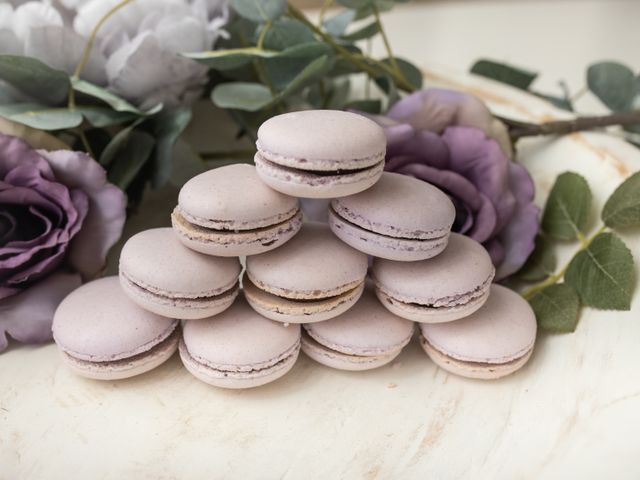
Eid Orange Blossom and Almond Macarons with Pistachio Ganache
Delicate French almond macarons infused with aromatic orange blossom water, filled with a luxurious pistachio ganache. These elegant petites showcase a harmonious blend of French technique and Middle Eastern flavors, making them perfect for celebrating Eid or any festive occasion. The crispy-edged shells with chewy centers are paired with a silky, nutty filling.
- Prep
- 35 min
- Cook
- 16 min
- Wait
- 1 hr 15 min
- Total
- 2 hr 6 min
- Makes
- 24 macarons (12 sandwich pairs)
Steps
Before you start
- Separate eggs at least 1 hour ahead; egg whites must be room temperature and free of any yolk
- Sift almond flour and powdered sugar together twice to remove lumps
- Line baking sheets with parchment paper or silicone mats
- Have a piping bag fitted with a ½-inch (1.3 cm) round tip ready before you start the meringue
Sift almond flour and powdered sugar
- In a food processor, combine the almond flour and powdered sugar.
- Pulse until very fine, about 30 seconds.
- Pour the mixture into a fine-mesh sieve set over a bowl.
- Sift the mixture onto the bowl, using a bench scraper or offset spatula to push it through.
- Discard the coarser bits.
- Repeat this sifting process a second time to ensure a smooth, lump-free flour blend.
- Set aside.
+ Show details− Hide details
Ready when: Almond flour mixture is very fine and uniform
Tip: Double-sifting removes lumps that would create cracked or bumpy shells. Do not skip this step.
Whip egg whites and sugar
- Place the room-temperature egg whites in the bowl of a stand mixer fitted with the whisk attachment.
- Start on medium-high speed and whip until soft peaks form, about 2 minutes.
- Gradually add the granulated sugar while the mixer runs, pouring it in a thin steady stream over 1 minute.
- Continue whisking on high speed until stiff, glossy peaks form, about 2 minutes more.
- The meringue should be thick, white, and hold sharp peaks when you lift the whisk.
+ Show details− Hide details
Ready when: Stiff, glossy peaks form when whisk is lifted; meringue does not slide in the bowl when tilted
Tip: Even a tiny trace of egg yolk or grease will prevent the whites from whipping properly. Use a spotlessly clean bowl and whisk.
Add orange blossom water to meringue
- Reduce the mixer speed to low.
- Add the orange blossom water and mix gently for about 15 seconds until just combined.
- Do not overmix or you risk deflating the meringue.
+ Show details− Hide details
Ready when: Orange blossom water is evenly distributed throughout the meringue
Tip: Add the flavoring at the last moment to preserve the meringue's volume.
Fold in almond flour (macaronage)
- Transfer the meringue to a large bowl.
- Add half of the sifted almond flour mixture.
- Using a rubber spatula, fold gently but deliberately: cut down through the center, scrape along the bottom, fold up and over the top, give the bowl a quarter turn, and repeat.
- This technique, called macaronage, must be done carefully to incorporate the flour without deflating the meringue.
- After 8–10 folds, the mixture should be partially combined.
- Add the remaining almond flour and continue folding for another 10–12 folds until the batter is smooth, glossy, and ribbons off the spatula.
- The batter should flow like lava—thick but fluid.
+ Show details− Hide details
Ready when: Batter is smooth, glossy, and flows like thick lava; no streaks of egg white remain
Tip: Undermixing will leave the batter lumpy and shells will crack. Overmixing will make batter too thin and shells won't have feet. Practice getting the consistency right—it's the trickiest part.
Pipe macaron shells onto baking sheetsOven 300°F / 150°C
- Preheat the oven to 300°F (150°C).
- Fit a piping bag with a ½-inch (1.3 cm) round tip.
- Fill the bag with the macaron batter, working in batches if necessary.
- Hold the piping bag perpendicular to the first prepared baking sheet, about ½ inch (1.3 cm) above the surface.
- Pipe small rounds about ¾ inch (2 cm) in diameter, spacing them 1 inch (2.5 cm) apart.
- You should get 24 shells total (12 pairs).
- Release pressure and pull the bag away smoothly to finish each shell.
- If the batter has peaks, gently tap the underside of the baking sheet on the counter 2–3 times to settle the shells and release any trapped air.
+ Show details− Hide details
Ready when: Shells are piped on the sheet and any peaks have flattened after tapping
Tip: Macarons spread slightly during resting, so leave adequate space between them. The piping bag angle and height take practice—consistent pressure and height yield uniform shells.
Rest shells to form skin
- Let the piped shells sit at room temperature for 30–45 minutes.
- A dry, papery skin will form on the surface of each shell.
- You'll know it's ready when you can touch a shell lightly with your fingertip and it doesn't stick.
- This resting step is crucial: it prevents the shells from cracking in the oven.
+ Show details− Hide details
Ready when: Surface is dry and papery; a light touch does not leave an indent or stick
Tip: Humidity affects resting time. In dry conditions, 30 minutes may suffice; in humid weather, allow up to 45 minutes. The skin is essential—do not skip this step.
Bake macaron shellsOven 300°F / 150°C
- Once the skin has formed and the oven is preheated to 300°F (150°C), place one baking sheet on the middle oven rack.
- Bake for 16 minutes.
- The shells should develop a firm, smooth dome top and little 'feet' (frilly bases) should be visible around the bottom edge.
- The shells should not be browned, just slightly set.
- Remove the sheet from the oven and let the macarons cool completely on the baking sheet (about 15 minutes) before carefully lifting them off.
+ Show details− Hide details
Ready when: Shells are firm with visible frilly 'feet' around the base; domes are smooth and not cracked or browned
Tip: If shells are browning too quickly, lower the oven temperature slightly to 280°F (140°C). Different ovens vary, so watch the first batch closely.
Prepare the pistachio ganache
- While the shells are cooling, make the ganache.
- Heat the heavy cream in a small saucepan over medium heat until it just begins to steam (do not boil).
- Place the finely chopped white chocolate in a small heatproof bowl.
- Pour the hot cream over the chocolate and let it sit for 1 minute to soften.
- Whisk gently until smooth and combined.
- Add the pistachio butter, stirring until fully integrated.
- Stir in the orange blossom water and a pinch of fine sea salt.
- Let the ganache cool to room temperature, stirring occasionally (about 10–15 minutes).
- The finished ganache should be thick but spreadable, similar to peanut butter.
+ Show details− Hide details
Ready when: Ganache is smooth, combined, and at room temperature with a thick, spreadable consistency
Tip: If the ganache is too thin, let it cool a bit longer. If it sets too firm, warm it gently over low heat, stirring often. The texture should be like thick frosting.
Add butter to ganache
- Once the ganache has cooled slightly but is still warm (around 80–90°F / 27–32°C), fold in the softened butter cubes one at a time using a whisk or rubber spatula, stirring until each addition is fully incorporated before adding the next.
- The mixture will transform into a silky, lighter-textured ganache.
- Continue cooling until the ganache reaches a consistency that holds its shape when piped but is not stiff.
+ Show details− Hide details
Ready when: Butter is fully incorporated; ganache is silky and holds soft peaks when a spoon is lifted
Tip: Add butter while the ganache is still slightly warm; cold ganache won't incorporate the butter smoothly. If lumps form, warm gently and whisk again.
Fill the macarons
- Transfer the cooled ganache to a piping bag fitted with a ½-inch (1.3 cm) round tip (or use the same tip as before).
- Match the macaron shells in pairs of similar size, placing them flat-side up.
- Pipe a small mound of ganache (about the size of a hazelnut) onto the flat side of one shell in each pair.
- Top with the second shell, flat side down, pressing gently until a thin layer of filling peeks out around the edges.
- Work quickly so the ganache does not set while you're piping.
+ Show details− Hide details
Ready when: All macarons are filled with a thin layer of ganache visible around the perimeter
Tip: If the ganache becomes too stiff to pipe, warm the bag gently in warm water for a few seconds. Do not overfill—a light press should show just a thin edge of filling.
Mature the macarons (optional but recommended)
- Place the filled macarons in an airtight container.
- Store at room temperature for 24 hours, or refrigerate for 4–6 hours.
- During this time, the filling will soften slightly and the flavors will meld, making the macarons taste better and easier to bite into without cracking.
- The shells will also firm up slightly, creating a better texture contrast between the crispy exterior and chewy center.
+ Show details− Hide details
Ready when: Macarons have rested; filling is slightly yielding when gently pressed
Tip: Maturing is optional but makes a significant texture and flavor difference. Even just 4–6 hours in the refrigerator will improve them.
Good to know
Tips
- Macarons are temperamental but learnable. Your first batch is a learning experience. Success requires precise measurements (use a scale, not cups), proper separation and aeration of egg whites, accurate folding, correct resting before baking, and consistent oven temperature. Record your observations so you can adjust on the next attempt.
- Orange blossom water is potent and can easily overpower the delicate macaron. Start with the amount specified and taste a fully assembled macaron from a test batch before increasing the flavoring in future batches. A little goes a long way.
- The macaronage (folding) step determines success or failure more than anything else. The batter must be smooth and flow like lava, not thick meringue. A few extra folds are better than too few. Practice the motion until it feels natural.
- Room-temperature egg whites whip to much greater volume than cold ones. Plan ahead to bring them to room temperature 1–2 hours before baking. You may speed this by placing the bowl in warm water for a few minutes, but do not let the whites get warm—just take the chill off.
Make ahead
Room-temperature shells (unfilled) may be stored in an airtight container for up to 2 days. The pistachio ganache may be made up to 3 days ahead and refrigerated in an airtight container; warm gently before filling. Filled macarons improve with 24 hours of resting.
Storage & reheating
Filled macarons keep in an airtight container at room temperature for 2 days, in the refrigerator for up to 6 days, or in the freezer (in an airtight, moisture-proof container) for up to 3 months. Thaw frozen macarons at room temperature for 1 hour before serving. The matured flavor and texture are best after 24 hours.
Substitutions
- natural pistachio butter (unsweetened) → almond butter or cashew butter. Maintains a smooth, creamy filling. Almond butter echoes the shell and is equally delicious. Cashew butter offers a milder, buttery flavor.
- orange blossom water → rose water or 1 tablespoon fresh orange zest (finely grated). Rose water brings an elegant floral note. Fresh orange zest adds brightness and is more tart. Use either sparingly—these are potent flavorings.
- white chocolate, finely chopped → cream cheese (2 oz / 57 g) combined with 2 oz (57 g) white chocolate. Adds subtle tang and reduces sweetness. Keep the total weight at 4 oz (115 g).
- blanched almond flour, finely ground → finely ground blanched hazelnuts or macadamia nuts. These will shift the flavor profile but yield similar texture. Hazelnut is particularly lovely with pistachio and orange blossom.