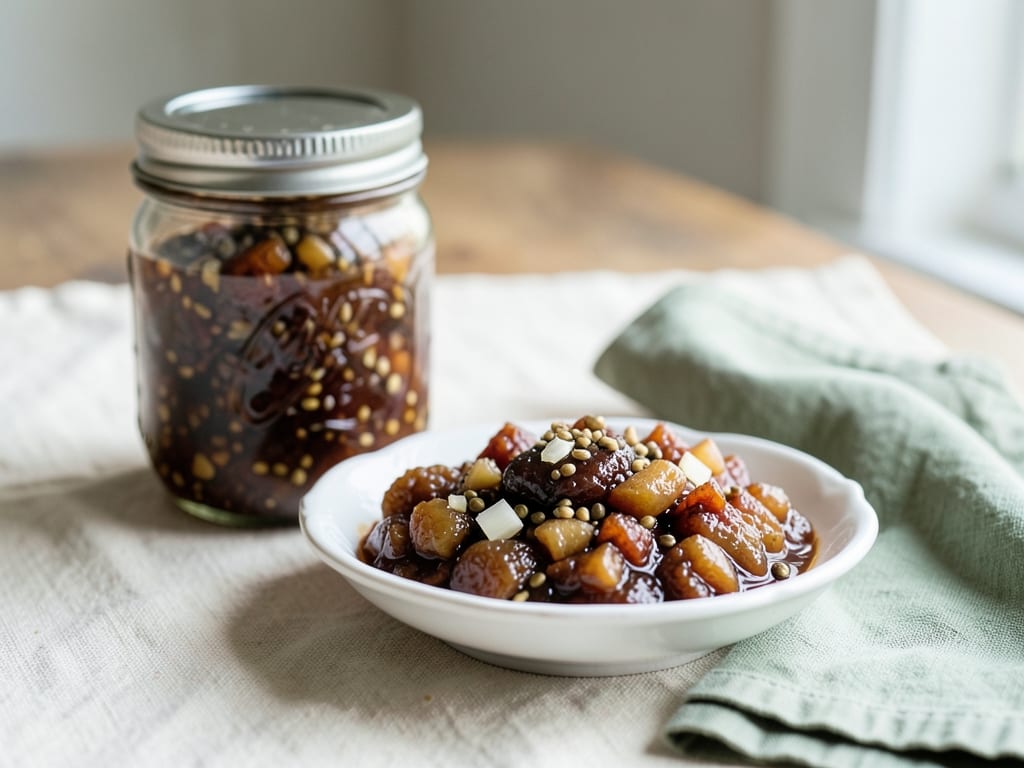
One-Pot Peach and Hazelnut Chutney with Black Pepper
A French-inspired chutney that balances sweet, tart, and savory flavors. Fresh peaches and toasted hazelnuts are cooked down with shallots, black peppercorns, and white wine vinegar into a thick, jammy condiment. Excellent with charcuterie, cheese, roasted poultry, or pork.
- Prep
- 15 min
- Cook
- 45 min
- Wait
- 30 min
- Total
- 1 hr 30 min
- Makes
- About 2 cups (480 ml)
Steps
Before you start
- Select ripe but firm peaches—overly soft ones will break down too quickly and turn mushy
- Toast the hazelnuts ahead of time or while the chutney cooks
- Have all ingredients prepped and within reach before you start cooking
- Read through the timing; this chutney needs gentle, patient simmering
Toast the hazelnuts
- Place the 1 cup (140 g) of raw hazelnuts in a small dry skillet over medium heat.
- Stir frequently for 5–7 minutes until fragrant and the skins begin to darken slightly.
- Watch closely so they don't burn.
- Transfer to a cutting board, let cool briefly, then coarsely chop.
- Set aside.
+ Show details− Hide details
Ready when: Nuts are fragrant and skins have darkened; they smell toasted but not charred
Tip: Toast in a dry skillet rather than the pot so you don't scorch them in the acidic environment of the chutney
Prepare peaches and shallots
- Halve the 2 lb (900 g) of peaches, remove the pits, and cut the flesh into ½-inch (1.25 cm) chunks.
- Peel and thinly slice the 3 medium shallots (about 150 g total).
- Have both ready in separate bowls.
+ Show details− Hide details
Tip: Cut peaches over a bowl to catch any juices; add both fruit and juice to the pot
Combine in the pot and add vinegar
- Place the heavy-bottomed 3–4 quart (3–4 liter) pot over medium heat.
- Add the peach chunks with their juice, the sliced shallots, the ¾ cup (180 ml) white wine vinegar, the ½ cup (100 g) sugar, the ½ tsp (3 g) kosher salt, and the 1 tbsp (7 g) whole black peppercorns.
- Stir gently until the sugar is mostly dissolved.
+ Show details− Hide details
Ready when: Sugar is mostly dissolved and mixture is warm
Tip: Use a non-reactive pot (stainless steel or enameled cast iron) to prevent discoloration from the vinegar
Bring to a simmer and skim foam
- Increase the heat to medium-high and bring the mixture to a gentle boil, about 3–5 minutes.
- A light foam will rise to the surface; skim it off with a spoon and discard.
- This keeps the chutney clear and refined.
+ Show details− Hide details
Ready when: Mixture is at a gentle rolling boil and foam has been skimmed off
Tip: Don't skip the skimming; it makes a big difference in the final texture and clarity
Reduce heat and simmer gently
- Lower the heat to medium-low and let the chutney simmer gently, uncovered, for 30–35 minutes.
- Stir occasionally with a wooden spoon, gently crushing some of the peach pieces against the side of the pot as they soften.
- The mixture will thicken and the color will deepen from pale gold to amber.
+ Show details− Hide details
Ready when: Mixture has thickened noticeably, coats the spoon, and the color is deep amber; most of the peach pieces have softened
Tip: Don't rush this step; gentle simmering ensures the chutney stays glossy and doesn't scorch on the bottom
Add toasted hazelnuts and vanilla
- Stir in the chopped toasted hazelnuts and the ¼ tsp (1.25 ml) vanilla extract (if using).
- Simmer for another 2–3 minutes to warm through and marry the flavors.
+ Show details− Hide details
Ready when: Hazelnuts are warm and distributed throughout; vanilla aroma is faint but present
Tip: Add vanilla near the end so its delicate flavor doesn't cook away; you can omit it if you prefer a more savory chutney
Taste and season
- Remove from heat and taste the chutney.
- Add a pinch more salt if needed.
- Remember that the flavors will round out as it cools and sits for a few hours.
- The balance should be: sweet (peach and sugar), tart (vinegar), and a gentle black pepper heat.
+ Show details− Hide details
Ready when: Flavor is balanced and pleasant
Tip: Taste while warm; the flavors will taste slightly stronger once cooled
Cool and set
- Let the chutney cool in the pot, uncovered, for 30 minutes.
- As it cools, it will thicken further and the hazelnuts will absorb some of the liquid, giving it a more cohesive texture.
- Stir gently once or twice as it cools.
+ Show details− Hide details
Ready when: Chutney has cooled to room temperature and is noticeably thicker
Tip: Don't be tempted to refrigerate immediately; letting it set at room temperature allows the texture to develop properly
Good to know
Tips
- Use a spoon to gently crush softening peach pieces against the pot's side rather than aggressively stirring; this keeps the texture slightly rustic instead of homogeneous
- If the chutney isn't thick enough after 35 minutes, continue simmering for another 5–10 minutes. It will continue to set as it cools, so stop before it looks 'done' in the pot—it will thicken further
- Serve at room temperature or lightly chilled alongside cured meats, soft cheese (Brie, goat cheese), grilled chicken, or roasted pork. It's also delicious in a cheese board
- The black peppercorns remain whole for visual appeal and a subtle bite. If you prefer a smoother texture, crush them lightly before adding, or strain them out at the end
Make ahead
You can make this chutney up to 2 weeks ahead. The flavors actually improve over 2–3 days as they meld. Store in the refrigerator in an airtight jar.
Storage & reheating
Room temperature (up to 4 hours): Keep in an airtight jar away from direct sunlight. Refrigerator (2–3 weeks): Store in a clean glass jar or airtight container. The chutney will thicken slightly more when cold. Reheat gently in a small saucepan over low heat, or serve cold straight from the jar. Freezer (up to 3 months): Freeze in ice cube trays for portion control, then transfer to a freezer bag. Thaw overnight in the refrigerator and warm gently before serving.
Substitutions
- raw hazelnuts, blanched or unblanched → toasted sliced almonds or crushed walnuts. Hazelnuts provide a distinctive earthy, buttery note, but almonds are milder and walnuts are richer. Use the same amount by weight.
- white wine vinegar → champagne vinegar or apple cider vinegar. White wine vinegar is subtle; champagne vinegar is more delicate, while apple cider vinegar will add a slight fruity tang. Start with the same amount and taste as you go.
- fresh peaches, ripe but firm → nectarines, or a mix of peaches and nectarines. Nectarines are slightly tangier and more floral. The ratio stays the same. Apricots can substitute in a pinch but will yield a thinner, less sweet chutney.
- black peppercorns → white pepper, pink peppercorns, or a combination. White pepper is more floral and less aggressive. Pink peppercorns are fruity and mild. Use slightly less (¾–1 tbsp / 5–7 g) if substituting because they can be more assertive in heat.