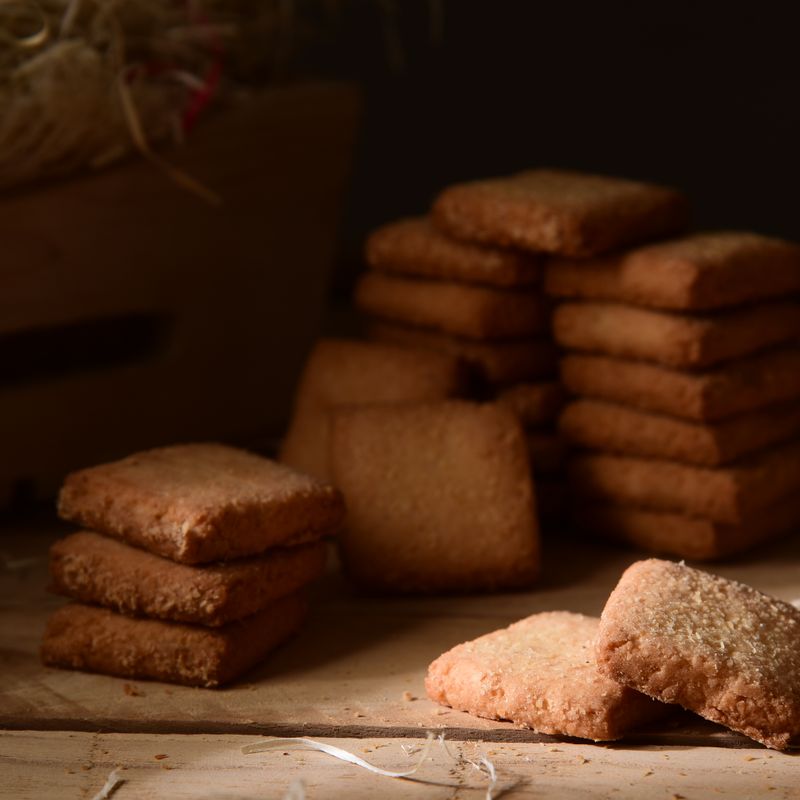
No-Chill Shortbread Fingers
Buttery, crumbly shortbread that's ready to bake immediately. This simplified method skips the long chill and relies on a higher ratio of butter to flour for tender cookies that hold their shape. Baked until pale golden with crisp edges, these fingers break cleanly and melt on the tongue.
- Prep
- 10 min
- Cook
- 12 min
- Wait
- 5 min
- Total
- 27 min
- Makes
- 24 fingers (about 2 inches / 5 cm each)
Steps
Before you start
- Use cold butter straight from the fridge
- Preheat oven to 325°F (160°C)
- Line an 8×12-inch (20×30 cm) baking pan with parchment paper
Mix butter and sugar
- In a large bowl, combine the cold butter cubes and powdered sugar.
- Using a wooden spoon or hand mixer on low speed, beat for 2–3 minutes until the mixture is pale, fluffy, and resembles wet sand.
- The butter should be fully broken down but not greasy.
+ Show details− Hide details
Ready when: Mixture is pale and fluffy, resembles wet sand
Tip: Don't overmix or the dough will become tough. Stop as soon as the texture is even.
Add flour and cornstarch
- Sift the flour, cornstarch, and sea salt together, then add to the butter mixture.
- Stir with a wooden spoon just until the dough comes together—this should take only 1–2 minutes.
- The dough will be soft but hold together when pressed.
+ Show details− Hide details
Ready when: Dough is homogeneous and holds together when pressed
Tip: Cornstarch keeps the shortbread tender and prevents it from becoming tough. Don't knead or work the dough.
Press into pan
- Transfer the dough to the parchment-lined 8×12-inch pan.
- Using the back of a spoon or a small offset spatula, press the dough evenly across the bottom of the pan in an even ¼-inch (6 mm) layer.
- The dough should reach all corners and edges.
+ Show details− Hide details
Ready when: Dough is evenly distributed and level across the pan
Tip: Use a ruler to gauge thickness if needed. Consistent thickness ensures even baking.
Score and dock
- Using a sharp knife or bench scraper, score the dough into 24 fingers: make 5 cuts lengthwise and 3 cuts across, creating a 6×4 grid.
- Pierce each square all over with the tines of a fork to prevent puffing during baking.
+ Show details− Hide details
Ready when: All 24 pieces are marked and docked uniformly
Tip: Score firmly but don't cut all the way through. Dock the dough to keep it flat.
Bake until goldenOven 325°F / 165°C
- Place the pan in a 325°F (160°C) oven for 12–14 minutes.
- The shortbread should be very pale golden at the edges and just set in the center; the top will appear barely colored.
- Do not overbake or the cookies will taste bitter.
+ Show details− Hide details
Ready when: Edges are pale golden; center is just set and not browning
Tip: Shortbread should look underbaked—it will firm up as it cools. Err on the side of light golden color.
Cool and cut
- Remove the pan from the oven and let it cool for 5 minutes at room temperature.
- While still warm, cut along the score lines with a sharp knife to separate the fingers cleanly.
- Let the pieces cool completely in the pan (about 10 minutes), then transfer to a wire rack or serving plate.
+ Show details− Hide details
Ready when: Fingers cut cleanly and cool completely without breaking
Tip: Cut while the shortbread is still warm—it will snap cleanly. Once cooled, the shortbread hardens and becomes brittle.
Good to know
Tips
- The secret to no-chill shortbread is a high butter-to-flour ratio and the inclusion of cornstarch. The mixture can go straight into the oven because the dough is already tender enough.
- Cold butter creates a crumbly texture; warm butter would make greasy cookies. Keep everything cool.
- Shortbread is best eaten fresh or within a day, when it's at its most crisp and buttery. After a few days it will soften slightly.
- For thicker shortbread, use a 7×9-inch pan and add 1–2 minutes to the bake time.
Storage & reheating
Store in an airtight container at room temperature for up to 5 days. Shortbread does not freeze well due to its delicate crumb, but it keeps well in the pantry.
Substitutions
- cornstarch → Rice flour. Use equal amount (¼ cup / 32 g). Rice flour also tenderizes but creates a slightly grainier texture.
- powdered sugar (confectioners' sugar) → Granulated sugar. Use ⅖ cup (80 g) granulated sugar. The texture will be slightly less fine, but the cookies will still be excellent.
- all-purpose flour → Cake flour. Use 1⅔ cups (180 g) cake flour. It will make the shortbread even more tender and delicate.
- fine sea salt → Kosher salt or table salt. If using table salt, reduce to ⅛ tsp (0.75 g) as it is finer and saltier by volume.
More cookies
See all →


Find more like this
- Meal
- Dessert
- Diet
- VegetarianHalal
- Method
- Oven
- Quick & Easy
- 30-Minute5 Ingredients or LessEasyBeginnerBudget