Greek Melomakarona Honey Cookies with Walnuts
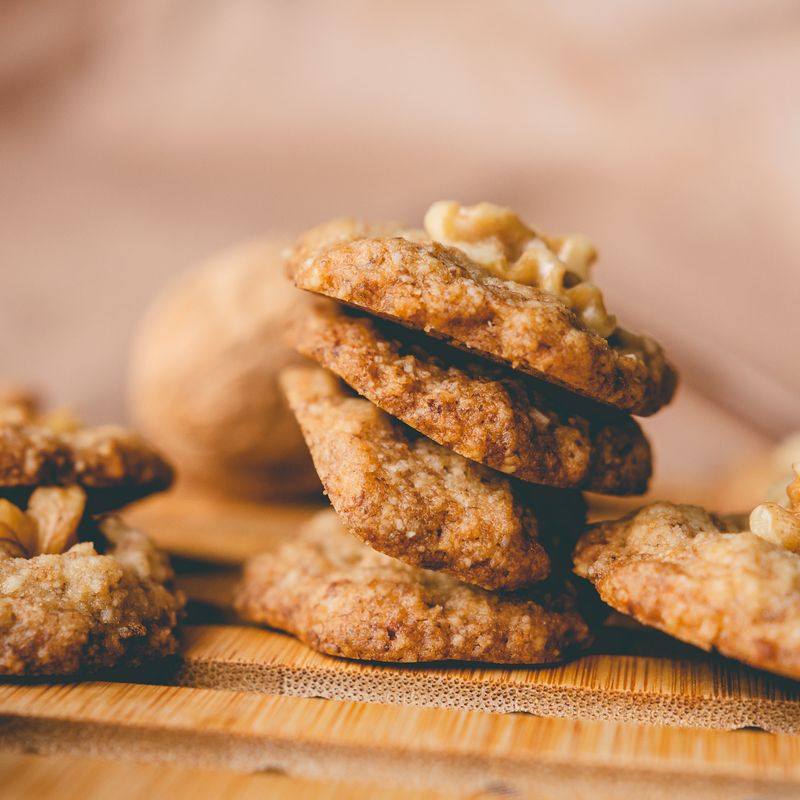
Melomakarona are traditional Greek holiday cookies that strike a perfect balance between crispy and tender. Made with olive oil and orange zest, they're baked until golden, then immediately dipped in warm honey syrup and topped with crushed walnuts and cinnamon. These cookies are best enjoyed after a day of sitting—the honey soaks into the cookies, creating a moist, chewy interior while the exterior stays crisp.
Steps
Before you start
- Preheat oven to 350°F (175°C) for 15 minutes
- Have all ingredients at room temperature
- Line two large baking sheets with parchment paper
- Finely chop walnuts for topping (reserve 2 tablespoons for honey syrup)
Cream olive oil and sugar
- In a large bowl, whisk together the olive oil and granulated sugar until pale and emulsified, about 2–3 minutes.
- The mixture should be light and fluffy, resembling wet sand.
+ Show details− Hide details
Ready when: Mixture is pale and emulsified, resembling wet sand
Tip: Use a wire whisk by hand or an electric mixer on medium speed. The olive oil and sugar should fully combine; don't skip this step, as it's the foundation for tender cookies.
Mix in zest and juice
- Add the orange zest and fresh orange juice to the creamed mixture, stirring until fully combined.
- The batter will smell bright and citrusy.
+ Show details− Hide details
Ready when: Orange zest and juice are evenly distributed throughout
Tip: Fresh orange juice makes a real difference; bottled juice lacks the bright aromatics that define melomakarona.
Combine dry ingredients
- In a small bowl, whisk together the flour, baking powder, cinnamon, ground cloves, and salt.
- Set aside.
+ Show details− Hide details
Ready when: Dry ingredients are evenly mixed with no lumps
Tip: Whisking the dry ingredients together ensures the spices are evenly distributed in the dough, giving every cookie the same warm flavor.
Fold in flour mixture
- Add the dry ingredients to the wet mixture in two additions, folding gently with a spatula until just combined.
- Do not overmix; the dough should come together but may still look slightly shaggy.
- Knead gently by hand 3–4 times to bring it fully together without working it too much.
+ Show details− Hide details
Ready when: Dough comes together and is soft, without visible streaks of flour
Tip: Overmixing develops gluten, which will make the cookies tough. Fold just until the flour disappears, then stop.
Shape cookies
- Break off pieces of dough about the size of a walnut (roughly 0.5 oz or 15 g each).
- On an unfloured work surface, roll each piece between your hands into an oval shape about 2.5 inches (6 cm) long and 1.5 inches (4 cm) wide.
- Gently flatten each oval to about ¼ inch (0.6 cm) thick.
- Place on prepared baking sheets, spacing them about 1 inch (2.5 cm) apart.
- You should have about 24 cookies.
+ Show details− Hide details
Ready when: All dough is shaped into ovals on baking sheets
Tip: Slightly wet hands will prevent the dough from sticking and make shaping easier. Keep your hands lightly damp throughout.
Bake cookiesOven 350°F / 175°C
- Bake at 350°F (175°C) for 22–25 minutes, until the edges are golden brown but the centers remain pale.
- The cookies will still feel slightly soft when pressed—this is correct; they firm up as they cool.
+ Show details− Hide details
Ready when: Edges are golden brown, centers are light and slightly soft to the touch
Tip: Don't overbake; the cookies should still feel a bit tender when you remove them from the oven. They'll continue to set as they cool. If baked too long, they'll be hard and dry.
Cool briefly
- Remove the baking sheets from the oven and let the cookies rest on the hot baking sheet for 5 minutes.
- This allows them to firm up just enough to handle, but they should still be warm.
- Transfer to a wire cooling rack.
+ Show details− Hide details
Ready when: Cookies are firm enough to move without breaking
Tip: Don't skip this resting step; moving the cookies too early will cause them to crumble.
Prepare honey syrup
- While the cookies cool, combine the honey and water in a small saucepan over medium heat.
- Add the cinnamon stick and whole cloves.
- Bring to a simmer and let cook for 5 minutes.
- The syrup should feel warm to the touch and smell fragrant.
- Remove from heat and let cool slightly (it should still be warm but not hot when you use it).
- Stir in 2 tablespoons of the finely chopped walnuts.
+ Show details− Hide details
Ready when: Syrup is warm, fragrant, and pourable
Tip: Don't let the syrup boil hard; a gentle simmer is enough to infuse the spices. If it becomes too thick, it won't coat the cookies evenly.
Dip cookies in syrup
- Once the cookies have cooled to warm (they can still be slightly warm to the touch), one at a time, use tongs or a slotted spoon to dip each cookie into the warm honey syrup for 1–2 seconds on each side.
- The cookie should be completely coated but not soggy.
- Place on a plate or shallow bowl as you work.
- Work quickly so the syrup doesn't cool too much.
+ Show details− Hide details
Ready when: Each cookie is evenly coated in honey syrup
Tip: If the syrup cools and thickens while you're dipping, reheat it gently over low heat for 30 seconds. Don't let cookies sit in the syrup; a quick dip is all you need.
Top with walnuts and cinnamon
- As soon as you dip each cookie, immediately sprinkle the top with the remaining chopped walnuts (about ½ teaspoon per cookie) and a tiny pinch of ground cinnamon.
- The walnuts will stick to the warm honey.
- Arrange the finished cookies on a serving plate or in an airtight container.
+ Show details− Hide details
Ready when: All cookies are topped with walnuts and cinnamon
Tip: Work quickly after dipping so the honey is still sticky enough for the walnuts to adhere. If they don't stick, the honey has cooled too much.
Rest and serve
- Let the cookies rest uncovered at room temperature for at least 24 hours.
- This is crucial—the honey will gradually soak into the cookies, creating a moist, chewy interior while the exterior stays crisp.
- After 24 hours, the cookies reach their perfect texture and flavor.
+ Show details− Hide details
Ready when: Cookies have absorbed honey and developed rich flavor
Tip: Patience is essential here. Eating melomakarona straight after assembly is a mistake—they'll be too crispy. A day or two of resting transforms them into the tender, honey-soaked treats they're meant to be.
Good to know
Tips
- The key to perfect melomakarona is timing: bake them until just barely set so they're still tender, then let them rest for a full day so the honey penetrates and the spices mature. Don't skip either step.
- Use fresh spices—old, stale cinnamon and cloves will result in dull, flat flavor. Melomakarona should taste warm and aromatic.
- Don't let the dough warm up too much during shaping; if it becomes soft or sticky, refrigerate it for 15 minutes and work in smaller batches.
- These cookies are best enjoyed after 1–2 days of resting, when the honey has fully soaked in. They're also excellent reheated very gently in a 200°F (93°C) oven for 5 minutes to refresh their texture.
Make ahead
The dough can be made up to 12 hours ahead and stored in an airtight container at room temperature. Reshape and bake as directed. The finished cookies are best made 1–2 days before serving; the honey and spices meld and deepen in flavor as they sit.
Storage & reheating
Store in an airtight container at room temperature for up to 2 weeks. The cookies will stay crisp on the outside and moist on the inside. Do not refrigerate, as cold temperatures can make them hard. They freeze beautifully for up to 3 months in a freezer-safe airtight container. Thaw at room temperature for 1 hour before serving; no reheating needed.
Substitutions
- extra virgin olive oil → Neutral oil (vegetable, canola, or light olive oil). Extra virgin olive oil gives the most authentic flavor, but a lighter oil will still produce good cookies. The flavor will be more muted without the fruity notes of extra virgin oil.
- walnuts, finely chopped → Finely chopped almonds or pistachios. Almonds are traditional in some Greek regions; pistachios add a slightly different but equally delicious flavor and color.
- orange zest → Lemon zest (1 tablespoon) combined with ½ teaspoon brandy. This creates a slightly different but equally traditional flavor profile. Orange is more common, but lemon with brandy is equally authentic.
- honey → Use a thinner honey (like acacia) or add 2 more tablespoons of water. Very thick honey may be harder to work with for dipping. A pourable honey ensures even coating.